I’ve been having someone else create my slide decks for a while now. Because I hate creating slide decks. Because I’m not good at it. Because I don’t want to get good at it – better to practise delegation instead. Because it forces me to think about message I want my slides to give, rather than look at some picture licensed for reuse and think “will this do?”
Who?
You need to find someone who fits with your aesthetic (and desired aesthetic). I don’t feel like I have a strong aesthetic when it comes to slides (or perhaps in general), but I definitely have clear ideas about what I like and what I don’t – and I don’t want to hate the deck I’m presenting with. You need someone whose work you like and identify with. For the raccoon aesthetic (shown above), Virginia and I talked about like Fit Cat, but a raccoon.
How?
As part of your talk prep, you figure out 1) how many slides you want and 2) what you want them to say. You probably also have an overall theme in mind – a metaphor that runs through your talk and ties things together. This is the start of your direction to the person making your deck.
Working in Google Slides can be convenient here – I made a deck and put ideas in the notes for what I wanted that slide to say. Then Virginia turned those notes into adorable raccoons.
When?
The earlier the better! I wrote about my process for breaking down a talk, and I try and get the deck started soon after I’ve figured out the structure. We can always add things in later!
Why?
Better slides – for most of us, anyway.
Practise delegation – it’s a skill!
Forces you to focus on structure.
More clarity about what you’re trying to illustrate with your slides anyway – first you explain it to someone who reflects it back to you.
My coolest title right now is “Instigator of Awesome” at Awesome Ottawa. So what’s Awesome Ottawa? It’s a group of 10 trustees and a Dean of Awesome, and every month we give away $1000 to enable something awesome. So far, we’ve funded an art-flash-mob, a living-evolving installation, a 350-org climate change event.
When Levannia asked me to give this talk, I thought “how am I going to talk for an hour about starting Awesome Ottawa! It’s not a very interesting story”.
The reality is, that I decided to do it, pitched it to some people, blogged about it, about within two months we were giving out our first award.
See! Boring!
So instead what I’m going to do is talk to you about some things that I learned along the way, that have enabled me to do things like this. I don’t have it all figured out, and it’s not all easy – if you want to do something awesome, you’ll have to learn to fail, and be okay with that. Not everyone will like what you’re doing. Not everyone will like you, period. There’s times, and I’ve definitely had them, where I question why I keep going, why I keep doing what I do – but I persist. I’m going to try and explain why.
1. Give yourself permission.
Credit: flickr / Duru…
There’s a great book by Tina Seelig, it’s called What I Wish I Knew When I Was 20 (Amazon). The main point that she makes in the book is that you have to give yourself permission – so succeed, to fail, to do anything of note. I’ve started three things now – Awesome Ottawa, CompSci Woman (a blog written by and for women in computer science), and WISE at uOttawa (that was really more of a resuscitation). Other people were really instrumental in every one of those things – I’ll get to that later – but first let me tell you why I started doing these things.
I worked in a crappy job. The person above me got fired, and my manager promoted this other guy, not me. I was pretty disappointed by this, and then this guy was not capable of this job. He was also kinda a drunk, and guess who picked up the pieces? Me. So I spent the summer proving to myself, and I hoped my manager, that I would be better for this position.
The following year, I had the weirdest “interview” with my manager. She was completely inappropriate, and I was so stunned by this, and so confident that my performance spoke for me being a better fit for this job that I never mentioned the guy’s drinking problem. You can guess what happened. I didn’t get it. Apparently the guy actually did a semi-decent job. I ended up in Shanghai (anther story).
And I decided that I didn’t need to wait around for someone to say, “OK Cate you can do this now”. I realized, that my manager at that company was never going to say that to me – she managed us remotely, and the people who I had actually worked with knew I would rock at it, which is what was important. So I knew that I was capable of it. In short – I gave myself permission to do something. And I did.
2. Say Yes. Then Learn to Say No.
Credit: picassa / eschipul
A friend told me the other day about a survey that had found that the reason why most Canadians don’t volunteer is because no-one asked them to. But opportunities to do things are everywhere – sometimes explicit, sometimes implicit. Take advantage of them.
For me, the more I say yes to things, the more opportunities present themselves. The more I say yes, the more I get a reputation as someone who does things – so when I want to start something, I have people who have noticed me, and people who owe me favours. That’s a good position to be in!
Saying yes has taken me to a bunch of different places, taught me new skills (like presenting in French!) and meant that I have met so many cool people. But at some point, I reach capacity and have to start saying no. I’m moving tomorrow, so things are even more hectic that usual so this week, giving a talk to you guys means that I couldn’t go to a meeting to talk about what WISE achieved whilst I was president. There are tradeoffs, because I’m not superhuman and I can’t do everything.
In a job, you discuss your responsibilities with your manager and that determines your priorities. But as the President and CEO of Cate inc., for what I do outside of work or school, I have to make those calls. Evaluating tradeoffs and saying no is hard when you’re an opportunity junkie. Do I always make the right call? Almost certainly not. But I have to make one.
3. Ideas are cheap, Execution is expensive.
Credit: flickr / dullhunk
Who has an idea for a product, or web service, or piece of software?
As a programmer, I can tell you that there are lots of non-programmers out there who have some “genius idea” that they think a programmer should build, for “equity” – a stake in the eventual, hugely profitable company.
The reality is that the company is rarely profitable, if it even gets off the ground. And programmers have their own ideas, which if they want they could implement. This is why people – especially programmers – get angry about patents, because you can literally patent an idea and the person patenting it doesn’t actually need to know how to implement it. To a programmer, implementation is everything. Ideas are 10 a penny. What does this have to do with starting an organization (or anything)? It means that it doesn’t matter how amazing your idea is, it’s nothing until you actually implement it.
And if someone else gets there before you, the idea was good enough that someone actually did it – so be pleased! And either get on board with them, or come up with something else and move faster. It also means, that it can be hard to sell your idea until you start doing.
We were the first Awesome Foundation outside the US, but we weren’t the first period. The fact that we have a network of people to ask questions to and this model has been proven made it much easier to get going.
4. Fail
Credit: xkcd
Think about how big your comfort zone is. What are you OK with doing? Introducing yourself to a stranger? Going to a foreign country by yourself? Standing up and talking in front of a bunch of people?
Chances are, there is a whole world outside your comfort zone. I really recommend going to explore that, but it can be scary. Stuff outside your comfort zone is stuff you don’t know – and as you go off discovering it there’s a good chance that things won’t go to plan. You’ll fail.
You know in Harry Potter, how the bogart turns into Prof. McGonnagall for Hermione and tells her she failed everything – that’s her biggest fear. It’s no wonder Harry always saves the day, he’s OK with failing, and that makes him more able to take risks. Hermione might seem more successful, there’s no doubt that she is academically, but that’s within her comfort zone. For her to be successful in other ways, she had to learn how to fail.
When we first started WISE, we tried an event and people were really enthused about it… but then no-one turned up. I was mortified, and really questioned what I was doing. We haven’t run that kind of event again, but we run different things that were successful. We’ve learned what our members want, and that’s what we put on for them. It was a setback, but it didn’t stop us from achieving a lot of other things.
In the summer, the Awesome Foundation didn’t get many submissions. Seriously, we’re giving away free money and people weren’t even filling out the application form! That was rough, because you get to this catch-22 – you don’t fund anything, and no-one hears about you. But now, our numbers are up.
There’s this great lecture by Randy Pausch. It’s an hour – go watch it. In it, he talks about how when you hit a wall, have a set back. He says that walls are there to keep out the people who don’t really want it. So when you fail, and I hope you do because I think that a life without failure is a life where you didn’t push yourself – you look at your failure, you evaluate what you can learn from it. And then you keep going.
5. Find Something You Believe In
Credit: flickr / insertnamehere.99999
Making something happen can be hard. That’s why not everyone does it. It takes longer than you imagine it will. Or it’s harder to get people on board with what you’re doing than you expected. You fail in some way.
In these moments of doubt, you need a story to tell yourself that reminds you why you’re doing it. When I moved to Canada, I knew no-one. And I’m in CompSci, so you can imagine how many women I met – not many. I’m sociable, so I met people, but I mostly met guys. Which is fine, but I would get homesick for my Edinburgh apartment and my roommates there, and girly movies and pizza. And so I really felt this lack of community, in terms of women in CompSci – because when there are only a few, it’s hard to meet them. So in times of doubt about what we were doing, and whether we could manage it, and when we didn’t have any funding, I told myself this story. That we needed this community here, and I knew that first-hand.
Now I run CompSci woman, and it’s a similar thing. We ask people to post for us, and it’s going pretty well but sometimes we don’t make the three posts a week that I would like us too. It’s discouraging, but the story I tell myself is that CompSci is changing the world, and we really need a more representative sample of humanity building our digital future. I tell myself that young women need role models, and that’s what we’re trying to do.
You don’t need to succeed right away. But you need a story for those moments of doubt.
6. Trying to get everyone to like you is a sign of mediocrity.
Credit: flickr / Jef Harris
Colin Powell said, “trying to get everyone to like you is a sign of mediocrity”. Be likable – it’s important – but the reality is, if you want to stand out and do something extraordinary, there are people who will try and tear you down for it. People might not understand that ideas are cheap, and think that you “stole” theirs, because you got their first. If you do things, people might need to attack your success in order to excuse their own inaction – like “oh Cate, she just got lucky”.
I’m not going to lie – it sucks. Who’s had something bad said about them that they knew wasn’t true? Who was hurt by it?
I had this recently. I really thought that I left high-school a long time ago, but apparently I was wrong! I had someone I used to be friends with telling people (people I know!), basically that I was doing I terrible job with Awesome Ottawa. Of course it gets back to me, and of course I was upset by it. The way it all played out was interesting, because I tried to ignore it and just keep running around doing my thing, and in the face of my non-response, this woman managed to make a different story in which I played the villan.
It was difficult, but I did have the support of the board and it’s all worked out for the best now. But at the time? Horrible. And honestly, I could not comprehend why someone would behave like this, when they could have pinged me for a cup of coffee and got everything they wanted. I was talking to one of my mentors, and we talked about whether I could have done more. Of course I could – you can almost always do more to resolve situations, you can always try to reason with someone, no matter how determined they are to dislike you. But in the worst 2 week period of this, I went to New York to pitch to top IBM executives with my team. I interviewed at Google, and filed two patents (within IBM). I got on a plane, and went back to Europe. So the question is not, “could I have done more?” – it’s with these other priorities going on, should I have. I think I made the right call that time.
Haters will hate. I always take the time to consider if they have a reason for it, is there anything I can and should do to resolve it. But – if someone is determined to dislike you, they will find a reason to. Anything you do can, will, be used against you. So at some point, you have to say – No. I’m doing what I’m doing, and I refuse to let you distract me.
I mentioned mentors earlier. Mentors are so important. Connect with people who have a little more experience than you in what you’re interested in, and benefit from their wisdom (and mistakes!). They’ll help you pick yourself up when you get knocked down.
There’s this idea of homophily – there was a study that found that if you hang out with people who are heavier, you’ll gain weight. I think, if you want to do something, you need a circle of people in your life who do things.
I’ve found Twitter to be a great way to connect with people like that – my friend Kelly, our new Dean of Awesome, and I connected on Twitter, but we became friends and work out together and hang out. She’s awesome. And she’s a great person to know, because she’s interesting and she does stuff, and she knows people. So when I’m having a crisis, she knows the story I tell myself and she has others to share with me. Recently, I got this nasty, anonymous comment on my blog. I was shocked by it and wrote a thoughtful response and doubted myself and what I’d written. Kelly called it right away. A couple of hours later, she was proven right. I really find that the more great, interesting, awesome people who do stuff are in my life, the more awesome I can do.
When you’re running something, you need other people to help you. With WISE, I had three really key people and we all have different strengths. Samera was amazing with bureaucracy. She can navigate piles of forms that would make me cry. Rachelle would take care of our communications. I basically live in fear of my inbox. Levannia is great at details, whereas every time I go anywhere and book my hotel and flight separately I’m double, triple checking dates anxious that I’ve messed it up in some way. They are all talented in areas that I am not. I might be more able to stand up in front of a room of people, or at networking, but that’s not enough and I couldn’t have done it without them.
I’m a programmer, and I love to code. This also means I’m practised in looking at a problem and decomposing it into manageable bits. But – this makes me bad at other things. I’m logical, and I don’t deal well will irrational behaviour. Aside from anything else, I find it inefficient. Philosophical arguments are another thing I’m terrible at. I got into a debate at one point with some guy, and he was talking about what the Ancient Greeks thought about something. And I was like, “they thought zero wasn’t a number!” So this guy goes off on one about how zero represents the absence of something and so in some sense doesn’t really exist. But as a programmer, the absence of something is a really important concept best expressed using a numeric datatype.
The point I’m getting at here – think about what you’re good at, and what as a result you’re not good at. The better you know yourself, the better you can pick a project that is a great fit for you – for example, one of the things that appeals to me about the Awesome Foundation is the lack of bureaucracy – and the better you can find a team whose strengths complement yours.
8. Give Up Control – Ask in order to Leverage
Credit: flickr / oedipusphinx — — — — theJWDban
When you start something, you have this vision of what you want it to become. That’s great – and important – you need to have an idea of what you’re working towards. But at some point, you face a choice. You can build a tiny, solid steel, structure, completely controlled by you. Or you can give up some control and plant the seeds for an organization that will grow bigger than you could do alone, do different things you could never have imagined. There’s a risk that it will die. But – that’s another tradeoff you can make, because giving up control allows you to move on to other projects that excite you.
I stepped down from WISE and Levannia took over. I know that things are going to change as a result but I’m OK with that – I trust her to do a good job, I mentor her and encourage her. But ultimately, she’ll have her own vision – and that’s a good thing. I don’t want to stay in grad school forever, running the same thing!
With the Awesome Foundation, we have a very flat structure. As Instigator of Awesome I go around getting excited about things, and do a little more organization stuff but every trustee puts in $100 and every trustee gets a vote. I can say “I think we should do this”, but if I’m outvoted, I’m outvoted. My role here is not really a leader, more of a facilitator. There’s an important distinction.
If you want other people to help you, you’ll probably have to ask them! Asking for things is hard. Asking someone to join the board of the Awesome Foundation was terrifying for me at first – “hey! How about you give $100 every month to some crazy idea that may or may not work?” – I’ve got better at it with practise (and I don’t say that!). But you need to learn to ask for things, for starters you’ll need to ask for help.
Early this year I read this great book, Women Don’t Ask (Amazon). I highly recommend it. And I started asking for things, for instance the other day I asked for a t-shirt.
I know, random. But at Grace Hopper the Yahoo! people had these awesome t-shirts that said “I code like a girl and I’m PROUD of it”, and I wanted one really badly! It happens that I know a guy who works for Yahoo!, in fact before he moved I would take care of his cat. So I asked him if he could get me one of these t-shirts and he did.
When uOttawa asked me to create a programming curriculum for a workshop we run for high-school students, I thought it sounded like a cool idea. But – I’d already created a proprietary curriculum and wasn’t really interested to do another proprietary one. So I asked if we could open source it. They agreed to my terms, and now anyone can use the materials I’ve created.
I’m still afraid to ask. But I’m getting better at it. So try it.
And, pro-tip, start being more attuned to people’s implicit asks. When someone you think is awesome talks about this new project they are starting, introduce the topic of how you can help them before they have to. And then follow through.
Because – the real secret I’ve found in asking, is that it’s easier to ask when people want to help you because they’ve seen you paying it forward already. Or – even better – they are also attuned to implicit asks, and you don’t need to.
9. Share and Engage
Credit: flickr / sofakingevil
Share what you are doing. It doesn’t matter if you’re still working things out – share. If you fail – share what you learned. When you succeed – share who and what helped you.
Document your path so others can follow. I use a related posts plug-in on my blog, so sometimes I write something and something I forgot I’d written pops up – past me giving advice to future me. Maybe I’m feeling discouraged, and I find a post I wrote another time I was discouraged and think about how I got through that. Maybe I read something that reminds me just how far I’ve come.
Even if you blog and no-one is reading, it can be useful. But most likely they will, and they you’ll have this new way of connecting with people and following their projects, successes, and failures, too.
Twitter is another good tool for connecting with people on the internet. 140 characters or less is way less intimidating than an email. Say hi! Chances are whoever you’re interested in will be happy to hear from you.
Check out my mentor Sacha’s blog – Living an Awesome Life – she has a lot of good posts on sharing and why it’s important.
10. Don’t Believe the Hype
Credit: flickr / Hot Meteor
There are so many people who come home from work at 5 and spend the evening watching TV, that if you do anything, people will start telling you how awesome you are.
Appreciate that, but take it as a thank-you. Every moment you spend believing it is a moment that someone else is overtaking you.
Someone tweeted something recently, and it was completely ridiculous. I won’t repeat the whole thing here for anonymity, but suffice to say the words “I’m so awesome” were used. I have no clue what this person does, but now I have zero interest in finding out. A couple of other people I know saw it and we laughed about it – her credibility was damaged by this gratuitously self-aggrandizing tweet.
The most impressive people don’t seem to need to talk about how gosh-darn impressive they are. They’re too busy getting on with things. Kelly and I were talking about this recently. At work, you need to document your achievements and put them forward to your manager for promotion. In the outside world, especially on the internet, if you’re awesome, people notice. Maybe not as fast as you’d like, but they do.
At my leaving party, this guy showed up and said that he’d wanted to meet me before I left. That was really cool, it totally made my day. That kind of moment is worth more than a million people agreeing when I say how awesome I am. I’m taking it as a thank-you, and encouragement to keep going. But I don’t believe that I did anything special, which is perhaps key to doing things at all. If you only believe that someone extraordinary can start something, you’ve set the bar way higher than it needs to be. Anyone can do it. Honestly. I did. You can too.
Someone said something really obnoxious to a friend of mine recently, and a group of us were talking about it and another girl nodded sagely and said, “low self-esteem”. I think she’s right. I could have stood up here and made the boring story last long enough, but I’m okay enough with how I’m doing to share the myriad ways in which I’ve failed. Because it’s more interesting, and because, I hope, more useful.
Apparently, Edison said about the invention of the lightbulb, “I have not failed 10,000 times. I have successfully found 10,000 ways that will not work”.
Every time we think we “fail” we can learn something important. These are just my 10, but don’t take my word for it – go and learn your own.
This week my supervisor, two of my office mates (Amir and Payam) and I have been working hard putting together a presentation we’ve recorded for a conference in Algeria on Sunday.
I laid out the slides in Keynote, using my color scheme (luckily the others were OK with the pink). We’ve been impressed with how easy it has been to record in Keynote, although I think due to the number of takes there are some glitches where the audio doesn’t quite match with the slides.
It’s taken longer than expected – I think we all got quite perfectionist, and when checking it the playback always started from the beginning – meaning with each additional person it took longer to check everything was working OK! Also – I hate listening to myself present. I say “So…” at the start of every slide!
The slides are available on slideshare (I’ve embedded it below). You may notice that my section is very similar to the presentation I prepared the other week, although I’ve had to add some text to the slides. You can also download the QuickTime movie here (it’s Benyoucef.mov and note – the first section is in French) my section starts at around 32:30.
I’ve created my slides for my presentation (abstract) following a Presentation Zen (Amazon) approach. So there are basically no words on any of my slides. I’m going to lay them out one by one, with narration. Let me know what you think!
Title Slide
I’ve gone for a blank template. I wonder if this is too plain and could use some background color? Let me know what you think. The color of the lettering matches the color scheme for my soon-to-be-launched website.
This is where I introduce myself and what I’m talking about. I don’t really like this bit of presenting, so I’ll keep it brief.
The World Wide Web
Image from iStockPhoto
I’m going to start off by talking about the “World Wide Web” and trying to provoke a bit of thought about it. It’s relatively recent, and yet it’s game changing. How many of us could live without it? I certainly couldn’t. Whilst the internet has been around since the 1960’s, the web as we know it (with hyper-linked web pages) has only been around since 1989. But within 20 years we’ve got to the point where the web is basically infrastructure…
… like electricity. For more on how I think the internet is just infrastructure like electricity, running water, or roads, see this post.
Clay Shirky – Why I Ignore 5 Year Plans
Clay Shirky – giving us some needed perspective. I think when we reflect on what’s changed, and how recent it is, we realize that this is really just the start of it. I remember life-before-Facebook but I can’t imagine living without it, even though I’m not always sure that the level connectivity it gives us is a good thing (for more on my mixed feelings about Facebook, read this post).
Near-Universal Authorship
A couple of hundred years ago, all the information your average person had came from the Bible, if they could even read. Now, not only are rates of literacy very high but the internet gives everyone the ability to be a publisher of content too. There’s a fascinating article on this here.
How Web 2.0 is Changing the Way we Comminicate
I put this graphic up in this post. What I want to show here is that there’s a shift to newer technologies and that it’s a process. This diagram captures what I’m thinking and finding now, but no doubt in a year it will be different. Also important, is how many arrows are going into Twitter – it’s simplicity and flexibility mean that it’s a great way to do a whole variety of things. There’s definitely stuff that’s missing from the diagram – the thing is to balance what’s important with trying to include everything and making it impossible to follow.
Serendipitous Connections
Image from iStockPhoto
Something that isn’t represented in the previous diagram though, is the possibility of serendipitous connections. By lowering the bar to communication, and through ambient awareness we can have more “weak-tie” relationships. Think about how many people you’ve lost touch with but found (or had find you) on Facebook, or the number of people you “follow” on Twitter but have never met.
I don’t think Twitter is a Pointless Waste of Time, but a lot of people do. If you do think Twitter’s pointless, why do you? Have you tried it? Over the next couple of slides I’m going to talk a bit about the impact that Twitter has had on events and the reasons why I think it’s useful.
In the aftermath of the Iranian election, the US government intervened to change Twitter’s maintenance schedule so that it wouldn’t be down during the day in Iran. Twitter allowed Iranians to communicate with the outside world and express their distress at the rigged election. The governent’s reaction to this did not help their case.
I was working in Shanghai during the summer, and when the riots started they shut down Facebook and Twitter (at the time, I wrote this post). When I was there in 2007, you couldn’t access Wikipedia – but this time I could. This makes me think that the government is no longer afraid of information – it’s afraid of the conversation.
What's the Connection Between the British Parliament and an Irish Pop Star?
As a Brit, I tend to follow the news over there and the other week two things happened. The first one that a law firm got an injunction to prevent a newspaper reporting from a question to be asked in parliament regarding some toxic waste and a firm called Trafigura. The newspaper (the Guardian – read their story here) could only report that they couldn’t report anything about the MP asking the question or the question itself. However some smart people soon worked out what the question was and soon #trafigura was trending – causing the very awareness that they had sought to prevent.
The seond thing that happened was that this pop star died, of a heart condition. However he was gay, and with his husband at the time so it was enough to get some vile columnist in the Daily Mail to write a homophobic diatribe about him. Her name was soon trending as people expressed outrage (interestingly the Wikipedia article on Jan Moir consists of little more than the story of this).
I think what these two events show, is that Twitter provides a forum for people to express their frustration with all kinds of things – whether it’s concern over restrictions of reporting on parliament or just celebrity gossip. It also captures what people are getting angry, or excited about. Trending topics can answer what’s hot right now – Apple trends whenever it has an announcement, Windows 7 and even Ubuntu 9 were trending on their release.
Trend Graph for #trafigura and "Jan Moir"
Trendistic is a service that allows us to graph how often words are occurring in Tweets. We can see that #trafigura rapidly became popular and disappeared again quickly once the injunction had been lifted. “Jan Moir” has a wider curve, and there was another flurry of mentions when she released an apology a week later.
Information Gathering
Image from iStockPhoto
Information gathering is the best use I get out of Twitter, and I feel it’s something that it would be hard to replicate anywhere else with as little effort. Follow leaders in your field, or just people who work in a similar area to you who tweet interesting stuff they found, or people who inspire you. I get so much information this way, and it doesn’t take very long to go through it. I’m literally crowd-sourcing my news! And if someone I’m following tweets too much or I lose interest I can un-follow them. Lists are going to make this even easier.
Ambient Awareness / Ambient Intimacy
Image from iStockPhoto
Ambient Awareness is like the Facebook newsfeed. It’s passively letting information about your friends lives come to you. But on Twitter, people often update more often – so if it’s someone you’re really fond of it can be better than Facebook for staying in touch with their lives. Two of my good friends live in London and I love the little bits of their lives that I see on Twitter and we definitely use ambient awareness to stay in touch. I was having a lousy day last week and I tweeted about it and one of my friends sent me a message just saying “*hug*”. When another friends released his work project (Google Sync) and it hit the trending topics, it was really nice to share his excitement about it in real time.
Twitter is amazing for overhearing what your customers are saying about your business. There was actually a paper published earlier this year analyzing brand sentiment on Twitter. Businesses (and non-profits, like @kiva) that get it are on Twitter seeing what’s being said about them and taking part in the conversation.
I wrote more about customer relationship management in this post.
Conversations on Twitter
Image from iStockPhoto
I think conversations are a great way of measuring engagement on Twitter, and this is what I’m working on at the moment. If your a brand, how engaged are you with your community? If you’re an individual, how engaged are you with the people you’re following? Are you passively absorbing content or are you sharing, adding value? If you’re a spammer, no-one’s talking to you!
Who's Following You?
Image from iStockPhoto
It’s possible to have a large number of followers by either paying for them, or by following people in the hopes they’ll follow you back (and unfollowing those that don’t) until eventually you have several thousand people “following” you.
But are they listening? Or are they just spammers? If they were listening you’d expect at least some of them to be talking to you.
Is Anyone There?
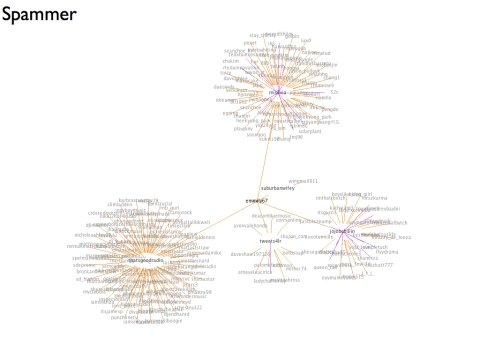
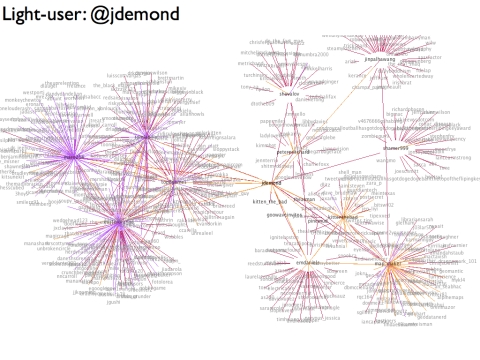
So I decided that follower/following counts were basically meaningless, and wrote a program that will graph your conversation network (more on that in this post).
And it’s fascinating, because someone’s graph really says a lot about the kind of user they are. Are they a power-user? A regular user? A spammer? A light user?
My Conversation NetworkSpammer Conversation NetworkPower User Conversation NetworkModerate User Conversation NetworkLight User Conversation Network
It’s nice how you can see the different networks that he’s a part of here. I hope to use a clique finding approach to draw out this kind of information for bigger and busier networks.
Is This Pretentious?
Cookie Consent
We use cookies to improve your experience on our site. By using our site, you consent to cookies.