My co-supervisor, Michael Weiss, came up with this diagram expressing the interactions we have with people on Twitter.
Direct messaging is the most intimate form of communication, which we cannot track through the API without authentication (and then only for an individual user) as it is private. We have engagement through conversation and retweets, passive listening (also known as lurking) and ignoring. In reality, we probably move between these states over the course of our interactions, depending on how we use Twitter; sometimes communicating by direct message, sometimes retweeting or conversing publicly, sometimes passively consuming, and sometimes occupied elsewhere and not reading the stream. Only spammers, interesting only in pushing their content, will remain always at the outside – ignoring, not consuming other peoples’ content.
So these have been on a bit of a back burner lately, with the end of the semester and associated craziness. However I had a suggestion from Treena that’s been sitting in my inbox for a while. She suggested I try @erinblaskie‘s lists, here’s hoping they show more of what I think this visualization will be useful for bringing out (lists that represent actual mini-communities, rather than just grouping people you follow).
First up: metinreallife. After I graphed this for the first time, I removed an outlier who was following/followed by a ton of people, causing every other point to clump together at the bottom left of the axes. removing it improved things somewhat, as you can see below. It’s noticeable that the more engaged people in the list (in terms of conversations) are not those with the most followers. You can get to the interactive version by clicking on the image (for any of the graphs below).
Next: interesting. There were no conversations in this, though, so I decided not to graph it.
Third: askerinlive. Again, there were few conversations in this, so I didn’t graph it.
I’m really looking for lists that represent communities, and perhaps a better way to go about this is to look for lists with more people following them. Erin’s most followed list is one for Ottawa, but that has 500 people in it. Intuitively, I’m looking for lists with a good ratio of people following them to the people in the list.
Let’s try geekylikeme: Following 155, followers 18. This one is better, but the outliers make it really hard to read. I wonder if it’s better to do it by ratio of followers/following plotted against number of mentions. I’d like to try this on a logarithmic scale, but ManyEyes does not support it. Really, I want more control over the graph which does not appear to be supported.
The last list I’m going to try is entrepreneurship, Following 107, followers 14. Again, the points with more influence within the list (more conversation) are clustered in the bottom left corner.
What have I learned from this?
Outliers are rarely the most influential in a list. Interaction is probably limited by followers/following – when very popular interaction will be low proportionally out of necessity.
I’m not looking for lists of celebrities (or wannabe celebrities), I’m looking for lists that represent communities. Thus the GGDOttawa list is the best I’ve found so far.
ManyEyes does not give me all the functionality I want, for example logarithmic scales, and it’s hard to remove outlying data-points (lots of clicks). Going to try Google Widgets next.
I’ve created my slides for my presentation (abstract) following a Presentation Zen (Amazon) approach. So there are basically no words on any of my slides. I’m going to lay them out one by one, with narration. Let me know what you think!
Title Slide
I’ve gone for a blank template. I wonder if this is too plain and could use some background color? Let me know what you think. The color of the lettering matches the color scheme for my soon-to-be-launched website.
This is where I introduce myself and what I’m talking about. I don’t really like this bit of presenting, so I’ll keep it brief.
The World Wide Web
Image from iStockPhoto
I’m going to start off by talking about the “World Wide Web” and trying to provoke a bit of thought about it. It’s relatively recent, and yet it’s game changing. How many of us could live without it? I certainly couldn’t. Whilst the internet has been around since the 1960’s, the web as we know it (with hyper-linked web pages) has only been around since 1989. But within 20 years we’ve got to the point where the web is basically infrastructure…
… like electricity. For more on how I think the internet is just infrastructure like electricity, running water, or roads, see this post.
Clay Shirky – Why I Ignore 5 Year Plans
Clay Shirky – giving us some needed perspective. I think when we reflect on what’s changed, and how recent it is, we realize that this is really just the start of it. I remember life-before-Facebook but I can’t imagine living without it, even though I’m not always sure that the level connectivity it gives us is a good thing (for more on my mixed feelings about Facebook, read this post).
Near-Universal Authorship
A couple of hundred years ago, all the information your average person had came from the Bible, if they could even read. Now, not only are rates of literacy very high but the internet gives everyone the ability to be a publisher of content too. There’s a fascinating article on this here.
How Web 2.0 is Changing the Way we Comminicate
I put this graphic up in this post. What I want to show here is that there’s a shift to newer technologies and that it’s a process. This diagram captures what I’m thinking and finding now, but no doubt in a year it will be different. Also important, is how many arrows are going into Twitter – it’s simplicity and flexibility mean that it’s a great way to do a whole variety of things. There’s definitely stuff that’s missing from the diagram – the thing is to balance what’s important with trying to include everything and making it impossible to follow.
Serendipitous Connections
Image from iStockPhoto
Something that isn’t represented in the previous diagram though, is the possibility of serendipitous connections. By lowering the bar to communication, and through ambient awareness we can have more “weak-tie” relationships. Think about how many people you’ve lost touch with but found (or had find you) on Facebook, or the number of people you “follow” on Twitter but have never met.
I don’t think Twitter is a Pointless Waste of Time, but a lot of people do. If you do think Twitter’s pointless, why do you? Have you tried it? Over the next couple of slides I’m going to talk a bit about the impact that Twitter has had on events and the reasons why I think it’s useful.
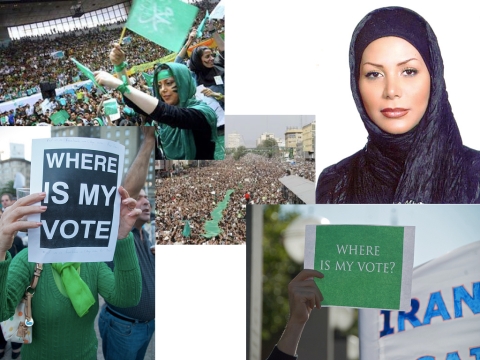
In the aftermath of the Iranian election, the US government intervened to change Twitter’s maintenance schedule so that it wouldn’t be down during the day in Iran. Twitter allowed Iranians to communicate with the outside world and express their distress at the rigged election. The governent’s reaction to this did not help their case.
I was working in Shanghai during the summer, and when the riots started they shut down Facebook and Twitter (at the time, I wrote this post). When I was there in 2007, you couldn’t access Wikipedia – but this time I could. This makes me think that the government is no longer afraid of information – it’s afraid of the conversation.
What's the Connection Between the British Parliament and an Irish Pop Star?
As a Brit, I tend to follow the news over there and the other week two things happened. The first one that a law firm got an injunction to prevent a newspaper reporting from a question to be asked in parliament regarding some toxic waste and a firm called Trafigura. The newspaper (the Guardian – read their story here) could only report that they couldn’t report anything about the MP asking the question or the question itself. However some smart people soon worked out what the question was and soon #trafigura was trending – causing the very awareness that they had sought to prevent.
The seond thing that happened was that this pop star died, of a heart condition. However he was gay, and with his husband at the time so it was enough to get some vile columnist in the Daily Mail to write a homophobic diatribe about him. Her name was soon trending as people expressed outrage (interestingly the Wikipedia article on Jan Moir consists of little more than the story of this).
I think what these two events show, is that Twitter provides a forum for people to express their frustration with all kinds of things – whether it’s concern over restrictions of reporting on parliament or just celebrity gossip. It also captures what people are getting angry, or excited about. Trending topics can answer what’s hot right now – Apple trends whenever it has an announcement, Windows 7 and even Ubuntu 9 were trending on their release.
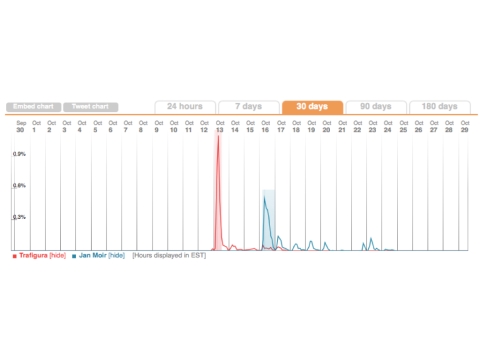
Trend Graph for #trafigura and "Jan Moir"
Trendistic is a service that allows us to graph how often words are occurring in Tweets. We can see that #trafigura rapidly became popular and disappeared again quickly once the injunction had been lifted. “Jan Moir” has a wider curve, and there was another flurry of mentions when she released an apology a week later.
Information Gathering
Image from iStockPhoto
Information gathering is the best use I get out of Twitter, and I feel it’s something that it would be hard to replicate anywhere else with as little effort. Follow leaders in your field, or just people who work in a similar area to you who tweet interesting stuff they found, or people who inspire you. I get so much information this way, and it doesn’t take very long to go through it. I’m literally crowd-sourcing my news! And if someone I’m following tweets too much or I lose interest I can un-follow them. Lists are going to make this even easier.
Ambient Awareness / Ambient Intimacy
Image from iStockPhoto
Ambient Awareness is like the Facebook newsfeed. It’s passively letting information about your friends lives come to you. But on Twitter, people often update more often – so if it’s someone you’re really fond of it can be better than Facebook for staying in touch with their lives. Two of my good friends live in London and I love the little bits of their lives that I see on Twitter and we definitely use ambient awareness to stay in touch. I was having a lousy day last week and I tweeted about it and one of my friends sent me a message just saying “*hug*”. When another friends released his work project (Google Sync) and it hit the trending topics, it was really nice to share his excitement about it in real time.
Twitter is amazing for overhearing what your customers are saying about your business. There was actually a paper published earlier this year analyzing brand sentiment on Twitter. Businesses (and non-profits, like @kiva) that get it are on Twitter seeing what’s being said about them and taking part in the conversation.
I wrote more about customer relationship management in this post.
Conversations on Twitter
Image from iStockPhoto
I think conversations are a great way of measuring engagement on Twitter, and this is what I’m working on at the moment. If your a brand, how engaged are you with your community? If you’re an individual, how engaged are you with the people you’re following? Are you passively absorbing content or are you sharing, adding value? If you’re a spammer, no-one’s talking to you!
Who's Following You?
Image from iStockPhoto
It’s possible to have a large number of followers by either paying for them, or by following people in the hopes they’ll follow you back (and unfollowing those that don’t) until eventually you have several thousand people “following” you.
But are they listening? Or are they just spammers? If they were listening you’d expect at least some of them to be talking to you.
Is Anyone There?
So I decided that follower/following counts were basically meaningless, and wrote a program that will graph your conversation network (more on that in this post).
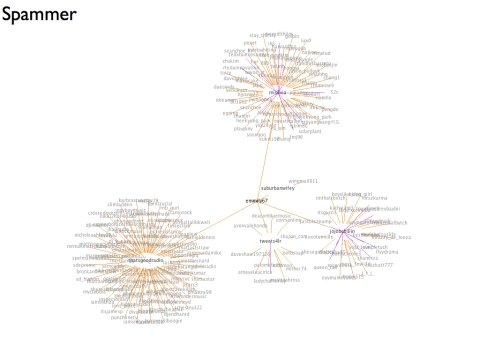
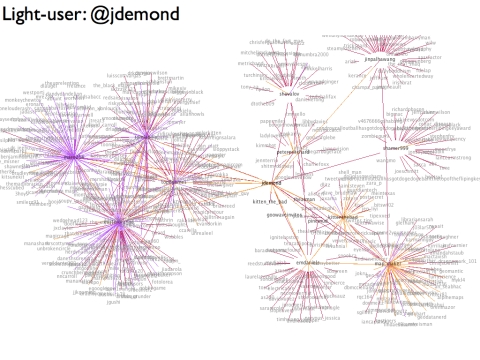
And it’s fascinating, because someone’s graph really says a lot about the kind of user they are. Are they a power-user? A regular user? A spammer? A light user?
My Conversation NetworkSpammer Conversation NetworkPower User Conversation NetworkModerate User Conversation NetworkLight User Conversation Network
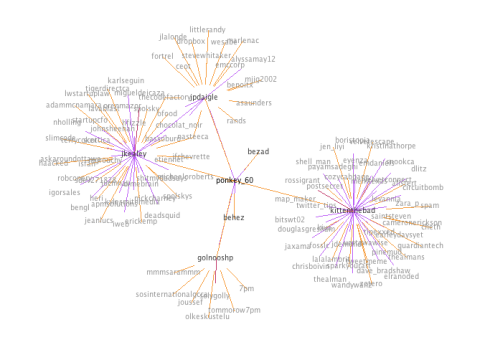
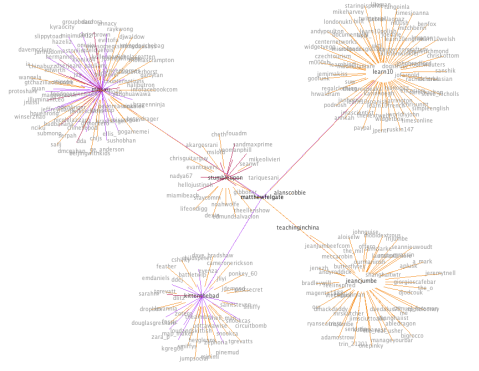
It’s nice how you can see the different networks that he’s a part of here. I hope to use a clique finding approach to draw out this kind of information for bigger and busier networks.
@ponkey_60 – this one is interesting because usually she protects her tweets. She unprotected them for me so I could create the graph. I wonder if people with protected tweets typically have smaller networks?
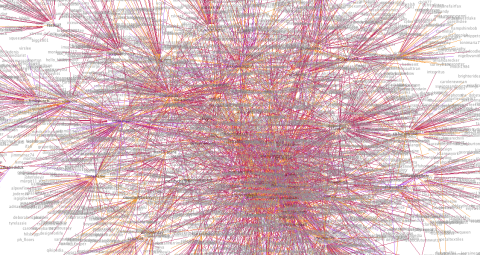
@tgrevatt is having a lot of conversations!! With a lot of people who have a lot of conversations. This graph is fairly densely connected (next step is to be able to pull these networks out). There are a few purple links, which are likely to indicate things like ReTweets.
I’d like to say a big thankyou to @CoureyGetsMoney for following me (3,109 Following 2,831 Followers). His bio reads:
Thanks for checking out my page im a real cool guy making 12,000 a month working from home with GDI
I suspect he’s lying about his income and about being a “real cool guy”. I also suspect he’s using auto-follow and is just trying to drive traffic to his scam. Lets check out his graph…
He’s not part of the conversation. Just a scammer. Spammer. Whatever. What does your graph say about you?
Cookie Consent
We use cookies to improve your experience on our site. By using our site, you consent to cookies.