Tag: Facebook

  • How Web 2.0 is Changing the Way we Communicate

    How Web 2.0 is Changing the Way we Communicate

    How Web 2.0 is Changing the Way we Communicate


    How Web 2.0 is Changing the Way we Communicate

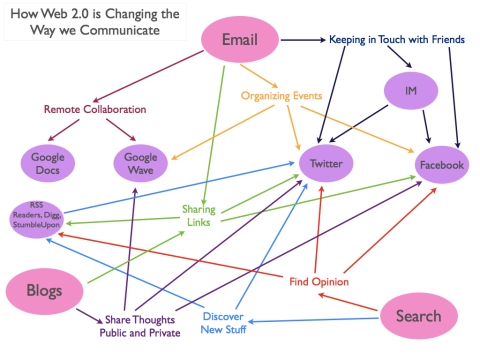
    This is what I’ve been finding in my research – what do you think? Anything missing?

  • Awesome Quote from Clay Shirky

    Awesome Quote from Clay Shirky

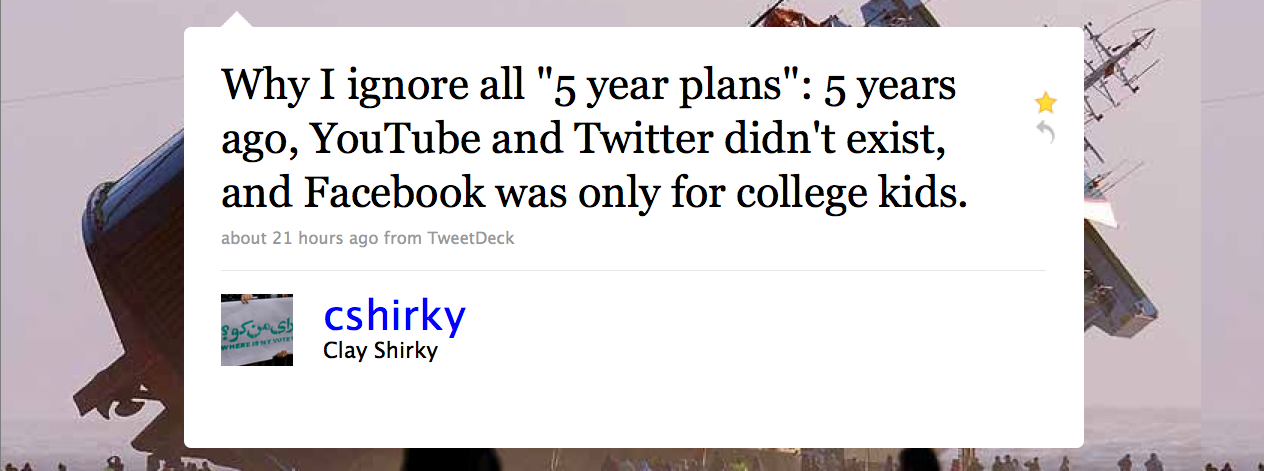
    Clay Shirky - Why I Ignore 5 Year Plans
    Clay Shirky – Why I Ignore 5 Year Plans

    Gives you something to think about, huh? This stuff that’s so natural to us is new and game changing. Who knows what will be different in 5 years time? I can’t wait.

  • Social Networking

    I got an email from my dad the other day, asking me what I used Twitter for. I wasn’t sure why he was asking so I asked for clarification and got this response: “Just discussing Social Networking it would help to know why you use it and what you get from it”.

    “Social Networking” is a broad term, and not one that I’d actually use to describe what I’m doing when I am “Social Networking”. Right now, I wouldn’t say I’m “Social Networking” – I’d say I’m blogging. Or I’m Tweeting, or I’m on Facebook. These are all things I see as distinct activities, even if they make up what can be called, in a broader sense, my “social network presence”. For each of the “Social Networking” services I use on a regular basis, I have different goals and different things I get out of it – below I’ve written a little bit about what these are.

    This Blog

    There’s the odd bit of personal information on here, and those posts that are more personal than others but my goal here is to write about what I’m working on as it progresses, to share what I’m thinking about. It’s linked to my Brazen Careerist and LinkedIn profiles and my Twitter account, as well as being linked on my Facebook.

    Brazen Careerist and LinkedIn

    These are my “professional” profiles. I don’t have many contacts yet on Brazen Careerist (it’s a new site) but LinkedIn I use to add people I’ve worked with and collect and give recommendations. Brazen Careerist is cool in that it makes the RSS feed from this blog part of my profile. There’s an interesting Q&A session with Penelope Trunk (from Brazen Careerist) and one of the things she says is,

    A good way to think about Brazen Careerist is that LinkedIn focuses on experience and Brazen Careerist focuses on ideas. If you are young and short on experience, ideas is a better bet for you.

    Despite have no contacts on Brazen Careerist yet (I should sell it more to my friends), the site drives more traffic to this blog as LinkedIn does.

    Facebook

    Facebook for me is purely personal. I use it to share photos and organize events with my friends. Because of how we use it for WISE I’m a bit more careful about my profile picture etc now but my privacy settings are fairly high and I’m picky about what friend requests I accept, deleting people who I no longer speak to etc. I wrote more about my mixed feelings about Facebook in this post.

    Twitter

    Twitter is my favorite social network at the moment. I really love it. I use it for communicating with my friends and the ambient awareness of knowing what they’re up to. I also use it to crowd-source my news. Following people whose opinion I respect I get a range of interesting information and links that keeps me informed and on top of what’s going on through very little effort on my part. I tend to tweet about what’s going on and interesting stuff that I find on the web.

    Mycrocosm, 43 Places, Wakoopa and Last.fm

    These are all website where I track stuff. Mycrocosm is really cool, it’s like micro-blogging through graphs. At the moment, I’m logging everything I drink. On 43 places I track the places I’ve been and the places I want to go to. Wakoopa and Last.fm both run on my computer – Wakoopa tracks the applications I’m using and Last.fm tracks the music I’m listening to.

  • Relationships 2.0

    I had an argument with a friend yesterday. He’d been a little economical with the truth and I found out and was angry. I found out via Facebook – of course. Facebook knows everything.

    This propelled me to write this post I’ve been thinking about for a while. The thrust of the talk that I will give in December is how much computers and the internet have changed the way humans live. Perhaps the thing that has been changed most is our relationships.

    If the web is now a communication medium, what more powerful way to change our relationships than to change the way we communicate? I know someone who broke up with her boyfriend by changing her relationship status. My boyfriend and I mostly keep our interactions off Facebook, but we do argue on Twitter from time to time – to the amusement of our friends. Of course, I’ve also seen people playing out their breakups on Facebook, using it as a medium to exchange those messages, you know, where he tries to explain that it’s over and she begs and pleads and promises everything to make him come back.

    One of my friends is dating someone who I consider toxic and try and avoid. Now that they’re “Facebook-official” I can’t use the reasoning that it’s not on Facebook and therefore can be ignored anymore. Wow. Taking a step back and looking at this objectively – I’m amazed that this is how we interact now. My friends and I have our share of drama, but I don’t think that as a group of 20-somethings we’re that out of the ordinary.

    Admittedly most of my knowledge of dating in the pre-Web 2.0 era comes from Sex and the City. But did people use to look up the people they go out with using Google and Facebook? Pick people up via mutual friends on Facebook? Analyze their date’s Facebook profile with their friends? Pick people up on dating sites? Check out the exes? Facebook increases jealousy in relationships, well yeah. Of course it does! What other medium can you use to obsessively stalk and obsess over your recent exes’s new girlfriend? Note – this was not my behavior, but the behavior of someone I knew. She was obsessive after her breakup – and Facebook helped every step of the way. She’s not alone, though – there was an article in September’s (UK) Cosmo written by a guy who’d found out that his ex had got married (via Facebook). He was quite upset, but is continuing the stalking – looking for baby pictures.

    When I last broke up with someone I quit Facebook for a month. I also started checking my email only once a week (after reading Tim Ferris’s The 4-Hour Work Week) and I happened to be working in the US (I’m British, most of my friends are too – this was before I moved to Canada). So I literally didn’t talk about how upset I was for a month. By getting rid of Facebook, I could just put dealing with it on hold for a while. I was working about 70 hours a week – it was helpful.

    However it got me thinking. We used to take our dumped friend’s phone when she was inebriated. Change “his” number to ours to stop the obsessive calling. What do we do now? I changed someone’s password, once, to stop the stalking. Others thought it a step too far, but it seemed to help (albeit temporarily). Our friends could be our will power before, but how do we do that now? I wonder if there’s a business model in a 3rd party service that locks you out of things, archives the romantic emails and the pictures until you (and a trusted friend) confirm that you’re no longer a nutcase.

    On a more upbeat note, you can also use Facebook to help create relationships – basing your dating profile on your Facebook profile and having your friends vouch for you. Niche dating sites are doing well, there’s even one that’s more of a matchmaking service (although results seem to be mixed). So it’s not like Web 2.0 is just destroying relationships – it’s creating them too. It’s just a lot of change.

    Some people still meet the normal way. I recently introduced two people last week, they’re getting on well so far! And in India it’s common to meet your partner at work – some companies even have internal dating sites! And, of course, if it doesn’t work out there are plenty of blogs by and for the dumped.

    It’s not just your boyfriend or girlfriend though. What about our friends? Like I mentioned above, I don’t interact with my boyfriend much on Facebook but I definitely interact with my friends. I use it to plan and organize events for my local friends and keep in touch with the ones I’m away from. I’m a big fan of ambient awareness or ambient intimacy, I like to know what’s going on with my friends that I don’t get to see that often any more. Sure, some people are less interesting than others but I can turn them off any time I want. There’s a really interesting NYT Magazine article about ambient intimacy, it’s long but very worth reading. Of course, there are mixed opinions – the alternative view. For younger people, “real” friends are on Facebook, apparently – due to ease of sharing and the level of interaction.

    What about, though, the people you’d like to just fade out of your social circle. In the past if someone pushed it too far, you could just “forget” to invite them to things. If you delete someone’s number, they’re never going to find out unless you run into them (and you can always claim to have got a new phone / had a problem where all your numbers mysteriously disappeared). Whilst Facebook doesn’t broadcast when you “un-friend” someone, if someone catches on they can definitely tell. Unfriending is this more active step to dropping someone from your social circle – but it’s so necessary, because there’s so much information on Facebook that if you don’t they will know what’s going on, maybe assume they’re invited. There’s not much overly personal about me on Facebook anymore, but even so – there’s enough that I’m just not comfortable with someone I don’t like having access to it. De-friending, or Un-friending is this whole new area of privacy and etiquette that there’s no consensus on yet. Will there ever be, though? We’ve probably always managed our relationships differently. Just now with the popularity of services like these, it’s harder to hide how differently.

    Sometimes I feel like Facebook is awful. In some ways, I kinda hate it. I hate how gossip propagates, how quitting it for a while is a big deal. I hate that some people don’t just fade away as you thought they would. I hate the whole area of un-friending, but think it’s necessary. I hate the opaque privacy settings. I’m a little weirded out by how it’s normal to start a conversation by, “So how’s <<X>>? I saw <<Y>> on Facebook…”. But here’s what I hate most – that I can’t live without it, because it’s so great for keeping in touch, because for those people I want on my Facebook there’s this great medium for us to interact and invite our other friends to interact with us. Because weird a conversation starter as it is, it’s a conversation starter. And I love having conversations in the real world, too.

  • Spam

    I spend a lot of time thinking about Spam. It may be an inherent danger of being a Programmer. Even though I take care of my email address not being posted around the internet I get junk mail. Some of it is quite funny, although I hear some people fall for the bank with unclaimed money in Nigeria… so I guess not for them.

    I bet back in the day people said that spam would ruin email, and I don’t mean to negate it as I know spam costs companies a lot in lost time and productivity. But I think Spam on Twitter and Facebook is even more interesting.

    Take Facebook. The primary source of spam for me on Facebook is Facebook Applications, that send me notifications inviting me to add things I have no interest in and frankly don’t want accessing my personal information to my profile. I definitely consider those to be spam, and block any that I receive. On the rare occasion that I do consider adding an application, asking me to notify some / all my friends will immediately cause me to change my mind. But – many of my friends who I’ve actively acknowledged a relationship with clearly don’t consider these aps to be Spam, as they add them to their profile.

    Maybe this is similar to email. After all, whilst the vast majority of people consider invitations to buy Viagra online, or contact from a bank manager in Nigeria to be spam sufficiently many people respond that it’s worth the cost to the spammer of harvesting email addresses and buying the bandwidth to send the spam out. I think the difference is, I don’t personally know anyone who buys Viagra in response to an email or really believes that they’ll get thousands of pounds out of Nigeria. So the response rate for spam on Facebook is higher? Or one person’s spam is another person’s… ham?

    However spam on Facebook doesn’t (thus far) have the power to ruin the whole experience. And since the Facebook applications are now old news, I definitely get fewer notifications. Twitter though – is different.

    Twitter has the issues of Facebook and of email. You can get spammed by people you follow (like you can get spammed by people you’re friends with on Facebook – the Spymaster game springs to mind) and you can get spammed by people you don’t. There’s an intereting article on Twitter spam here. But the real way that spam annoys me on Twitter is because it takes over every trending topic. So, in an unscientific study I checked the trending topics a little after 19:00 BST today, and counted how much was people just including the topic to get their post showing up in searches for it.

    Trending Topic # of Spam Posts % Spam
    Follow Friday 0 0
    #whentwitterwasdown 1 5
    #welovekevinjonas 2 10
    #flywithme 4 20
    GI Joe 2 10
    RIP John Hughes 3 15
    #tls09 8 40
    UberTwitter 6 30
    TGIF 4 20
    #IranElection 0 0
    Average 3 15

    So there’s an average of 15% spam, which is lower than I expected (clearly things have improved since this article) but still – some trends are as high as 40%. I want to say – really, does anyone fall for this… but clearly like all spam enough people do for it to be worth the very low overhead for spammers to do it. One of the coolest things about Twitter is it’s ability to capture the zeitgeist, and trending topics being full of spam damages this.

    Another thing I consider to be spam is pyramid follower schemes. You know the ones, you follow everyone and give them your details and it spams your followers with the link and adds you to the list, so the next idiot follows you. I’ve un-followed two people (doesn’t sound like much, but I only follow about 50-60 people) for using these. I loathe them – and there are so many! I’ve been keeping track of the ones that come up and (these are just those that I’ve made a note of) have a list of 13 since June. They have such inventive names as: “Twitter Train”, “TweeterPro”, “GatherFollowers”, “BestFollowers”, “FollowersFast”, “QuickFollowers”, “ThousandFollowers”, “EasyFollowers”, “FollowersFree”, “AddFollowers”, “MaxFollows” and they all look the same, and all have the “VIP” option – which is how they make money. Really? People pay to spam the followers they have in the hope of getting more followers who are only following them in order to get more followers themselves? Really?!

    Great article which highlights the stupidity of such schemes and that the best way to “grow your follower count” is organically, by interacting and treating Twitter as a conversation medium not a broadcast medium is this one. For people wanting to run a live Twitter stream on their website, spam in the search results is a real issue. TidyTweet aims to minimize this (and take out inappropriate language as well). Whilst there have been a plethora of “make money on Google” links lately, even legitimate companies have been guilty of spamming, so I can’t see there being an easy fix. And, when this kind of promotion makes it into the trending topics I wonder where we draw the line between what’s spam and what’s just an aggressive and questionably honest marketing strategy.

    Unwanted @ messages are another form of spam that’s pretty common, although Twitter seems to be clamping down. This morning I had a RT that I never tweeted in the first place, but by this afternoon it (and presumably the person who sent it) was gone.

    Finally, Bot’s that follow you because of keywords or just because in the hope that you follow them back and click on their links are the things that annoy me most. Apparently it’s grounds for account suspension, however I haven’t noticed much effect on the number of times I get added by accounts following this strategy. I’ll have to write another post just about this, because this one is already too long. Briefly, for the past 2 months I’ve been tracking who follows me, if I suspect they used a keyword, and whether or not I followed them back. Since the start of June, 120 people have followed me. If you check out the number of people I follow, it’s apparent that I haven’t followed a fraction of them back. I’m also not being followed by much over 100 people, so clearly they haven’t kept following me! They often give you 24 hours to follow them back, and then unfollow you in order to maintain their ratio. In fact, 120 is inaccurate because this contains the same account following me 3 times!  Of this 120, 3 I was already following (when they followed me), and I followed 21, 3 of whom I later unfollowed. So 80% of the follower notifications I received I did not consider to be worth following back.  This article demonstrates an extreme example of this. That’s a pretty high rate of spam. If you’ve been following everyone who follows you back, there is something you can use to get rid of them – mashable has a good article on this.

    Of course these are just ongoing issues I have with spam on Twitter. There have also been isolated incidents, like when loads of legitimate accounts were hijacked, or fake celebrity re-tweets. Twitter is also definitely trying to minimize the issues of spam, although with mixed results, such as blocking bad URLS, and suspending accounts. But with the rise of sponsored tweets, such as this service it may get more complicated.

  • Tweeting Normally, Mr. Average

    This week I’m at another conference, this one put on by FOSSLC. It’s an Open Source conference, which isn’t strictly related to what I’m doing but it’s good to get out there and meet people, and hear about what people in industry are saying.

    I’ve had a few conversations about Twitter… of course. I’m really fascinated by how people use Twitter. I follow a little over 30 people myself, don’t actively look for people to follow, but if people follow me and I know them or they look interesting I follow them back. You can see my “twitter personality type” (and check out your own). Apparently my tweeting is now “tip-top”, how flattering! Finally an electronic device that doesn’t disparage me… my wii fit puts me down constantly. However until quite recently it was telling me that I needed more followers and I should try following people in order that they follow me back. I hate that tactic, and, by extension – things like TopFollowed and, this one even more horrifying TopLinked (do they know what LinkedIn is for? Really?!?). If that’s the future of social networking, I want to cancel my internet connection.

    So yesterday, I got talking to a guy about Twitter and he said he had 1000 followers and was following about that many people and of course I wanted to know how he managed it. Following 30 people, my feed is pretty busy (especially first thing in the morning, a lot of my friends and the people I follow are on UK time). He can’t possibly be reading the time-line! His strategy: he has a search for his username running and only saw those tweets directed at or referring to him. Twitter is useful when he wants to ask a question, he gets real-time answers. But clearly given how he uses Twitter he won’t be answering other people’s questions unless they are directed at him. Perhaps his followers don’t mind, and those that answer just enjoy being helpful. Perhaps they haven’t yet reached critical mass in their own following that they need a similar strategy, but eventually, if we all try to use Twitter the way he does no-one will be answering anyone’s questions, except when asked directly. But all this is speculation. Even if his strategy sounds a little free-loader-esque, it’s certainly not going to bring down Twitter any time soon.

    I also met two other people who said they “didn’t get” twitter. One had abandoned it, the other was just passively following and wondering about business models.

    There was also another guy (back to him later) who, like me, had been convinced to try Twitter by the NYTimes post, “Twitter? It’s What You Make It”. Not a very insightful statement on the basis of it – isn’t the same is true of any social network? I might use Facebook to keep in touch with my friends, just to passively stalk people I barely know, to vet prospective employees, or to try and pick up far younger and more attractive women. OK the last one would be hard – but a creepy guy did add me who was clearly doing just that, looking through his friend list it was just beautiful woman after beautiful woman… I blocked him, but I was flattered to be chosen! But I think Twitter is more versitile still, especially with the open API.

    I’m a typical NetGenner I guess, I use Facebook to keep in touch with my friends. I use Twitter to keep in touch with my friends too, but also to get news stories from a specific area of the paper (technology) that interests me (via @guardiantech) – so I don’t get distracted by the front page. And I follow various others who link to interesting / useful articles. But… I want the majority of things that show up on my feed to be interesting. And I’d like to be able to read pretty much everything that shows up on it. Perhaps that’s weird. But I think the truth is – no-one’s weird. I was talking to my supervisor the other day about Grown Up Digital: How the Net Generation is Changing Your World because one of the things Tapscott says is that his daughter has over 700 friends on Facebook, and that’s normal. Not normal for my circle, and in fact overall on Facebook the average user has 120 friends. Of course you’d want to adjust that for age, which you don’t have the information to do. Anyway, so I said, I don’t think this is normal, and my supervisor said, but what is normal any more? Do we know?

    Probably we don’t.

    So now I’ll come back to the other guy, Mekki. Before, I wrote about Average Users, which was driven by a paper I wrote about Vista. So when I saw there was a presentation on the user’s perspective of switching between Microsoft Office and Open Office I was keen to see it. And so he started his presentation and he too was talking about Average Users, so a little way in, I asked if he’d ever Googled “average users”. And he said, no, what do you get. And I said – sod all. The only definition I could find was in Wikipedia. We talk about our average user a lot but we don’t know who they are, we don’t know what they want, and we don’t know what they do. And he’d come to a similar conclusion. More – Sun had realized this back in 2004 trying to promote OpenOffice. That’s a company trying to promote use of free and open source software, not the company charging hundreds of dollars a pop. Wow. You can find his presentation and thesis here.

    So we don’t know what normal is. We don’t understand average anymore. But we’re trying and, even if it makes our lives as programmers a little more difficult… I think it makes our lives as people a little more exciting.