Tag: Spam

  • Another Spammer

    Another Spammer

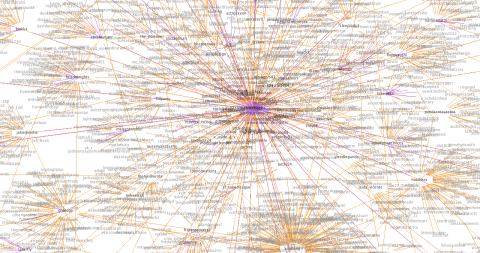
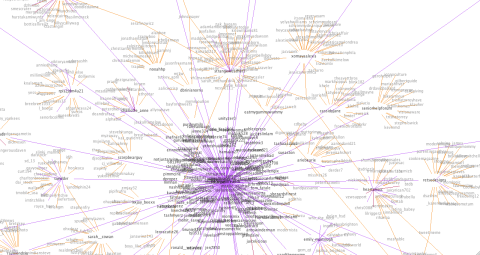
    @NonaCobbzea's Twitter Conversation Network
    @NonaCobbzea's Twitter Conversation Network

    This one is interesting – the network is fairly connected, if it wasn’t for the big ball of purple in the middle (@NonaCobbzea) it would look pretty normal. She’s sending unwanted @ messages with the same link in each one to a weird “blog” that’s a overly descriptive of certain aspects of her life I’d rather not know about. But is it working? Most likely it’s driving traffic, but no-one’s talking to her and hopefully Twitter will kick her off soon.

    There’s a bit of an Ottawa focus, so I wonder if the connectedness in the graphs is a result of that.

  • Graphing @spam

    Graphing @spam

    I wonder how this will change with the new report as spam feature.

    @spam on Twitter - October 22nd
    @spam on Twitter – October 22nd
  • Spammers etc.

    Spammers etc.

    I got another irrelevant @ message. The content of this one was a link to … you knew where I was going with that. I don’t need to say it! Check out the graph for the originator – @BaileyWolfeaem:

    @BaileyWolfeaem's Twitter Conversation Network
    @BaileyWolfeaem's Twitter Conversation Network

    Again, lots of one way links to “normal” Twitter uses (who have reciprocal conversations). the graph is huge (goes way off the screen) and quite sparsely connected.

    Another spammer, this one better disguised, brought to my attention by @smiffy:

    How amusing. I have just been followed by what looks like a ‘bot. The funny bit is that half of the ‘bot’s followers are ‘bots themselves.

    So here is @tina_revers:

    @tina_revers's Twitter Conversation Graph
    @tina_revers's Twitter Conversation Graph

    Again, the one way links and a fairly small graph. Obviously for this spammer what I really want to graph are who’s following who – I have a theory that there is a clique of bots all following one another and spewing out spam – but this is difficult because of the way the API works and the limitations on calls. I’m working on it, though!

    Finally, below is the graph for @connectcreators – I don’t think they’re a spammer, in fact what they’re doing looks like a good initiative but I do think they need to “connect” more!

    @connectcreators Twitter Conversation Network
    @connectcreators Twitter Conversation Network
  • @ Message Spam

    @ Message Spam

    I used Twitter’s new “Report as Spam” feature today for the first time, after I got a bizarre @ message from @billy_Napper_ (Following 0, 0 Followers) about the top 10 hosting sites. I don’t pretend to know all the different kinds of spam on Twitter, but there are those spammers that follow you in order to get you to follow back and click on their links (I talked about them in this post) and then there are the kind that send you unwanted @ messages.

    So – I graphed him! See below:

    @billy_Napper_'s Twitter Conversation Network (spammer)
    @billy_Napper_'s Twitter Conversation Network (spammer)

    Notice the one way links (purple) and the disjointed network (although I’m surprised it’s not more disjointed). The graph is also large relative to the number of people he’s following/being followed by.

  • What Constitutes Spam on Twitter?

    What Constitutes Spam on Twitter?

    I don’t know if this is particularly harsh, but I consider anyone who regularly promotes the same website without declaring an affiliation to be a spammer. Sometimes a well-disguised spammer, kudos to that, but a spammer nevertheless. Note – this doesn’t include people promoting their blog on Twitter. I tweet posts from my blog that I consider to be particularly important, but by no means all. I figure if people were that interested, they’d be subscribing to my RSS feed. But I digress.

    Yesterday I was followed by @emmily67. As of now is following 2,001 and has 1,222 followers. She’s tweeting amusing little things like “Marriage is a relationship in which one person is always right, and the other is a husband.“, and “Life would be easier if you could mark people as spam“. Four of her links are the same site as the one in her bio, though, and some of the amusing phrases seemed to be running on repeat. So I, ah, marked her as spam.

    However I’m interested in these kinds of Twitter users because I want to graph them (if you have any examples of this, let me know). So here’s hers:

    @emmily67's Twitter Conversation NetworkWhat do you think? Does this constitute spam? Or is it legitimate albeit self-promoting?

  • Scam Spam

    This made it through my junk mail filter. It’s kinda funny! A £300,000 407? That would be quite some car…

    You are a winner of £300,000.00 and Peugeot 407 car courtesy of Peugeot
    Automobile,London,UK.

    your secret pin code PGA00111234 and your reference number PGA: 12058006/06.

    Please acknowledge the receipt of this mail with the details below to Sir.John
    Greening , email: johngreening04@live.co.uk

    Name
    Address
    Age
    Occupation
    Tel
    Country

    With Best Regards
    Dominic Gerald
    Lottery Manager

    It came from a peugeot.org email address. Spammers are getting better and junk mail filters aren’t enough. We need to be vigilant and learn the patterns that spammers use – the information request at the bottom is typical, for example. Also, anything that asks you to reply to different addresses, especially Hotmail and Yahoo is probably a scam.

  • Spammers Getting Creative

    Spammers Getting Creative

    This morning I found a spammer who I actually have a grudging admiration for. They’ve been a little more creative than posting a headless picture of a young (hot) girl or mass following anyone who mentions whatever they’re pushing in the hope they follow them back.

    Check them out: http://twitter.com/SkiClubs

    At the moment of writing they have 491 followers (to the 640 they are following). Twanalyst, a service I find very useful tells me:

    Tweets per day: 8.5
    Readability index: (?) 18
    % conversations: 3
    % links: 96
    % hashtags: 1

    Personality: popular obsessive cautious
    Style: garrulous academic
    ROBOT

    So there’s actually a website about skiing linked to from their profile, which doesn’t try to sell anything and has some content. Not a huge amount, but enough to appear legitimate from a casual glance – maybe it is, even. A nice background and a profile picture.

    But let’s take a look at their ten most recent tweets…

    Tweet 1
    Tweet 1
    Tweet 2
    Tweet 2
    Tweet 3
    Tweet 3
    Tweet 4
    Tweet 4
    Tweet 5
    Tweet 5
    Tweet 6
    Tweet 6
    Tweet 7
    Tweet 7
    Tweet 8
    Tweet 8
    Tweet 9
    Tweet 9
    Tweet 10
    Tweet 10

    So here’s what I think is impressive (for a spammer):

    1. There’s content that looks legitimate.
    2. 357 Tweets so this is someone who has some history.
    3. Some of the content is actually interesting, I would love to know what “Skwittering” is!
    4. It’s targeted. (They likely added me because in my profile it lists “ski instructor”)

    Here’s what makes me say it’s spam:

    1. Anything which contains anything about “making money”
    2. Same “money making tweet repeated twice (tweets 2 and 8 )
    3. Almost all content links link to the homepage of the website. It suggests there’s content, an article or a blogpost – but there isn’t. So I still don’t know what “Skwittering” is…
    4. The content links as well are recycled. If you go back further through their tweets, there are multiple of the same of those as well.

    Here’s what I would love to know:

    1. Did they make the ski website themselves or is it one they found? How much effort are they actually going to here?
    2. What’s the click-through rate?
    3. Are there multiple areas which are targeted? I.e. are they running a “rock climbing” twitter and website as well.
    4. Do they actually ski?
  • Spam

    I spend a lot of time thinking about Spam. It may be an inherent danger of being a Programmer. Even though I take care of my email address not being posted around the internet I get junk mail. Some of it is quite funny, although I hear some people fall for the bank with unclaimed money in Nigeria… so I guess not for them.

    I bet back in the day people said that spam would ruin email, and I don’t mean to negate it as I know spam costs companies a lot in lost time and productivity. But I think Spam on Twitter and Facebook is even more interesting.

    Take Facebook. The primary source of spam for me on Facebook is Facebook Applications, that send me notifications inviting me to add things I have no interest in and frankly don’t want accessing my personal information to my profile. I definitely consider those to be spam, and block any that I receive. On the rare occasion that I do consider adding an application, asking me to notify some / all my friends will immediately cause me to change my mind. But – many of my friends who I’ve actively acknowledged a relationship with clearly don’t consider these aps to be Spam, as they add them to their profile.

    Maybe this is similar to email. After all, whilst the vast majority of people consider invitations to buy Viagra online, or contact from a bank manager in Nigeria to be spam sufficiently many people respond that it’s worth the cost to the spammer of harvesting email addresses and buying the bandwidth to send the spam out. I think the difference is, I don’t personally know anyone who buys Viagra in response to an email or really believes that they’ll get thousands of pounds out of Nigeria. So the response rate for spam on Facebook is higher? Or one person’s spam is another person’s… ham?

    However spam on Facebook doesn’t (thus far) have the power to ruin the whole experience. And since the Facebook applications are now old news, I definitely get fewer notifications. Twitter though – is different.

    Twitter has the issues of Facebook and of email. You can get spammed by people you follow (like you can get spammed by people you’re friends with on Facebook – the Spymaster game springs to mind) and you can get spammed by people you don’t. There’s an intereting article on Twitter spam here. But the real way that spam annoys me on Twitter is because it takes over every trending topic. So, in an unscientific study I checked the trending topics a little after 19:00 BST today, and counted how much was people just including the topic to get their post showing up in searches for it.

    Trending Topic # of Spam Posts % Spam
    Follow Friday 0 0
    #whentwitterwasdown 1 5
    #welovekevinjonas 2 10
    #flywithme 4 20
    GI Joe 2 10
    RIP John Hughes 3 15
    #tls09 8 40
    UberTwitter 6 30
    TGIF 4 20
    #IranElection 0 0
    Average 3 15

    So there’s an average of 15% spam, which is lower than I expected (clearly things have improved since this article) but still – some trends are as high as 40%. I want to say – really, does anyone fall for this… but clearly like all spam enough people do for it to be worth the very low overhead for spammers to do it. One of the coolest things about Twitter is it’s ability to capture the zeitgeist, and trending topics being full of spam damages this.

    Another thing I consider to be spam is pyramid follower schemes. You know the ones, you follow everyone and give them your details and it spams your followers with the link and adds you to the list, so the next idiot follows you. I’ve un-followed two people (doesn’t sound like much, but I only follow about 50-60 people) for using these. I loathe them – and there are so many! I’ve been keeping track of the ones that come up and (these are just those that I’ve made a note of) have a list of 13 since June. They have such inventive names as: “Twitter Train”, “TweeterPro”, “GatherFollowers”, “BestFollowers”, “FollowersFast”, “QuickFollowers”, “ThousandFollowers”, “EasyFollowers”, “FollowersFree”, “AddFollowers”, “MaxFollows” and they all look the same, and all have the “VIP” option – which is how they make money. Really? People pay to spam the followers they have in the hope of getting more followers who are only following them in order to get more followers themselves? Really?!

    Great article which highlights the stupidity of such schemes and that the best way to “grow your follower count” is organically, by interacting and treating Twitter as a conversation medium not a broadcast medium is this one. For people wanting to run a live Twitter stream on their website, spam in the search results is a real issue. TidyTweet aims to minimize this (and take out inappropriate language as well). Whilst there have been a plethora of “make money on Google” links lately, even legitimate companies have been guilty of spamming, so I can’t see there being an easy fix. And, when this kind of promotion makes it into the trending topics I wonder where we draw the line between what’s spam and what’s just an aggressive and questionably honest marketing strategy.

    Unwanted @ messages are another form of spam that’s pretty common, although Twitter seems to be clamping down. This morning I had a RT that I never tweeted in the first place, but by this afternoon it (and presumably the person who sent it) was gone.

    Finally, Bot’s that follow you because of keywords or just because in the hope that you follow them back and click on their links are the things that annoy me most. Apparently it’s grounds for account suspension, however I haven’t noticed much effect on the number of times I get added by accounts following this strategy. I’ll have to write another post just about this, because this one is already too long. Briefly, for the past 2 months I’ve been tracking who follows me, if I suspect they used a keyword, and whether or not I followed them back. Since the start of June, 120 people have followed me. If you check out the number of people I follow, it’s apparent that I haven’t followed a fraction of them back. I’m also not being followed by much over 100 people, so clearly they haven’t kept following me! They often give you 24 hours to follow them back, and then unfollow you in order to maintain their ratio. In fact, 120 is inaccurate because this contains the same account following me 3 times!  Of this 120, 3 I was already following (when they followed me), and I followed 21, 3 of whom I later unfollowed. So 80% of the follower notifications I received I did not consider to be worth following back.  This article demonstrates an extreme example of this. That’s a pretty high rate of spam. If you’ve been following everyone who follows you back, there is something you can use to get rid of them – mashable has a good article on this.

    Of course these are just ongoing issues I have with spam on Twitter. There have also been isolated incidents, like when loads of legitimate accounts were hijacked, or fake celebrity re-tweets. Twitter is also definitely trying to minimize the issues of spam, although with mixed results, such as blocking bad URLS, and suspending accounts. But with the rise of sponsored tweets, such as this service it may get more complicated.