Tag: management

  • The Anatomy of a 1:1

    The Anatomy of a 1:1

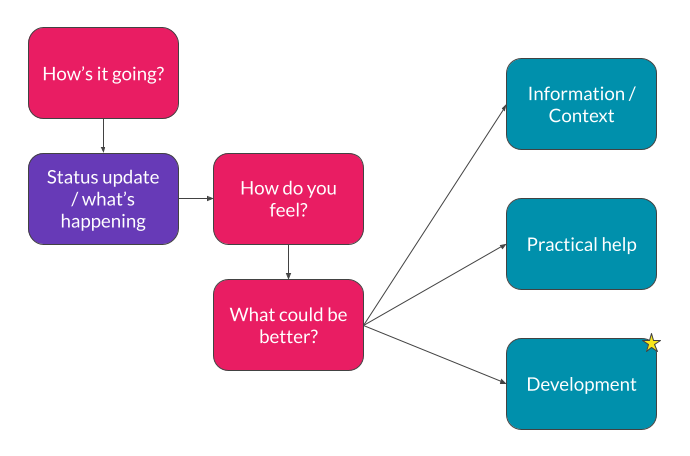
    Broadly speaking, my overarching agenda for any 1:1 is as follows:

    It starts with the checkin, “how’s it going?”, an open ended question that some people respond with a status update, and some do not. The important thing is what comes next – finding out how the person feels. Sometimes a status update is useful context for that, sometimes it’s just how we get there. Either is fine.

    Then we move into the most interesting part of the 1:1: what could be better.

    Information / context is where I spend a lot of time for new hires, or someone taking on new responsibility. E.g. if I have a new lead, they might have questions about how things work or what they share about how they think things are going will surface things they may be missing or need to pay more attention to.

    Practical help is less common, but sometimes necessary – if someone is overwhelmed, or needs to escalate something, then that’s something we would spend time on. Equally, I might help them with finding help elsewhere.

    Development is the most interesting part of the 1:1. This is about helping them be more effective (or sometimes just happier at work). For many people, it’s not necessary to be in this space every week, but making some time for this more often than not is key to supporting people’s development.

    Below is my model for developmental conversations.

    Thanks for the Feedback breaks feedback into evaluative feedback (where someone stands) and developmental feedback (how someone can improve). Coaching is separate – where the individual decides what they want to do, and can – in context – build on both of these, or exist outside of it in a pure coaching relationship.

    Evaluative feedback is critical – if someone doesn’t know where they stand, that can undermine everything else – but is the least empowered place. The failure mode is the evaluation loop, where you keep discussing the evaluation but it doesn’t change, because there was no meaningful action. In this space, there’s a lot of emotional work on both sides, but no movement.

    Moving into “how can I improve” moves into action, and is more empowering. The person can change the outcomes or evaluation through changing their actions. It’s less empowering than coaching, because it’s more about implementing suggestions. The feedback loop is more productive than the evaluation loop, but progress is linear. The disempowerment trap is to return to evaluation through the question of “is this enough?

    Coaching is the most empowered space, because it is where the person asks what do I want, the empowered choice loop is where transformation – or exponential growth – happens. The disempowerment trap here is to give away the choice, and ask for direction instead.

    I want to be clear that no space in this model is bad, typically we need to visit all of them. However the difference is between people who are highly coachable and those that are not is the time spent in each place.

    Someone highly coachable:

    • Gets some evaluative feedback.
    • Takes suggestions well.
    • Figures out how they want to build on it and what they want to do.

    This follows the top path, and as a result very little time is spent in evaluation, some time in developmental, but the bulk of the time is in the coaching space, and that extends well beyond the time spent together.

    Someone who is not coachable:

    • Doesn’t have ideas on how they can improve.
    • Asks what to do instead.
    • Falls into an evaluation loop.

    This follows the bottom path, and cycles down and around, i.e. even after moving into developmental, returns to evaluative. The bulk of the time is spent in evaluation, with a small amount of time in developmental, and none in coaching.

    Whilst the evaluation space is not a hugely productive one, it’s unwise to skip it entirely. Someone who is hard on themselves might seem very receptive to feedback and full of ideas about how they can improve, but if they come to this from the idea that they are falling short and need to do better, it’s less empowering than if they are confident they are doing well and valued, and deciding what they can do to truly thrive.

  • Energy Management for Newer Managers

    Energy Management for Newer Managers

    Credit: darksouls1 / Pixabay

    When I coach new managers, or transition ICs into management, one of the key struggles initially (which I also remember myself) is overwhelm. For some, this ends up in exhaustion, and those are the people who often switch back onto the IC path – they find management unsustainable at that time (some return to it later; some do not).

    Superficially, it’s understandable that people become overwhelmed. They get a bunch of new responsibility, and need to process that responsibility; it can take some time to filter through it all and figure out how to manage it. The context switching can also be very draining, particularly context switching at different levels of abstraction (i.e. from strategy to detail level code review).

    But one of the deeper things driving this, is that ICs often differentiate through strong time management. They work their schedule to really prioritize the deep work for some chunk of every day, they figure out how to churn out small things alongside it. They manage their time well, and that makes them effective.

    Shifting into management, the biggest challenge is not time management, but rather energy management. This requires a different approach.

    As an engineer, often the most challenging thing to do in a given week is some gnarly problem. Carving out four hours of complete focus to make a dent in it can make a huge difference.

    As a manager, often the most challenging thing to do in a given week is a hard conversation. It might even be a short, hard conversation. The biggest challenge is psyching yourself up to do it, and whilst you might (arguably should) spend time preparing, often that is more about managing your own emotions in order to do it, rather than the actual work required.

    Even aside from the truly challenging things, to a more “normal” week, being emotionally present in your 1:1s or team meetings allows you to detect potential problems earlier, and help people more effectively. If you show up distracted and exhausted (which happens to everyone from time to time, we’re human) you’re less effective in some of your highest leverage activities.

    If your meetings are not high leverage then that is a similar, but related problem. If you don’t have time or energy to think through how to improve (or delete) them, then that will not change.

    Similarly, being proactive instead of reactive is largely an emotional regulation issue. It requires getting ahead of things, perhaps by doing something very tedious, versus reacting to whatever seems most pressing in the moment. Making active decisions here requires a level of emotional calm and mental clarity that we lose when we are stressed and overwhelmed. Proactive work is also less of a dopamine hit than reacting and “fixing” something.

    If you’re a new manager and feeling overwhelmed, the first thing is to figure out whether you have a time management problem or an energy management problem.

    • What things do you add to your todo list on Monday, but delay until Friday? Why do you put them off?
    • What things do you struggle to do at the end of the day even though you technically “have time”?
    • Looking at your task list for the last week, what was draining beyond the time spent on it?
    • Looking at your task list for the next week, what do you worry you won’t have time for? Why is that?
    • Looking at your task list for the next week, what are you dreading? Why?
    • Looking at your task list for next week, what are you looking forward to? Why?
    • What do you think is the most valuable thing you do? Why? How much time do you spend on it?
    • What do other people think are the most valuable things you do? Why? How much time do you spend on them?
    • Audit your calendar / regular work and ask yourself for each thing: how valuable is this, how much time is spent on it, and whether or not it’s energy-giving, energy-taking, or neutral.

    Once you’ve worked through some of these questions, you will probably know whether the problem is just sheer volume of things (which okay, time management, but probably mainly figuring out what you can get rid of) or whether it is not the volume, but the emotional drain of certain activities.

    The final question is this: When you step away from work, are you able to disconnect. If not, what do you keep thinking about?

    Thinking about work long after we have finished for the day – especially in terms of ruminating on things we are stressed about – is how we work forty hours in time and sixty in energy. If we physically leave the computer but don’t emotionally leave the work we exist in the limbo of neither working nor resting, and that creates resentment and exhaustion.

    Some ideas to improve your energy management:

    • Think about things you can do at the start and end of the day that ground you.
      • Such a cliché, but even just a 20 minute spin class before I start the day makes a huge difference to how I experience it.
    • Think about things you can do during the day to ground you.
    • Schedule lunch breaks, and take some time to do something, away from your desk.
      • You could take a short walk, savour a hot beverage, or read a chapter of a book.
    • Make a daily (or weekly) list that accounts for energy rather than time.
      • If you have a heavy road mapping week, or are doing performance reviews, perhaps you won’t be in a frame of mind to write a chirpy blogpost on engineering best practices. Accepting that and planning for it is much easier than dreading it and struggling.
    • Look at your calendar and commitments for a day, and consider what is emotionally realistic versus technically possible?
      • Recently, I was dealing with a huge chunk of my team being in the vicinity of a war zone. So much emotional energy went to that situation and those 1:1s – even though they took a the typical amount of time – that I kept 1:1s with people who were not directly impacted by that shorter and lighter. Is that ideal? No. Would I do it every week? Also no. But in that kind of situation it’s better to be realistic about my own limitations and set expectations accordingly.
    • Take 15 minutes to think about each meeting before you have it, decide what outcomes you want to drive and how you can do that most effectively.
      • If you don’t have time to do this, you probably have too many meetings. See about deleting some! (Start with the boring ones, they can most easily be replaced by text).
    • Consider the activities that you find most emotionally draining. Is there anything you can do to change your relationship with them?
      • Are you on a learning curve? Do you need to take more time to better understand how to approach it?
      • Are your expectations for yourself too high?
      • Do you lack an understanding of the purpose of the activity? Can you find one?
      • Is your relationship with the activity shaped by previous bad experience? Can you change it? E.g. you dread your meeting with your current manager because your previous manager was horrible. Actively catching yourself in old thinking patterns, resetting your expectations and re-enforcing to yourself that this relationship is not that relationship can help shift your relationship to the meeting over time.
      • Do you need to be doing this activity? Can you transition it to someone else, or just stop doing it?

    If we want things to be different, we have to create space for them to change. Being overwhelmed each week and finishing behind and exhausted are a vicious cycle. Whilst things may improve “naturally” over time, as you get more comfortable with the role, much stress and suffering can be alleviated with some meta-thinking into how you’re approaching your work, and adjusting self-management to emphasize energy-management as even more important than time-management.

    Good luck! Let me know how you get on. My inbox and Twitter DMs are always open.

  • LeadTime – How teams work: DuckDuckGo’s engineering team

    LeadTime – How teams work: DuckDuckGo’s engineering team

    I did an interview with Range, talking about how the fully distributed teams I lead at DuckDuckGo work.

    Read it here

  • The culture of process

    The culture of process

    My latest in LeadDev…

    One of the challenges we face as engineering managers is how people react to process differently. Sometimes it’s like we’re talking about entirely different things – we propose something we expect to be lightweight, and people react like we’re instituting TPS reports or time-tracking in six minute intervals (normal for lawyers, everyone else: hell no).

    Continue reading…

  • Pandemic Problems

    Pandemic Problems

    For the past couple of months, I’ve kept a post it on my desk. It says:

    How are people doing?

    – Downtime
    – Social isolation
    – Perspective

    You can probably guess what it’s for – it’s a reminder of the core struggles I’ve been noticing from people.

    Downtime: downtime is lower quality, and people struggle to recharge. Also, given restrictions they aren’t planning vacation, and might delay taking time off for when they can do something (this ‘when’ never comes).

    Social isolation: especially for people who live alone, it’s easy for this time to be very isolating. Many people are lonely.

    Perspective: It’s been very easy for techworkers to live in a bubble for the year or so, and combined with other two things it’s not uncommon for people to lack perspective – to get more angry or upset or anxious than they would usually.

    Whilst we can’t do much about the current situation, these are reminders to:

    • Encourage people to take time off – and take time off myself. Little and often has been working better for me. When someone starts to seem a bit fried, I encourage them to at least take a long weekend. This is easier in environments with untracked AFK where people actually take it. I know some companies gave people extra vacation days in 2020 – what a great idea. Even Putin gave people extra holiday this year (although maybe it was just a disguised lockdown 🤷‍♀️).
    • Take the time to check in with people as a human and ask how they are personally. Encourage team social events. Just do my little bit to maintain some sense of connection in the darkest timeline.
    • Encourage a little more perspective. Generally, for example five of us from DuckDuckGo are attending LeadDev Together, and also specifically – when people have a harder time seeing the other person’s point of view, it’s more likely to create (or exacerbate) conflict. Often the first step to resolving these things is to encourage people to think a little more broadly.

    So much of decent management is consistently showing up and giving a damn about people as human beings. This has been harder than ever to do over the past year, with our own struggles depleting our emotional energy.

    Sometimes it seems like some people think the pandemic is over, but it’s not, and even once life resumes it will take time for people to recover and reset. I think I’ll be keeping this post-it on my desk for a while longer, so I’m sharing this post in the hope that it may be helpful to you, too.

  • Empowering your engineering team with an effective decision-making process

    Empowering your engineering team with an effective decision-making process

    My latest for LeadDev…

    A common area where managers fail to scale is in decision-making.

    The two extremes are: being responsible means making all decisions and enabling a team means staying out of details and letting them make decisions.

    Both of these are bad. One is controlling and fails to scale for obvious reasons. The other fails to scale because it pushes all the work onto the team, creating variance and evading responsibility. Managers in this category will be fine as long as they have high-performing individuals making good decisions, but they won’t know where to begin with people who can’t make good decisions, or how to address issues when things go wrong.

    Continue Reading…

  • Lead Time Chat

    Lead Time Chat

    My friend Jean and I recorded a little video for her Lead Time Chat series on the topic of coaching. Some topics we covered…

    • The difference between an external coach and a manager.
    • Working with an external coach across multiple jobs.
    • Finding a good fit with a coach.
    • Whether an engineering background is what you need in a coach.
    • When external coaching can harm a situation.

    There are other videos and space to discuss in the Lead Time community.

  • Leading your engineering team with ‘experiments’ not ‘processes’

    Leading your engineering team with ‘experiments’ not ‘processes’

    My first post for the LeadDev…

    Many teams have the same fear when it comes to a new manager: they fear the process monster.

    Process monster (n): a manager for whom the answer is always, always ‘process’. The process monster will add more and more processes to the team until the team collapses under the weight of them. Eventually, the monster will move to another role, and the failure of the team will be explained as ‘resistance to process’.

    I’m sure you’ve encountered process monsters in the wild before. Some have enough empathy and are in the right roles to be successful, while some have the effect of strong glue: slowly grinding a team to a halt under the illusion of improving efficiency that never materializes.

    Continue reading…

  • Supermanagers Podcast

    Supermanagers Podcast

    I recorded an episode of the Supermanagers podcast and it was really fun! We talked about many things including the importance of coachability, why you should get rid of your boring meetings, and the worst manager I ever had.

    Listen on: [iTunes] [Spotify] [Google Play] [Anchor]