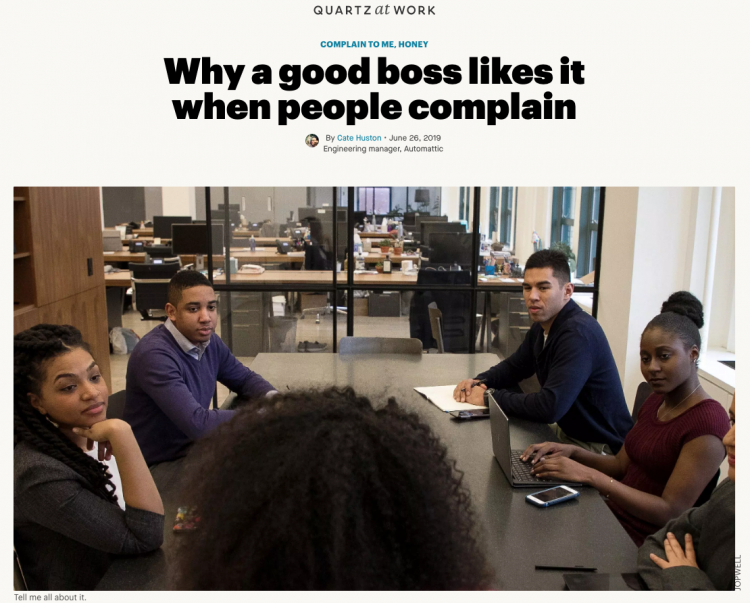
I know some managers say “don’t bring me problems, bring me solutions,” but personally I don’t subscribe to it.
I love when people complain to me. Of course, complaining is a national past time for the British, and we don’t just limit ourselves to complaining about the weather, or the poor availability of good tea when traveling. Brexit has provided some strong fodder for complaining (where do we begin?) but really your average British can complain about anything.
But, here’s why complaining is so useful to me as a manager.
Leadership roles evolve, especially through periods of transition. As a leader, I have found my own role changing as challenges on the team change—around every four months I realize everything is fundamentally different, and the way I need to spend my time changes, too.
Recently the number of my direct reports more than doubled, and I added two different roles reporting to me. This was a very obvious instance of change, and I opened up a discussion on our team blog about what that meant. I confessed to certain things I had noticed about myself when I felt overwhelmed, and asked them four questions:
– What do you see as the most important thing(s) I do (generally)? – What are the most impactful things I do for you specifically? – What is one thing you think I should stop doing? – What is the biggest area of your work where you want/need me to support you?
But even when it’s not as obvious, your job as a manager can still evolve. Maybe you used to have mostly new managers reporting to you, and now they’ve found their feet, meaning you can be less involved and spend your time on something else instead. Maybe your team had some kind of pressing problem—a big project with a looming deadline or bad releases that needed to be fixed—but now it’s on track, so what do you focus on next?
Some leaders are fantastic at “team branding”—communicating about their group in ways that give the rest of the organization a good understanding of what the team is all about. Others are squarely focused on “team public relations”—telling a great story about a team that, if we looked more closely, we might find is not delivering or functioning very well (it always comes out in the end).
Team PR is usually overly positive, glossing over the hard questions. It’s about generating the right illusion. But when what you say (i.e. your PR) doesn’t align with what people say about you (i.e. your branding), it’s a surefire way to undermine trust in your leadership.
Don’t get me wrong. PR is a legitimate part of the team branding process. You need to be able to talk about your team’s strengths and accomplishments. But to build a brand that reflects and projects reality, you also need to be able to talk about your team’s failures, and the gap between where the team is now and where it hopes to be.
There’s a saying in software that all bugs are eventually user interface bugs, because someone has to see them to report them. In organizations, it often seems like all problems are eventually communication problems, because communication is the way we interface with each other—and the way most problems surface.
There are a lot of reasons why communication within a company can break down. Here are some of the most common.
Someone once said to me “you’re good at change management” and I was like, what?
I sat with the idea for a couple of weeks and eventually realized: Oh! That is what I do! I take teams that are struggling and help them focus, align, and start delivering at their potential, i.e. change management.
The thing about change management is that it involves a lot of invisible work that’s hard to follow from the outside. The two things that people see in change management are the change (toward the end, if they are paying attention) and when it goes (sometimes horribly) wrong. Here are some lessons I’ve learned from the change-management trenches, whether as the manager or the changee.
Early on at Amazon, CEO Jeff Bezos famously issued a memo about how software was to be built at the company. Teams would share their data through service interfaces, or APIs, the same way that they would share it with an outside customer. That meant that a developer on one team didn’t need to know anything about how another team operated in order to integrate the product it made—he or she could follow the documentation and use that product as though it were an external service. Ultimately, this ease of cooperation became extremely efficient and is what paved the way for Amazon Web Services—a $6.7 billion business that powers huge parts of the web (including Netflix).
Georgetown University computer science professor Cal Newport recently argued that a similar idea could be applied to humans, or the way that leaders put together teams. By defining each person’s work as a collection of inputs and outputs, leaders could define communication protocols to reduce the overhead of collaboration (often measured in meetings) and allow for greater efficiency in communication across teams and more “deep work.”
This is the kind of extreme stance that Newport is known for—the kind of thing that makes him well known and successful as a theoretical computer science academic and author. I learn a lot from what he writes; I never apply it to the same extent.
Functional teams have four layers of communication:
– A mission (also known as a vision) – Strategy (made up of proximate objectives) – Tactics and process – Execution
This list might seem like it includes categories of action—it does. But it’s not just doing these things, but also communicating them that ties teams together. Communicating the items on this list plays a major role in scaling teams and leaders. With these things in place and communicated, it’s much easier to add people to a team, and then entire teams to an organization.
Something I struggled with as a new manager was finding a sense of accomplishment, and as I’ve moved on to manage managers, I’ve seen this become a challenge for them, too. It’s hard to find the right success metrics upon which to judge our work because our output is to make the team better, and so hopefully we give credit generously to them.
Without success metrics beyond the team’s improvement, though, it can be be easy to feel like you’re just riding a wave of good people doing good work without contributing anything yourself.
Some managers deal with this feeling by seeing their success metric as being available to their teams 24/7 (unsustainable), or by counting lines of code (which would be like editors focusing on the number of words they wrote themselves—absurd). Some embrace the performance of management without understanding the underlying motivations. They “perform good manager” in one-on-one meetings, team stand-up meetings, and feedback cycles, but it doesn’t really make them feel accomplished, and it’s hard to put a finger on why.
To that end, I’ve compiled a list of signs that I look for in managers on my teams that suggest they’re doing a good job.
I’ve never stepped into a leadership role without it quickly becoming clear why a new leader was needed. I think it’s normal for companies to hire new leaders when there are problems that need to be addressed. So I suspect that as the congratulations die down, it’s also normal to look at the set of problems that surround you and ask, “Where do I begin?” (also normal: “What have I done?!”). I suggest instead starting with these two questions: