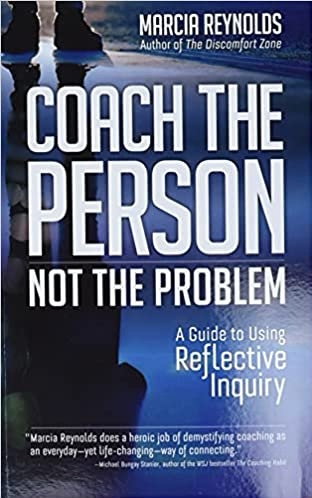
I really got a lot out of Coach the Person, Not the Problem [Amazon]. Whilst the content was covered in the courses I took, it approached it in a different way – deconstruction versus experiential – and that was really helpful for solidifying my learning.
At it’s core, it’s about switching your focus to the person, because the temptation to focus on the problem is what leads to advice, solutionizing etc. By focusing on the person, you make them bigger than the problem and support them through the process of deciding themselves what they want to do.
Reflective enquiry is about making people feel really heard. By reflecting back to them you allow them to see themselves more clearly, define steps forward. Sometimes people have the impression that coaching is passively asking open ended questions. Reflective enquiry is crucial for more effective coaching. It helps the person step back and see their actions / themselves from another perspective.
In terms of the writing, one thing I really appreciated about this book was that it took the time to really explore the topic without feeling excessive. As such, it took me a while to read it, but I felt the time was worthwhile. Definitely recommend if you want to better understand coaching.
I would love to find a new name for this, now that JK Rowling is cancelled, but in the Harry Potter books, house elves are powerful magical beings, who are condemned to (mostly invisible) servitude, largely of people who would uphold harmful power structures (much like JK Rowling herself).
The tragedy of the house elf is that they could be capable of so much, but they do not get to do it, because they are busy pleasing people who can never be pleased. Some of them become so enmeshed in that situation, that they cannot allow themselves to be free, even when they have been freed.
What does this have to do with management? Well, new managers often present exhausted and overwhelmed, and the question I often ask in this situation, is, “how are you house elfing your team?”
House elfing comes from a good place, often tied to some idea of “servant leadership”. People who internalize this idea that they exist to work for their team, and the way they know how to do that is to pick up all the small annoying things, run all the meetings, plan all the team activities, pick up the boring grunt work, tidy up the bug list etc.
The outcome of this is that they are:
Wholly reactive ➡️ unable to focus on bigger / more impactful work.
Buried in small details ➡️ unable to step back and see the bigger picture.
Exhausted ➡️ running around all day picking up after people does that to you.
Overwhelmed ➡️ see also: reactive. By being buried in the details, you don’t have time to make the meaningful improvements.
Worse, these managers often start thinking it’s their job to make their team happy. Wrong! It’s your job to make your team effective. Constant picking up of small things does not make your team more effective – noticing the patterns and improving the processes, or the projects themselves does that.
And here’s the thing, the biggest problem I have with servant leadership: you can’t be the servant of people you have power over. So either you deny that power dynamic, or you give away that power.
Because if you behave in such a way that your team starts to believe your job is to make them happy, what is going to happen when you inevitably have to disappoint them? When you have to tell them they didn’t get the promotion, or the project has been cancelled, or the is no budget for the thing they want?
They will blame you.
Everyone on your team is – hopefully – an adult. You don’t need to “protect them” from the realities of the workplace. Trying to do so is patronizing and a recipe for making yourself miserable. If you believe people are adults, you can focus them – make it clear what’s important, what’s valued and what’s not – and trust them to take their share of team housekeeping.
I’m not saying you should refuse to do anything – I’m saying you should not do everything. I’m also not saying you shouldn’t help your team, that is an important part of your job. But it is your job to help them through kindness not erode everyone’s effectiveness with niceness.
The thing about house elfing, is that it comes from a good place – the desire to help. This is something to honour.
It can also be a product of some level of insecurity, that by doing small tasks you are providing value. It’s a way to get the small dopamine hits that we miss from writing code. This is something to critically evaluate.
To escape the house elf trap:
Pay attention to how often you are house elfing. Make a list of things you do when you catch yourself house elfing.
After a week or two, evaluate the list. How much is on it? What has that cost you in terms of focus time or energy?
Redefine your priorities. What are your most important things to do?
Catch yourself before you house elf. Let that thing go undone (by you). Does someone else pick it up? Does it need to be done at all?
Remember that even if you can successfully house elf a team of five, there is no way to succeed in this mindset with five teams of five. This can be one of the biggest ways that people get in the way of their own advancement – so the time to readjust your approach is now.
Originally shared internally and lightly edited for external readability. Note that this comes from a context where the self review is not part of the promotion packet so focuses on it as a tool to help the manager put together the review.
Time to reflect and clarify what you’ve achieved over the past cycle.
Alignment between you and your manager on your work, impact, and goals.
None goals of self review:
Sales pitch on why you should be promoted.
Your self review – done effectively – is one of the most helpful tools for your manager in accurately representing your work and impact in the feedback cycle. It can help them cut through all the noise of various projects to hone in on the most useful points or outcomes. This makes a huge difference in how much time it takes to put together, and your manager will thank you for that alone. But it also helps highlight things they might miss if they just read through everything in your project management tool of choice. E.g. you might feel that calling and structuring a meeting was crucial to the success of your project. That might not be as apparent from the notes and project updates unless you tell them what to look for.
I’ve put together this list of tips for you.
1. Effectively summarise. Don’t make your manager read through every project you have ever done. Help them know what to look for. Put the most important projects at the top, and make the impact clear, as well as key points in the project timeline that are worth their attention. Leave out small projects that just needed to be done, or if you can’t bring yourself to do that, add them to “other projects” section at the end of the doc.
2. Focus on Impact. It’s tempting to justify how hard you worked, but focus on communicating the impact of that work instead. What was different because this project was executed? What was different because this project was executed by you? What is possible or known now that wasn’t before? If you’re not clear on the impact of a project, ask your product manager (and next time consider asking before you agree to do it).
3. Surface invisible work. We all do things that are more behind the scenes. Code reviews, releases, peer support, onboarding etc… the kind of work that makes the team run well but isn’t always visible and is easy to overlook. Make sure you surface this work in your self review, talk about the impact, and think about who you can ask for feedback that will re-enforce that. E.g. if you were an onboarding buddy, the person you onboarded or their manager can be good people to tag. If you did a lot of work improving release automation, maybe the person who does the most releases is the person to ask. It’s worth telling them what you’re hoping they will speak to and help you make more visible.
4. Deconstruct strategy. Often the value of a project is not in any one project, but in a collection of projects pushing towards some outcome. If you have a situation where multiple projects build on each other to increase impact, expose that. Explain how they fit together and what they are working towards. For instance, if you had a set of work to improve release quality and confidence, it’s worth grouping that together and explaining it overall, because the individual work within it might seem like minor tasks. This applies even if your strategy is not yet complete; you can explain where you expect to go next and initial indicators.
5. Show progress. Everyone should have things they are working on, and this is an opportunity to illustrate progress. It’s fine if it’s ongoing, but think about whether you have made progress, or whether you’ve not (and if not, why). It’s also (usually) fine if you’ve decided this is not what you want, e.g. last cycle you thought you would want to be a manager but on reflection you’ve realised that’s not where your strengths or interests truly lie. If you have areas of development from the last cycle, this is a good place to start.
6. Show what you learned. It’s okay to fail, but it’s not okay not to learn from it. Don’t gloss over the things that didn’t go the way you’d hoped, show what you’ve learned from them instead.
7. Choose your own career goals. You are the DRI of your career, so you get to have clarity on your own goals rather than expecting your manager to set them for you. Getting promoted is not a career goal, and it’s rarely a good reason to do anything (“if-then” rewards rarely motivate us, we do better with things tied to autonomy, mastery and purpose: see Driveor the TED talk). Your career also exists beyond where you work currently. Think about how you want to grow and the kind of work you want to do, and set goals around that instead.
Meta-problem (n): root cause issues of a collection of symptom problems.
One of the things I do as an engineering director, is live in the realm of the meta problem. The thing that is behind the problems that people are talking about.
For instance, a meta problem of an individualistic mindset on the team might result in:
Poor onboarding
Inequitable division of work
“Not my job” attitude
Lack of collaboration
Lack of feedback
Yes, these things individually need to be addressed, but that will look different if you address them one by one, or guided by a North Star of “collective responsibility”.
Similarly, a meta problem of poor people management might result in:
Lack of feedback
Lack of interest in management
Lack of growth
Lack of clarity around team purpose
Burnout
Fear of change
Resentment of authority
Addressing the root cause by doing good people management and empowering others to do good people management will shift these issues more effectively than considered one by one.
Teams that are struggling have a collection of issues, and part of transformation to a functional team is to root cause and address the meta problems. Working symptom by symptom may not change, may actually re-enforce the meta problem. E.g. if you have a problem of code review being slow and a meta problem of team workload, then the answer is different if you have a problem of slow code review and a meta problem of individualistic mindset.
Addressing meta problems often involves shifting the culture in some way. Things are the way they are for a reason – a series of decisions reflecting organizational priorities at the time, distorted by the coping mechanisms of individuals (particularly those with more influence on the team). It takes time to address the ensuing consequences, but much less time if you take it holistically rather than symptomatically.
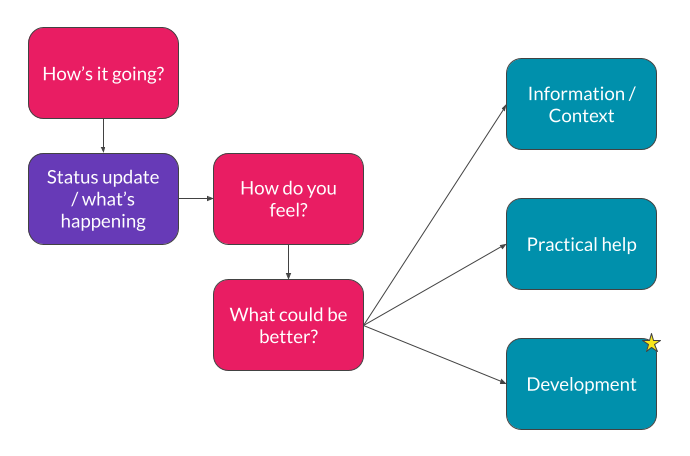
Broadly speaking, my overarching agenda for any 1:1 is as follows:
It starts with the checkin, “how’s it going?”, an open ended question that some people respond with a status update, and some do not. The important thing is what comes next – finding out how the person feels. Sometimes a status update is useful context for that, sometimes it’s just how we get there. Either is fine.
Then we move into the most interesting part of the 1:1: what could be better.
Information / context is where I spend a lot of time for new hires, or someone taking on new responsibility. E.g. if I have a new lead, they might have questions about how things work or what they share about how they think things are going will surface things they may be missing or need to pay more attention to.
Practical help is less common, but sometimes necessary – if someone is overwhelmed, or needs to escalate something, then that’s something we would spend time on. Equally, I might help them with finding help elsewhere.
Development is the most interesting part of the 1:1. This is about helping them be more effective (or sometimes just happier at work). For many people, it’s not necessary to be in this space every week, but making some time for this more often than not is key to supporting people’s development.
Below is my model for developmental conversations.
Thanks for the Feedback breaks feedback into evaluative feedback (where someone stands) and developmental feedback (how someone can improve). Coaching is separate – where the individual decides what they want to do, and can – in context – build on both of these, or exist outside of it in a pure coaching relationship.
Evaluative feedback is critical – if someone doesn’t know where they stand, that can undermine everything else – but is the least empowered place. The failure mode is the evaluation loop, where you keep discussing the evaluation but it doesn’t change, because there was no meaningful action. In this space, there’s a lot of emotional work on both sides, but no movement.
Moving into “how can I improve” moves into action, and is more empowering. The person can change the outcomes or evaluation through changing their actions. It’s less empowering than coaching, because it’s more about implementing suggestions. The feedback loop is more productive than the evaluation loop, but progress is linear. The disempowerment trap is to return to evaluation through the question of “is this enough?“
Coaching is the most empowered space, because it is where the person asks what do I want, the empowered choice loop is where transformation – or exponential growth – happens. The disempowerment trap here is to give away the choice, and ask for direction instead.
I want to be clear that no space in this model is bad, typically we need to visit all of them. However the difference is between people who are highly coachable and those that are not is the time spent in each place.
Someone highly coachable:
Gets some evaluative feedback.
Takes suggestions well.
Figures out how they want to build on it and what they want to do.
This follows the top path, and as a result very little time is spent in evaluation, some time in developmental, but the bulk of the time is in the coaching space, and that extends well beyond the time spent together.
Someone who is not coachable:
Doesn’t have ideas on how they can improve.
Asks what to do instead.
Falls into an evaluation loop.
This follows the bottom path, and cycles down and around, i.e. even after moving into developmental, returns to evaluative. The bulk of the time is spent in evaluation, with a small amount of time in developmental, and none in coaching.
Whilst the evaluation space is not a hugely productive one, it’s unwise to skip it entirely. Someone who is hard on themselves might seem very receptive to feedback and full of ideas about how they can improve, but if they come to this from the idea that they are falling short and need to do better, it’s less empowering than if they are confident they are doing well and valued, and deciding what they can do to truly thrive.
Periodically, I like to step back and think about the things that I’m not doing.
I’m not talking about the things that are on my list, but that I haven’t done yet, or the things that I’m actively choosing not to do.
I’m talking about the things that I didn’t have time to think about. I ask myself questions like:
What would I do, if I was free of $responsibility?
What would I do, if $area was a priority?
If I had a clone, what would I ask them to do?
What would I do if I were more inclined to enforce things?
What would I do if I was more inclined to be democratic?
What would I do, if I knew I was going to leave in 6 months?
What would I do, if I was optimizing for a year from now?
… two years from now?
Often this exercise results in things that I’m definitely not going to do. That’s okay, at least I know what they are. But sometimes it opens up my thinking in useful ways.
Try it! And if you want to, let me know how you get on.
When I coach new managers, or transition ICs into management, one of the key struggles initially (which I also remember myself) is overwhelm. For some, this ends up in exhaustion, and those are the people who often switch back onto the IC path – they find management unsustainable at that time (some return to it later; some do not).
Superficially, it’s understandable that people become overwhelmed. They get a bunch of new responsibility, and need to process that responsibility; it can take some time to filter through it all and figure out how to manage it. The context switching can also be very draining, particularly context switching at different levels of abstraction (i.e. from strategy to detail level code review).
But one of the deeper things driving this, is that ICs often differentiate through strong time management. They work their schedule to really prioritize the deep work for some chunk of every day, they figure out how to churn out small things alongside it. They manage their time well, and that makes them effective.
Shifting into management, the biggest challenge is not time management, but rather energy management. This requires a different approach.
As an engineer, often the most challenging thing to do in a given week is some gnarly problem. Carving out four hours of complete focus to make a dent in it can make a huge difference.
As a manager, often the most challenging thing to do in a given week is a hard conversation. It might even be a short, hard conversation. The biggest challenge is psyching yourself up to do it, and whilst you might (arguably should) spend time preparing, often that is more about managing your own emotions in order to do it, rather than the actual work required.
Even aside from the truly challenging things, to a more “normal” week, being emotionally present in your 1:1s or team meetings allows you to detect potential problems earlier, and help people more effectively. If you show up distracted and exhausted (which happens to everyone from time to time, we’re human) you’re less effective in some of your highest leverage activities.
If your meetings are not high leverage then that is a similar, but related problem. If you don’t have time or energy to think through how to improve (or delete) them, then that will not change.
Similarly, being proactive instead of reactive is largely an emotional regulation issue. It requires getting ahead of things, perhaps by doing something very tedious, versus reacting to whatever seems most pressing in the moment. Making active decisions here requires a level of emotional calm and mental clarity that we lose when we are stressed and overwhelmed. Proactive work is also less of a dopamine hit than reacting and “fixing” something.
If you’re a new manager and feeling overwhelmed, the first thing is to figure out whether you have a time management problem or an energy management problem.
What things do you add to your todo list on Monday, but delay until Friday? Why do you put them off?
What things do you struggle to do at the end of the day even though you technically “have time”?
Looking at your task list for the last week, what was draining beyond the time spent on it?
Looking at your task list for the next week, what do you worry you won’t have time for? Why is that?
Looking at your task list for the next week, what are you dreading? Why?
Looking at your task list for next week, what are you looking forward to? Why?
What do you think is the most valuable thing you do? Why? How much time do you spend on it?
What do other people think are the most valuable things you do? Why? How much time do you spend on them?
Audit your calendar / regular work and ask yourself for each thing: how valuable is this, how much time is spent on it, and whether or not it’s energy-giving, energy-taking, or neutral.
Once you’ve worked through some of these questions, you will probably know whether the problem is just sheer volume of things (which okay, time management, but probably mainly figuring out what you can get rid of) or whether it is not the volume, but the emotional drain of certain activities.
The final question is this: When you step away from work, are you able to disconnect. If not, what do you keep thinking about?
Thinking about work long after we have finished for the day – especially in terms of ruminating on things we are stressed about – is how we work forty hours in time and sixty in energy. If we physically leave the computer but don’t emotionally leave the work we exist in the limbo of neither working nor resting, and that creates resentment and exhaustion.
Some ideas to improve your energy management:
Think about things you can do at the start and end of the day that ground you.
Such a cliché, but even just a 20 minute spin class before I start the day makes a huge difference to how I experience it.
Think about things you can do during the day to ground you.
Schedule lunch breaks, and take some time to do something, away from your desk.
You could take a short walk, savour a hot beverage, or read a chapter of a book.
Make a daily (or weekly) list that accounts for energy rather than time.
If you have a heavy road mapping week, or are doing performance reviews, perhaps you won’t be in a frame of mind to write a chirpy blogpost on engineering best practices. Accepting that and planning for it is much easier than dreading it and struggling.
Look at your calendar and commitments for a day, and consider what is emotionally realistic versus technically possible?
Recently, I was dealing with a huge chunk of my team being in the vicinity of a war zone. So much emotional energy went to that situation and those 1:1s – even though they took a the typical amount of time – that I kept 1:1s with people who were not directly impacted by that shorter and lighter. Is that ideal? No. Would I do it every week? Also no. But in that kind of situation it’s better to be realistic about my own limitations and set expectations accordingly.
Take 15 minutes to think about each meeting before you have it, decide what outcomes you want to drive and how you can do that most effectively.
If you don’t have time to do this, you probably have too many meetings. See about deleting some! (Start with the boring ones, they can most easily be replaced by text).
Consider the activities that you find most emotionally draining. Is there anything you can do to change your relationship with them?
Are you on a learning curve? Do you need to take more time to better understand how to approach it?
Are your expectations for yourself too high?
Do you lack an understanding of the purpose of the activity? Can you find one?
Is your relationship with the activity shaped by previous bad experience? Can you change it? E.g. you dread your meeting with your current manager because your previous manager was horrible. Actively catching yourself in old thinking patterns, resetting your expectations and re-enforcing to yourself that this relationship is not that relationship can help shift your relationship to the meeting over time.
Do you need to be doing this activity? Can you transition it to someone else, or just stop doing it?
If we want things to be different, we have to create space for them to change. Being overwhelmed each week and finishing behind and exhausted are a vicious cycle. Whilst things may improve “naturally” over time, as you get more comfortable with the role, much stress and suffering can be alleviated with some meta-thinking into how you’re approaching your work, and adjusting self-management to emphasize energy-management as even more important than time-management.
Good luck! Let me know how you get on. My inbox and Twitter DMs are always open.