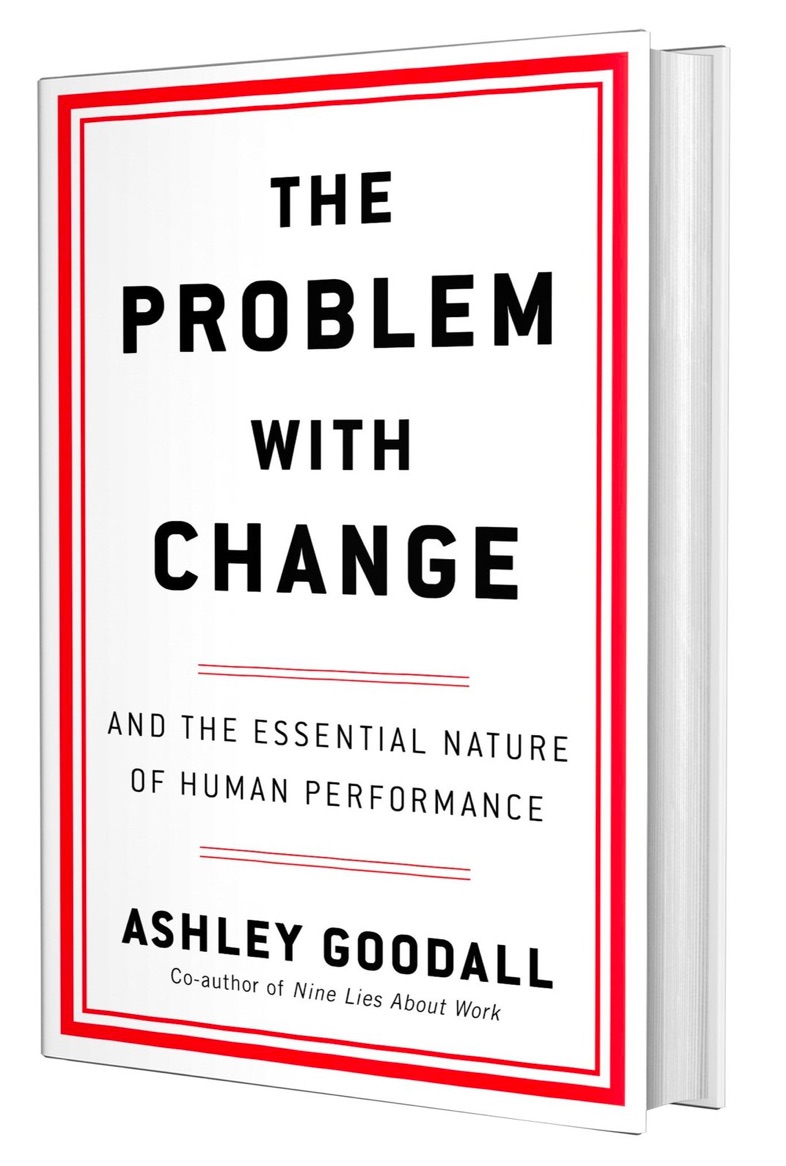
I think the thing I enjoyed most about Ashley Goodall’s The Problem with Change is the author’s cynicism about corporate America. In places it’s a little bit of a diatribe, but what can I say, I love it. I love it all the more that it comes from someone who successfully navigated the Byzantine ladder of advancement that is Corporate America – this is someone who succeeded in the system enough to add extra weight to the deconstruction of why the system itself is nonsense.
The core thesis of the book is that there is too much change for change’s sake, and a lack of evidence that backs that up as driving effectiveness. In fact the opposite. Human flourishing and human productivity are entwined, and the things that make the best conditions for that are themselves quite human.
Make space – don’t control people, create the conditions for effectiveness.
Forge undeniable competence – understand strengths and unique value, and how it delivers value.
Share secrets – belonging is not driven by corporate values statements but by information that is specific and more meaningful.
Be predictable – leaders who are consistently defined by the people multiple levels drive more impact.
Speak real words – remove corporate jargon and buzz words and be clear about what is.
Honor ritual – ritual is a core way to create belonging, and consistently is the most important aspect.
Focus most on teams – teams are the units that drive results (and also the strength of the team is one of the strongest predictor of engagement scores).
Radicalize HR – HR needs to align with employee flourishing rather than business metrics.
Pave the way – look at making the paths people do take easier, rather than defining new paths.
Some things in the list are easier to implement than others; it’s not the most directly actionable book. But it gave me many things to think about, and was worth the time to read.
No team is perfect, but I think it’s often kind of obvious when a team is bad – there’s usually a level of chaos or drama, a sense that they can’t be relied on or don’t really deliver the value that the organization needs. I think it’s also quite obvious when a team is good, mainly from the output of the team, but the underlying operating that goes into that tend to be less obvious.
Practically, most teams are somewhere in the middle. Not terrible, but not as good as they could be either. Here’s my list of what I think makes a good team. If you think I’m missing anything please let me know in the comments or on your preferred social media.
Clarity of purpose – people understand why the team exists.
Defined work streams aligned with purpose – people understand what the team is doing (and why).
Good team communication (openness, psychological safety) – communication is the foundation of collaboration.
Connected, but not cliquey – the biggest predictor of work happiness is having a friend.
Good delivery fundamentals – this is the team delivering its purpose, consistently and over time.
Work gets done and to agreed standards
Delivery is consistent medium term, not just short term sprints + burnout
Mistakes are a source of learning
Team is reliable <> people are reliable
Time is spent on higher value activities (complex tech designs > linting)
Good people fundamentals – the necessary ongoing maintenance work for any team. Without good people fundamentals, management debt gets generated, which over time becomes corrosive.
Everyone has a good manager
Onboarding is predictable
Feedback loops are solid
Under-performers are addressed (up or out)
High performers get developed
Equity (in work allocation, advancement)
Good process fundamentals – like the oil that keeps a team moving, process is the base level organization that facilitates team effectiveness.
All process has a purpose
Easy things are easy
Hard things are possible
Processes are fluid and evolving (continuous improvement mindset)
The above items were the static needs of a team, if a team is going through a period of higher growth there is some additional complexity, such as:
More complex hiring (new roles)
More intense people development (stretch assignments)
Removing bottlenecks before they hit
Updating processes before they break
Balancing risk/reward, (stretch assignments, creative bridging of gaps)
The Stake [Amazon] is the book about the CoActive Leadership program. It’s written in a different way, from the other books from the perspective of the people taking it and the journeys they go on. As a result, it’s more engaging to read and the application and impact more clear.
One of the most important concepts in it is that of the “Leader’s stake”, which means the orientation around which a leader is operating. The stake is not a goal, but goals serve the stake. So a stake is not “to be right” but in software something more like, “we can maximize value whilst working sustainably”.
I read this for a couple of reasons, not least of which is that I am thinking about when and how to take the full Leadership program. The thing I love about CoActive is how the training takes people on a journey. I recently did my first back of the room assisting, and was so interested in how the training addresses what is needed, often without talking about it directly. The Stake unravells how some of that is done, such as the co-leadership concept, and the focus on managing the space rather than individuals.
All in all might be quite a specific book and not suited for everyone, but personally I got what I wanted out of it.
You’re learning coping mechanisms rather than skills
You feel morally conflicted about hiring
Your job is affecting your confidence
Your job is affecting you physically
I stand by this list, I do think this is a solid list of reasons to think about moving on. But three years later, the market is very different and there are two great reason not to quit.
How hard will it be to find another job?
Will that new job actually be any better?
A brief diversion that will make sense – I know I should do more weight training, but I really really love cardio. I keep meaning to do more but… the spin bike is right there, and so tempting. So I put off weight training, again.
I think tech workers in a good market, we often approached career growth that way. We know there are some set of things to do which might help us get what we want where we are, but recruiters are emailing and it’s easier to interview elsewhere instead. This goes particularly for under-indexed people, the latest McKinsey report on Women in the Workplace shows that advancement for women, and particularly women of color, is still moving slowly – and in some cases, regressing.
The current market is like… enforced weight training (or enforced spinning, if you have the opposite inclinations). It sucks, and it hurts, but it can also be an opportunity to expand your skills at maximizing the current situation rather than the skills to seek out a new one.
One of the specific things that I think is hard right now is the constraints we operate in. When organizations say “do more with less” that means individuals have more to do. When inflation goes up but wages stay stagnant, that means individuals – even those who are fine overall – have less discretionary income that can be used to save time, recharge, or invest in learning. When things overall feel risky, we’re more likely to be risk averse. If it was hard to do a side project before, when the market was better, it’s probably even harder when things are more difficult and more precarious.
Three suggestions to DRI your career in a bad market (without quitting):
Take a longer view
Get creative with what can you learn and where can you learn it
Mine “opportunities” for Opportunity
Take a longer view
When you think about career goals, we often think about the external markers – we talk about getting the job title rather than doing the work, about publishing a book rather than writing it, about giving a talk rather than preparing a talk. This is totally fair – this is when the goal is “done” after all. But if you accepted that external markers are particularly hard to come by right now, that all the work you might do might come to nothing – what would you do?
What would you prioritize just because you enjoy it?
What groundwork could you lay for the future?
What would you stop chasing – and where would you put that effort to better use?
In my book, I write about how this job is just a moment in your career. The same is true here – this market is just a moment in the overall arc of your career. Things may not return to where they were, but the way things are won’t last either. Software engineers have valuable skills that will continue to be needed. If you are in the fortunate position to be able to ride out this period, what do you want to be true at the end of it? What can be intrinsically motivating to you? Orient you? Find that, and hold on to it.
Get creative with what can you learn and where can you learn it
Before the pandemic, I used to love going to conferences. I enjoyed meeting people, I appreciated the insights I got, I liked the feeling of having given a talk (not so much everything that went up to that point, let’s gloss over that). I still like to attend the odd event, because I enjoy it, but in terms of professional development, it’s perhaps not the best ROI. Things that have better ROI for both money and time for me personally:
Regular conversations with friends in the industry
Books
Podcasts
More directed / focused learning (paid courses)
Maybe you also had your way of doing professional development, and now it’s more of a struggle to get it paid for or carve out the time, or whatever is holding you back. This doesn’t have to mean no more professional development. What it does mean is that you have to 1) be more clear about what you want to learn and why 2) get creative about how you do that, 3) navigate a possible (likely) lack of organizational support in order to prioritize the things that matter to you.
Yes, it will be harder, and yes it’s easy to be annoyed that your current employer isn’t supportive. But, your career is bigger than your current job, and it makes sense to prioritize accordingly.
Mine “opportunities” for Opportunity
Let’s get real, tech has always loved the trailing promotion, the whole “perform at the next level in order to advance”, and this has always generated bias in terms of the people who are allowed to do that, and those who have a harder time. For many of us, “do this and get promoted” was always kind of a gamble. In this market, you know the odds are even more stacked against you. Why bother?
In this market, there’s less Opportunity, and more “opportunity” – where you get the (additional) work, but not the job title, and certainly not the money. It’s easy – fair – to view this as a con, and not bother. That is certainly a valid option, and at times the correct one.
Sometimes though, the “opportunity” is an opportunity to negotiate, and to think about how to craft it in such a way that it furthers your career goals. This means you need to know what your career goals are. If you’re an IC with aspirations of being a manager that is a hard switch to make currently. But given the option, perhaps you can pick up some additional responsibility, and use it to build your resume in order to be in a stronger position when the market recovers. The trick is to do it in a way that does genuinely build your resume. So in this case, negotiation starts with looking at what is available to take, and crafting a piece of it with a clear narrative that you’re willing to take on. So less “I work as an IC and manage four random people my manager wanted to offload” and more “I run the sub team working on the $component, as a TLM”.
To be clear, I’m not on the side of organizations extracting labour they have not paid for. In my view, you can take the deal as long as it suits you to and you owe the organization nothing. Once you find a situation that will pay you for the work you’re doing, if you get a counter offer, remember you should also be owed back pay.
My bigger point, is that in this market, where down levels are rife, opportunity is scarcer and budgets are frozen, a moral stance might mean less progress for you overall. If that’s the right choice for you, great, but if you can get creative and make progress regardless, you can hopefully turn that progress into money down the line. Remember that job titles are inconsistent to the point of being meaningless, and you’re not obligated to reveal your salary when interviewing for your next job – I strive not to give advice but definitely don’t reveal your salary if you have reason to believe you’ve been underpaid.
Even in this market, some of us should still be very actively looking to move on. Remember the sunk cost fallacy – in good times when you can get what you want (title, money) elsewhere, but in bad times it feels more risky to give up “progress” – even if that progress is not rewarded. The meta point of all of these ideas is to figure out if you can make progress – even if it’s not recognized. If you can’t, then figuring out how to get yourself to a situation where you can make progress is job number one.
Coming back to external markers, these things are like the milestones by the side of the road. Occuring periodically, some places more frequently that others. The current market might be lighter on the milestones, but that doesn’t mean that you personally are making less progress. However in the absence of external validation, you need to maintain your own measures, and rely more on intrinsic motivation. This may be a bit harder, but that’s okay. You can do this. I believe in you.
As the year wraps up I spent some time thinking about how it went, and what I’m hoping for in 2025.
Personal
My word for 2024 was connection – a correction from a multi year pandemic that flowed neatly into [living under a rock] writing a book. I wanted to prioritize being a better friend, and rebuild my sense of community locally. As a guiding principle throughout the year, this was so helpful, and I feel dramatically better about this aspect of my life than I did a year ago. I’m looking forward to more connection in 2025.
This was also the year that we finally finished the multi year building project of renovating the attic. It’s been a bit of an ordeal for a number of reasons that I won’t get into, but super happy to have the house the way we want it with an extra bedroom and bathroom, and moving things around such that we can each have an office.
Adventures
A wedding in Sydney, where I got to see many old friends from when I lived there. A brief but fantastic layover in Hong Kong. 10 incredible days in Bali.
A weekend in London for my birthday, we saw the Sister Act musical (amazing), the Cruel Intentions musical (pure nostalgia), caught up with friends, and saw some fantastic exhibitions at the V&A and the Tate.
A weekend at Castlemartyr for the art show (beautiful).
A trip to the Inchydoney spa (2023’s birthday present from my parents).
Another weekend in London, this time to see Nils Frahm (and also many friends).
A brief overnight trip to Glengarrif for a friend’s birthday, we took in Garinish island and the ever weird, ever wonderful, Ewe Experience.
A week with my parents visiting Killarney (the Muckross hotel, right in my favorite part of the national park) and returning to the beautiful Liss Ard estate.
Another wedding, this time in Dehradun, India, with a few days in Chandigarh (to see the incredible Nek Chand’s stunning rock garden) and an all too brief but fantastic stop in Delhi, where we saw Humayun’s tomb and did some important shopping for Hamper Season.
One night at the Cliff House in Ardmore for Bas’ birthday. Absolutely gorgeous.
A weekend in Dublin for the ballet and to see friends.
Professional
2024 will always be the year my book came out, in print in April, and as an audio book in November – a product of years of work. Aside from locking myself away [at Castlemartyr] for a brutal week of edits in January, and having to read it 2-3 more times during proofs, most of the work was done and I got to think about what comes next. Still no answers there but I’m trying to give myself time!
I didn’t do a great job at promoting the book, but I did do a number of podcasts, a book signing at LeadDev, and a talk at Leading Eng. I have some more things planned for next year already, so that’s exciting.
This year I also took on another advisory role with Twill. I’m really excited about this, because I find the product compelling – currently hiring feels a bit like candidate and hiring manager AIs talking to each other, and it’s tough to separate the signal from the noise – making for a bad experience on both sides. Twill cuts through that directly to well qualified, vetted candidates. I also just genuinely love advisory work, and am super happy to have another opportunity to do it.
For my own professional development, I took the Co-Active Leadership Workshop – which was really great and I want to try and figure out the time and money for the full program. I also did my first back of the room assisting for Fundamentals, which was interesting. I’m fascinated by the Co-Active facilitation model, and the idea of experiential learning.
I passed the four year mark at DuckDuckGo, which was interesting – in previous jobs this was the time at which I decided to move on. I thought about it, of course, partly because I think it’s healthy to think about this every year, and partly because passing the 4 year milestone for the first time invited deeper thought. Ultimately though, I decided to stay put because 1) I’m working on something huge and interesting, 2) I’m enjoying being with a team I’ve built up and the work of good-to-great, and 3) this market is terrible, why subject myself to it unnecessarily.
2025?
I’m not a big planner and I don’t make New Year’s resolutions. I do like the act of setting a word and an intention. For 2025, I picked “health”.
First and most obviously, this is about prioritizing physical health. 2024 was a bit up and down here, and I would like to be more consistent.
Secondly, I think there’s a broader meaning here – about healthy behaviours and patterns. I’ve been thinking a lot about garbage in garbage out for the mind – this stage of capitalism is so intent on making us consumers of low value content, and I know I personally need better quality inputs there to have better quality thinking myself.
As always, the word starts as an intention and my experience with it will no doubt evolve over the course of the year. I’m looking forward to seeing where this one goes!
Thanks as always for following along; wishing you a wonderful 2025.
I had a chat with Sergio Visinoni who recently wrote this lovely review of my book, to talk about writing as a habit, the challenges of leadership, and what’s driving OSS drama. You can read it here.
My coach recommended The Outward Mindset, from the Arbginger institute, same as Leadership and Self Deception (one of my all time most impactful books) and The Anatomy of Peace. It feels in many ways a continuation of those ideas, but more team/business oriented.
The first part of the book focuses on the impact of mindset, and how you can focus on changing behavior, or you can focus on changing mindset and let behavior change follow from it. I really liked this way of expressing something that I’ve really found to be true.
The outward mindset is about how when teams and businesses that think about the perspective of the teams they work with before their own perspective, can be more impactful and effective. When you have an inward mindset, you’re thinking about what you want to get out of things. When you have an outward mindset, you’re thinking about what others need and focusing on that.
One example was that of a debt collection agency, who instead of hounding people for debt started focusing on helping those people make more money.
Another example was of a non profit building wells, who identified that the real success metric was how many days children were in school. They took a more expansive view of what they were doing, and it shifted their approach.
There’s a shift in mindset in both of those from “what is my job” to “what is the real outcome I’m trying to drive”, which is pretty fascinating.
I’ve been thinking about concept a lot in terms of the challenges of building a first team mindset. When people have a perspective of competition, they tend to be inward focused. Having a first team mindset is having an outward mindset with your peers; focusing on being a good team mate rather than being a good competitor.
As with other Arbinger books, I totally see that it’s a really powerful concept when it’s shared, and a really challenging concept to hold up when it’s not. I’ll be thinking about this one for a while.