Tag: time

  • The “Not Doing” List

    The “Not Doing” List

    Periodically, I like to step back and think about the things that I’m not doing.

    I’m not talking about the things that are on my list, but that I haven’t done yet, or the things that I’m actively choosing not to do.

    I’m talking about the things that I didn’t have time to think about. I ask myself questions like:

    • What would I do, if I was free of $responsibility?
    • What would I do, if $area was a priority?
    • If I had a clone, what would I ask them to do?
    • What would I do if I were more inclined to enforce things?
    • What would I do if I was more inclined to be democratic?
    • What would I do, if I knew I was going to leave in 6 months?
    • What would I do, if I was optimizing for a year from now?
    • … two years from now?

    Often this exercise results in things that I’m definitely not going to do. That’s okay, at least I know what they are. But sometimes it opens up my thinking in useful ways.

    Try it! And if you want to, let me know how you get on.

  • Book: Off the Clock

    Book: Off the Clock

    In my current round of “argh what has this pandemic done to my life” I have been thinking a lot about time. Feeling too scheduled – at work, and outside of work needing to schedule every little thing (ok, mainly the gym) was really getting to me. I came across another book from Laura Vanderkam – whose 168 Hours I read ages ago and loved, and it seemed like exactly what I was looking for. The book is Off the Clock: Feel Less Busy Whilst Getting More Done (Amazon).

    It’s a book about feeling like you have more time, and outlines 7 strategies to help.

    1. Tend your garden. Think critically about how you spend your time and iterate on it. There are some helpful prompts for this, which I’ve started doing and appreciating.

    2. Make life memorable. Mix things up and do something different.

    3. Don’t fill time. Get rid of things that don’t add value, think about how to streamline things you do frequently.

    4. Linger. Savor the moment and enjoy it.

    5. Invest in your Happiness. Think about how to spend more time doing things you enjoy. Give yourself more treats.

    6. Let it go. Where can you lower your standards? Make something easier to make it a more tractable habit to build (e.g. exercise, writing).

    7. People are a good use of time. Investing in relationships and supporting activities.

    This list was revelatory to me in terms of how I’m struggling with time now in a way that I didn’t before the pandemic – and it goes way beyond feeling over scheduled. The monotony of life (even as I’ve been working to break things up lately and introduce novelty), the social isolation, the time constraints that kill lingering whether it’s in the hot tub after a nice swim or over brunch.

    But perhaps more than anything the lack of reflection on how I spend my time, that used to happen as part of every WTHIC. Each time I left – which was frequently – I would think about how I had spent my time and write something about it.

    Some changes I’ve made as a result:

    • Weekly plan under the categories of: career, relationships, self.
    • Daily reflection on how I’ve spend my time.
    • Prioritizing the “non standard” thing each day (last week: swimming, floatation, movie night, physio, massage, haircut, new brunch place).
    • Color coding my work calendar and putting a “DNS” block over lunchtime in a different color.
    • Seeking out opportunities to “linger” instead of rush.

    I really loved this book and thoroughly recommend it. I think almost anyone would get something out of reading it, but if, like me, you feel like the last 18 months has blurred into a series of endless zoom meetings… try it. It might give you a whole other perspective.

  • Start a Project. Kill a Project.

    Start a Project. Kill a Project.

    The Last Postcards (sent from Paris, Jan 3 2015)
    The Last Postcards (sent from Paris, Jan 3 2015)

    I have been enjoying everyone’s year in review posts, and reading what they hope to achieve over the next year. I love the enthusiasm and the new projects starting, but one thing I love even more is when I see people defining what they will do less of in 2016.

    For myself, I set my self a limit of 6 talks in 2016. This is a big constraint (in 2015 I gave 6 – different – talks in September alone). I’m also working to shed various things, most notably admin work (I will write more about how my word for 2016 is “scale”).

    Because the thing is, what you don’t do, is maybe more important than what you do do. When we say no to things, we create space. Then it’s up to us what we do with it.

    Like many people, I started the year with a new project. Well, instead I called it a challenge – it’s to send a digital postcard from every place I leave in 2016. I called it, since people ask me this a lot, Where the Hell is Cate?

    This came from the fact that I have realised that I only really stay in touch with people I communicate with on Twitter or IM. I don’t really use Facebook, and I am exceptionally bad at email. Sometimes I exchange emails with friends who are like “tell me everything” and I don’t even know how to respond… I mean I tweeted about it all, right? I don’t want to rehash it again. Every so often I send an email and include some longer form rambling about travel, or life. Things that aren’t particularly personal, but that I wouldn’t put on the public web.

    So: I decided that I could accept email as an outward bound form of communication, registered a domain, and started working on the first one (which I sent out yesterday from CDG airport). Basically I have taken everything I know about sustainable projects and applied it here. It may still fail, but at least should it fail it will fail in a new way that I cannot predict.

    1. Low bar. I firmly believe that most things fail because we set the bar for success too high. Whilst yesterday I sent out a lengthy essay talking about loneliness, languages, and commenting on the history of luggage, the bar is a picture and a favourite thing. I can put that together in 15 minutes at the airport as I wait for a flight. It feels very possible.

    2. Specific Trigger. I believe in a schedule. I operate my blog on a schedule. We run Technically Speaking on a schedule. If something is “optional”, it needs to have a specific trigger to happen because otherwise the constraint is “ready” and then it becomes very easy to overthink and delay. I usually use time as the trigger, but for this project the trigger is leaving. It’s the airport.

    3. Something Must End. At this point anything coming into my life means that something must leave it. When I contemplate a project I ask myself “what will I give up to do this project?” and if the answer is “nothing” then that is a sign that project should not happen. I shed a bunch of things to start my job, so projects that remain are ones that I really, deeply love. It is very hard for me to make space for a new project. For WTHIC, I am giving up two things: 1) the rambly emails periodically sent to friends, 2) sending postcards.

    One of the interesting and challenging things for me is the idea of creating something transient and ephemeral. I am very into the Documentation of Achievements, and rather than have the same conversation multiple times, I write things up in blog posts and then I can just share them. (Sometimes, when I write sentences like this, I am amazed I have any friends, let alone many). But one thing about transient and ephemeral is that is affords a greater level of privacy and a lower expectation of judgement than the forever web. A postcard is just a point in time. A blogpost is much closer to forever, or forever in digital terms, at least.

    Why Kill Postcards?

    I started sending postcards when I left Australia. It started as a controlled way to stay “in touch”, if you can call it that, with my favourite ex boyfriend. Leaving Australia also meant leaving him, and that broke my heart. Even though it was the right thing to do. Even though he and I were never going to figure it out. I started sending him postcards, from my adventures, as a way to let him know that I still thought about him, and still missed him, but not in a way that we actually had to… have a conversation.

    Over time, I started adding in other people to send postcards to, particularly friends who I knew were having a rough time. And sometimes I would tweet, and send a postcard to anyone who wanted one. This has been a surprisingly time-consuming activity. Sending 5 postcards from Paris yesterday took ~45 minutes (and where to find stamps had been on my mind for days). Sending 24 postcards (and 2 packages) from Easter Island took – I am not kidding – at least 3 hours. I spent 1-2 hours mailing postcards and failing to mail those packages from Santiago. I spent at least 2 hours writing and mailing things in Croatia.

    I was really happy to share a bit of my adventures with people, and really happy so many people wanted postcards! But this project was a prime one for killing for a few reasons:

    • I’m heading to Colombia, a place where there is basically no postal service (I bought postcards when I was there in April, and ended up mailing them from Santiago).
    • I get very little feedback from people who receive them. What was a feature of sending things to the ex – a communication medium outside, no need to respond – is a bug when it comes to sending them to other people. I asked a friend recently if he got the postcard I sent and he said, “yes I took a picture of it!” (He did not Social Media the picture, so does it really exist at all?)
    • It’s superficial. I write at most 1-2 personalised sentences per postcard, but usually just “hi from <LOCATION>. I pick cards that I think may speak to people, but usually it’s quite generic. I think people liked postcards because it connected them to my bizarre nomadic life, but did it really? It’s just a physical object transported from one place to another. It does not convey anything more than “I was here”.

    Onwards

    Start a project. Kill a project. Postcards are dead. For 2016, if you want to know about my nomadic life, let me send you letters from airports: Where the Hell is Cate.

    And if you are here for the musings about sustainability of projects and don’t care where I am, I leave you with the thought: things only exist if there is space for them. What space do the projects in your life need, and how do you plan to create it?

  • Space and Time

    Space and Time

    danbo buried in sand
    Credit: Wikimedia

    The list of things I’ve learned this year is pretty long, but one thing I keep coming back to is: if you want something different, you have to create space for it.

    And so I have tried to deliberately create it (with mixed results) but above all be mindful about what (and who) I let in, and what commitments I take on.

    It’s easy to say no to “bad” things. But it’s hard to say no to things that are good-but-not-great. I’ve been trying to celebrate saying no, create a reward cycle there.

    Last week I had cause to consider what I’ve been doing since leaving tech. I was on a podcast, and it’s one of the things we talked about, I hung out with a friend who just embraced funemployment, and I was thinking about what is next for me.

    Perhaps this is a long-winded way to say, I’ve completely come around to something I never thought would be me – leaving the old thing, without knowing what’s next.

    Because if you have a job that uses up most of your emotional energy, how do you figure out what’s next whilst doing it?

    And time. One thing I’ve observed over the course of a year is that the reasons I left, different ones have loomed larger at different times. The things that were most stressful to me in the last weeks disappeared pretty quickly. When a number of women left and talked about why, those reasons loomed larger. Really they were all a product of one reason: it was time.

    But it took time to figure out what should be next. What’s petty and what’s fundamental. What I want to do. What I care about.

    A year ago I would have made different decisions than I made last week. And this is always going to be true, hopefully. Because you learn and you develop and different things seem possible. But also we make different decisions from a place of panic and fear than we do from a centred calm. We make different decisions when we focus on our strengths than when our confidence has been eroded away.

    As a driven over-achiever type person, the idea that I might “opt out”, give myself space and time was a terrifying one. But nothing I have ever done has been so revelatory, or worthwhile.

  • On Not

    On Not

    pencils
    Credit: Pixabay / Bolette

    I realised something earlier this year: if you want something different, you have to create space for it.

    Something different requires time, creativity, serendipity. If there’s no space, you never find the new thing, because you’re so busy going from A to B you don’t have time to see it, even if you were looking for it, which anyway, you never have time to do.

    Giving myself this year was actually giving myself space. I know I wanted something different, and that I wasn’t sure what it looked like… so here I am with space to explore what that might be.

    So I thought, OK, take a break from writing a blog, and see what happens in that space! I thought I would feel more creative, maybe focus on some bigger projects, build up a backlog.

    I was wrong.

    I had a lot on in June. Maybe blogging doesn’t take up much time, maybe I just used that time badly, but I didn’t find that there was a resulting space which I could use to explore. I just… didn’t hit publish… didn’t write anything to hit publish on, didn’t think of much that I would write if I was going to sit down to do so.

    And oh well, failed experiment. And now I come back to trying to write and I feel so blah so uninspired. And I realised that I didn’t just fail at creating space I actually gave up space – filled with other people’s priorities (and, honestly, West Wing), space that I had already carved out – where I do something where each individual act has an impact so small to seem pointless, where the value lies in the habit, the act of carving out time to do something for me that has no clear ROI, no plan, just because I want to.

    Anyway. If you want something different, you need to create space for it. But creating space is much harder than I thought.

  • The Myth of the Intersection of Creativity, Energy, and Time

    The Myth of the Intersection of Creativity, Energy, and Time

    intersection - Plain

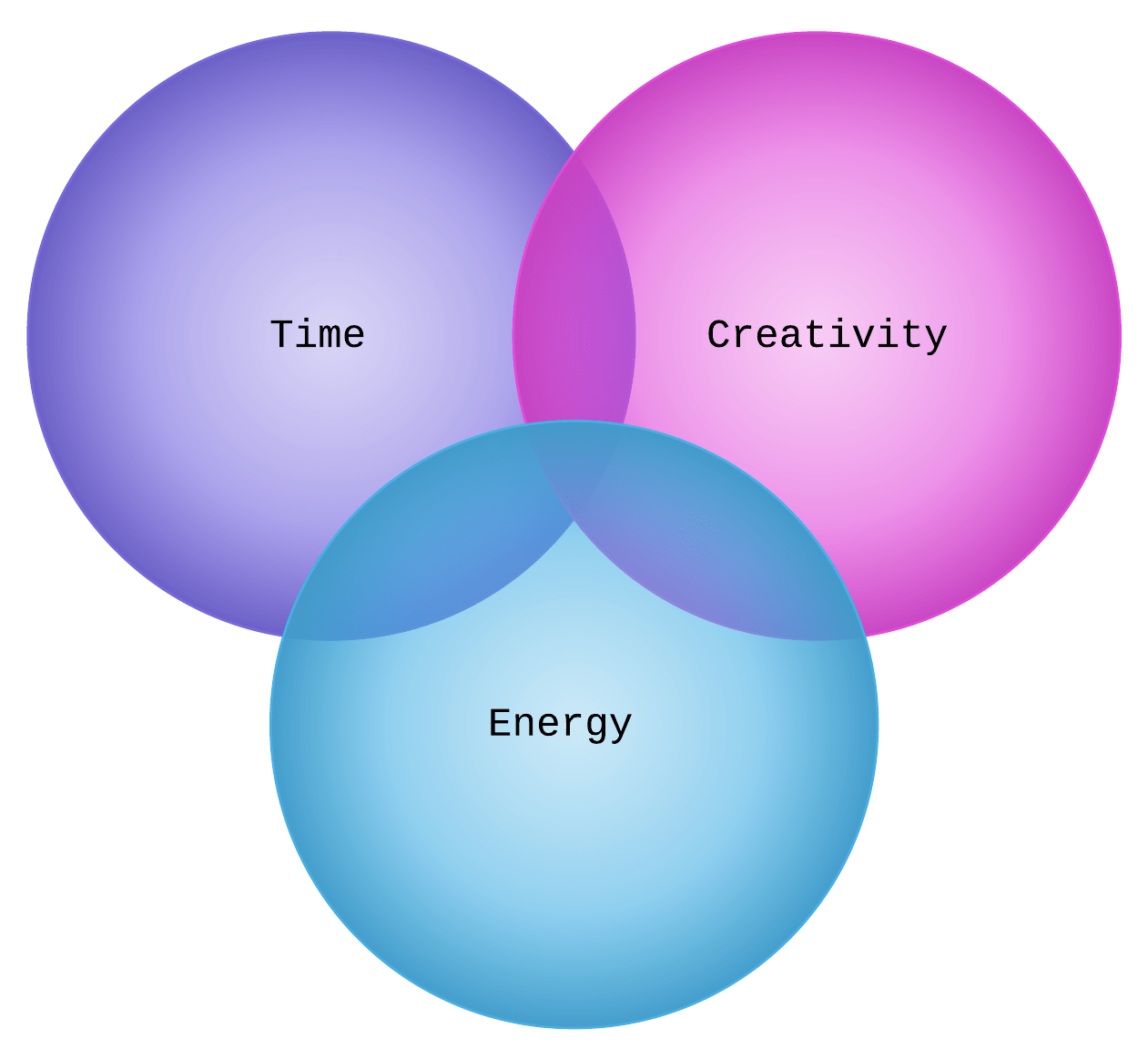
    There’s a common myth that makes side projects close to impossible. It’s thinking that side projects can only happen at the intersection of energycreativity, and time.

    That’s a pretty high bar. That intersection doesn’t come around all that often. For me, it’s usually about day 3 of a 3 day weekend.

    The UK has 8 public holiday days a year… so that’s 8 days a year. Max.

    Say half of these work out, and on each you get 6 hours of solid work done. That’s a whopping… 24 hours a year.

    Don’t get me wrong. These may well be the best 24 hours of the year. But, we have 168 hours every week. What if we could carve out 4 of them, every week?

    Our side projects might start to move a lot faster… or at all.

    Creativity

    This comes down to: pick one thing.

    If you have too few ideas, well, you only need one.

    If you have too many, how do you pick?

    Too Few

    • Jam with a friend!
    • Solve a problem you face yourself.
    • Answer a question: “Is it possible to…?”
    • A university project you wanted to extend?
    • Some feature of a platform you want to explore? (e.g. as an iOS dev I was keen to make something on Android that took advantage of intents).

    Seek our creativity:

    • Solo travel! (my fave)
    • Art galleries (an art gallery in Hong Kong encouraged me to start coding on a side project I’d had in mind for a long time).
    • Science museums.
    • Go somewhere to think: take a long walk, or go swimming (I solve so many problems and have so many ideas in the swimming pool).

    Too Many

    • What is the closest to done? Finish things first.
    • What can you build on later (i.e. projects that will teach you things to know in other, more complicated projects).
    • What has fewer dependencies (e.g. your collaborator has gone AWOL).
    • What will be most useful to learn.
    • What is the best break from your day to day?

    Energy

    Our energy is often sapped by work, especially when our work is not rewarding. We need side projects most when we are close to burn out, but that is often when we have the least energy. Days are often long in the tech industry, and work travel derails personal schedules and habits.

    Remember: Energy is renewable.

    Some ways to renew your energy:

    • Remind yourself what you love.
    • Disconnect from the office over the year (focusing on something else is the best distraction).
    • Small wins create bigger wins.
    • Aim for the next minimum shippable improvement.
    • There’s no need to be secretive.

    Where do You Draw Energy From?

    At one point, I was going home in tears several days a week. There were a lot of things wrong with my job at the time but here were the big two: 1) not shipping (for reasons outside of my control), and 2) not feeling appreciated.

    By focusing on side projects where had control of the feature set, and the priorities, and all of it, I could decide when to ship. And of course it was a much lower bar, it was “here’s something interesting”, not “here is a new product!”.

    And when I started to put things that I was making, and writing, out into the world, people started to notice, and say nice things to me, and about my work, and I started to get the appreciation that I needed, and feel like I was doing things that were worthwhile.

    When I’ve thought that what I did all day at work was meaningless, creating things that people found useful redressed this balance. And even if I came home in tears, it helped me get up and do it again the following morning. And over time, it helped me gain the confidence to go and find a better place to be. And when I’ve felt like I don’t have much to say about my day-to-day, I have a story to tell about my side projects, and things that I’ve learned, and what I’ve built.

    Time

    Giving up TV

    Everyone is short on time, and the standard advice is “cut out TV”.

    I don’t think this is helpful advice, I think people watch TV because they are too tired to decide what else to do. Because it’s nice to escape. After a long day a great TV series is a way to absorb yourself in someone else’s life, and forget about the things you should be addressing in your own.

    Personally my rule is, TV is OK, but not just TV. I watch most of my TV in the gym, it’s a great way to get enough cardio. Especially with dramas, like Covert Affairs. She’s running… I’m running… there’s shooting.. faster faster!

    Or whilst writing unit tests. I decide what they should be, then fill in the mindless boilerplate (Java has a lot of mindless boilerplate) whilst Keeping Up With the Kardashians plays in the background.

    Because no side project is 100% fun, although I understand my comprehensive unit testing strategy is somewhat aberrational. There will always be some dull, or less demanding tasks. Like setting up your environment, or downloading bits and pieces.

    So “I’m tired, I’m just going to watch some TV” can become “I’m tired, I’m just going to watch some TV and do some [task requiring less concentration]”. And somehow, I’ve caught up with the Kardashians and also made some progress.

    Even if it wasn’t amazing progress, even if it took twice as long because what is she wearing? Progress is progress.

    That One Hour Before Work

    The other advice is to find an hour before work. Definitely regardless of whether it is exercise or a side project, there’s something very powerful of knowing that whatever happens over the course of the rest of the day I have already done something that is just for me.

    However decisions in the morning are really hard. That’s why if you want to work out you’re supposed to pack your gym back the night before. But then you get advice like “write for an hour in the morning” and the first time I tried this I woke up and drew a blank, “write what?”

    Luckily I keep a very detailed task list, which includes blog posts I mean to write. So I just looked at what was at the top of the list, and wrote it. Draft over, I went to work. Then later I edited it and scheduled it.

    I live under the continual delusion that Future-Cate is going to be super-human, and I’m continually proven wrong. I’ve learned that Future-Cate in the morning is going to be a mindless zombie, so if I want her to crank out some of the stuff on my endless todo list, I need to make it really, really easy for her.

    Because future me, past me, and me as I write this, we’re all the same. We all find starting to be the hardest part. And yet in the throes of creativity, I never remember that. I think “what an amazing idea” as I pace up and down the swimming pool. I’m convinced that I will have it fully articulated within 30 minutes of walking in my front door.

    But actually by then I’m asleep and I forgot to hang my swimsuit out to dry, as well.

    You can do a lot with one hour, as long as none of it is spent wondering what to do, or looking for inspiration. Make your creative self put their brilliant ideas on a detailed task list, and your zombie self can probably knock one out before 8am.

    There is No You in Team

    I love being a software engineer. I love making things, big things, as part of a team. I love working with designers, because I appreciate great aesthetics but can’t create them, and I love working with good product managers, who care deeply about and take the time to deeply understand the user so I can trust their judgement and focus on building, coding, testing.

    But my side projects, they are all about me. What I want to make, what I want to learn, what I’m inspired by.

    And so amid decisions I don’t agree with, be they product or engineering, when some guy shoves me out the way to get what he wants, my side projects are this space on the internet, on my computer that is all mine.

    Everything else, it’s just a technique for making progress, and these work! Try them! But really your side project starts in the place where you decide that you want to carve something out that is all for you.

    It might grow, or it might fail. But it’s yours.

    Failing

    I had this idea for a side project, I was sure it was brilliant. Back in 2011. I wanted to be able to visualize a series of photos. I found the perfect layout (the sunflower layout) and then… did nothing with it. Later I returned to it and discovered that extracting the dominant color in an image was much more complicated than I had thought. I learned about different color spaces, the difference between HSB and RBG, and ended making my own image filters. Turned out, the original idea sucked. For starters, it takes forever to run. Secondly, it just doesn’t look as compelling as I thought it would! But making my own image filters became the main project, and later a book chapter.

    In so many ways, this project was a failure. Firstly, it’s kinda ugly. Second, it took nearly 3 years.

    But in other ways, it was a huge success. I applied some stuff that I’d had no need to apply before (the way images are just an array of pixels), and learned things about colour that I hadn’t previously known. And it was a great topic for a book chapter, and of course I’d had that common goal about seeing my name in print.

    It started, on one of those amazing 8 days of the year (although I lived in Ontario, Canada then, so technically it was 9). And really, it was a super fun day. But it ended up where it is because I found ways to carve out some time out of every week, every 168 hours, for the things I wanted to build, and that I wanted to write.

    4 hours a week will get you further than you think.

  • Time Blocking

    Time Blocking

    Dali's Clock

    The thing about knowing more about what you’re doing, is that more people want to talk to you about it, and you have less and less time to actually… do it.

    And so people block their calendars with “Do not Schedule” and “Make Time!” and presumably try to be diligent about actually enforcing this. But it’s hard. And when my schedule gets crazy and I contemplate doing this, the thing I come back to is – I want the make time to be the default, that other things eat in to. I want the assumption to be that all my “open” time is make time, and when I have time here or there I work on that not on… email.

    (I still hate email)

    I had a very engineer meeting recently. The guy didn’t block off my calendar, and didn’t book a meeting room, but sent a note saying “I can’t change this event so we’ll just do this”. I’d rushed from thing to thing most of the day, so nearly forgot, and was a couple of minutes late. But it was refreshing, and reminded me I used to be like that. Where a meeting was really just a chat with another engineer, and there was no need to schedule it because my calendar was open enough to remember it, and who needs a meeting room anyway? We’ll find somewhere to get together. Whatevs.

    For a year now I’ve been refusing meetings which could be done over lunch (e.g with people wanting to pick my brain on diversity stuff although moving made it easy to cut back on that kind of stuff), but it’s not the solution to my current problem. I absolutely refuse to put “make time” on my calendar. I refuse to get to the point that it’s not the default – all time is make time, unless something specifies otherwise.

    But what about going the other way? Blocking off time to handle non-making, whether it’s meetings, or writing design docs, or planning.

    I’ve been working on that instead, and it’s sometimes challenging – there can be non-technical emergencies that pull me back. But I’ve found it’s a helpful way to stop the constant pull of “oh I’ll just do X and my head will be clear to code”. I can proxy it by writing it down, and saying, “I’m dealing with this on Tuesday when I’ve blocked out time for a bunch of such tasks”. Working across timezones actually helps, so meetings get blocked into overlapping work time.

    The downside, is I’m back to needing a todo list – which I’d pretty much eliminated previously (notes in bug trackers and CLs sufficed).

    Anyway, so far my semi-promising strategy for keeping on top of non-technical things, whilst retaining make time as the default. How do you balance?

  • Experiment: No Novel November

    Experiment: No Novel November

    Baby penguin
    Credit: flickr / Joe Branco

    There was a period, thankfully a brief one, when I was spending $100 a week on Kindle Books. I know, shocking. I was reading them too, mostly novels.

    I’ve since started tracking my expenditure on books more – limiting myself to a $100 a month budget, which was helping me not purchase quite so many non-fiction books. I’d previously been buying them at about 2x the rate I was reading them, which after 3 years had added up to a 10-20 book backlog. This made me a bit more mindful, and I started using my wish list more, and only buying those non-fiction books I had an immediate need to read. This was also encouraging me to re-read novels I’d loved. It’s better to re-read a good book, than read a terrible new book.

    And then I took some time off, went to Bali (where I had a pretty poor internet connection) and read… erm.. about 15 novels. In 10 days. And started having these weird ideas about moving to the countryside. I’d also spent so much time and energy consuming other people’s work, that I completely lacked creativity to create my own. And finally, I didn’t want to look back at my precious time off and say, well what did I do? I read a bunch of novels.

    So with some encouragement from a friend (reaction: “You think about moving to the countryside? You ARE reading too many novels”) I decided to – quietly – ban myself from reading novels for the month. In the end, because I started on Australian time, I finished when November ended in Australia, not 11 hours later in Europe.

    And it was not as hard as I thought it would be, despite the number of flights (including some long haul, and a lengthy wait in Bangkok) – easier I think because I had overdosed on novels already, and I was relaxed, and didn’t have as much need for my usual methods of “relaxing” – one of which is ingesting novels, whole. Often 2-3 over a weekend.

    I watched a little more TV on my iPad, mostly on planes, but not that much more. I actually bought two magazines, which I really enjoyed and required less sneakiness during take-off and landing, although I think reading too many magazines has it’s own set of problems. I think I probably read slightly more online.

    I did start to feel more creative, and I wrote a lot. And I read a lot of non-fiction, about 8 books over the course of the month. This made a significant dent in my backlog of non-fiction!

    Overall, I found it really helpful. I would definitely do it again, although a couple of days before the end of the month I got excited and pre-emptively bought 7 new novels to read in December, so there was no danger of the experiment being extended!

    Sometimes it’s easier to have a blanket ban than try and moderate. So if there’s something that is distracting and being done to excess, maybe a month off is the answer. It’s at most 31 days, so how bad can it be?

  • 3 Things I Learned on my Burnout Break

    3 Things I Learned on my Burnout Break

    Piedras de primavera, spring stones
    Credit: flickr / Vicente Villamón

    I can live with less internet.

    Note – this is no no internet (although I survived my 6 days in NK), but less. Most of the time when traveling I’ve had some connection, but there has usually been a limit. Maybe it’s not on my primary (favorite) phone, or it’s really slow/intermittent (Bali! Portugal), or I have 15mb limit (Europe, O2 roaming data is 1.99 GBP for 15MB daily).

    It’s annoying, but I just drafted blog posts in the notes in the notes app instead. This was actually helpful, as I would not do any research or fact-checking as I went along (can be distracting) but later. As a result, I think I wrote more, and faster unplugged. It did put me off coding things though, knowing that I wouldn’t be able to look anything up or download anything. The other major annoyance is that most of the time over October and November, I have been unable to watch video – not great, but not the end of the world, either.

    I take for granted a constant and fast connection, and yes sometimes I don’t have it, but this is the longest period in a while where I’ve been internet deprived in some sense. It’s a helpful reminder, as an engineer, how important it is that the things we build function with poor, intermittent, or no internet. Twitter’s addition of photos to the stream annoys me for this reason. When I’m limited to 15MB, an image-heavy webpage will significantly deplete my internet reserves. Engineers could do a better job, in general, of handling this.
    The worst part of this was that sometimes “just this one thing” on the internet would take an hour or more. Because I often deal with poor internet by opening MOAR tabs… I don’t know why I do this. It is basically the opposite of what I should be doing if I really want to just do that one thing and go to sleep.

    Relaxing is not the same as Being Relaxed.

    This idea has it’s own blogpost, but essentially – once I had chilled out, I didn’t need the things I normally do to “relax”. I survived No-Novel November, for example.

    The things that made me want a break, were not the same as what made me afraid to go back.

    Obviously, no-one takes an extended break and moves to another country because they are completely happy with how things are.

    If you’d asked me what I was needing a break from at the end of September, and what I was worrying about going back a week ago, I would have given you a different set of things. And then, what actually made me excited to go back was something else again.

    I guess we don’t always know exactly why we need a break, and it can take time to process the things that are the most stressful – especially those things that we try so very hard to tell ourselves are fine. But I think it’s helpful to honor the feeling of needing one. I’ll do this again, should the need or occasion arise. And I understand better now, my friend who when I asked her how she had survived and got so far in this industry, told me she had burnt out and taken a break multiple times. I’m so grateful to her for admitting that, and making me feel that I could make the same call.