This week my supervisor, two of my office mates (Amir and Payam) and I have been working hard putting together a presentation we’ve recorded for a conference in Algeria on Sunday.
I laid out the slides in Keynote, using my color scheme (luckily the others were OK with the pink). We’ve been impressed with how easy it has been to record in Keynote, although I think due to the number of takes there are some glitches where the audio doesn’t quite match with the slides.
It’s taken longer than expected – I think we all got quite perfectionist, and when checking it the playback always started from the beginning – meaning with each additional person it took longer to check everything was working OK! Also – I hate listening to myself present. I say “So…” at the start of every slide!
The slides are available on slideshare (I’ve embedded it below). You may notice that my section is very similar to the presentation I prepared the other week, although I’ve had to add some text to the slides. You can also download the QuickTime movie here (it’s Benyoucef.mov and note – the first section is in French) my section starts at around 32:30.
I’ve created my slides for my presentation (abstract) following a Presentation Zen (Amazon) approach. So there are basically no words on any of my slides. I’m going to lay them out one by one, with narration. Let me know what you think!
Title Slide
I’ve gone for a blank template. I wonder if this is too plain and could use some background color? Let me know what you think. The color of the lettering matches the color scheme for my soon-to-be-launched website.
This is where I introduce myself and what I’m talking about. I don’t really like this bit of presenting, so I’ll keep it brief.
The World Wide Web
Image from iStockPhoto
I’m going to start off by talking about the “World Wide Web” and trying to provoke a bit of thought about it. It’s relatively recent, and yet it’s game changing. How many of us could live without it? I certainly couldn’t. Whilst the internet has been around since the 1960’s, the web as we know it (with hyper-linked web pages) has only been around since 1989. But within 20 years we’ve got to the point where the web is basically infrastructure…
… like electricity. For more on how I think the internet is just infrastructure like electricity, running water, or roads, see this post.
Clay Shirky – Why I Ignore 5 Year Plans
Clay Shirky – giving us some needed perspective. I think when we reflect on what’s changed, and how recent it is, we realize that this is really just the start of it. I remember life-before-Facebook but I can’t imagine living without it, even though I’m not always sure that the level connectivity it gives us is a good thing (for more on my mixed feelings about Facebook, read this post).
Near-Universal Authorship
A couple of hundred years ago, all the information your average person had came from the Bible, if they could even read. Now, not only are rates of literacy very high but the internet gives everyone the ability to be a publisher of content too. There’s a fascinating article on this here.
How Web 2.0 is Changing the Way we Comminicate
I put this graphic up in this post. What I want to show here is that there’s a shift to newer technologies and that it’s a process. This diagram captures what I’m thinking and finding now, but no doubt in a year it will be different. Also important, is how many arrows are going into Twitter – it’s simplicity and flexibility mean that it’s a great way to do a whole variety of things. There’s definitely stuff that’s missing from the diagram – the thing is to balance what’s important with trying to include everything and making it impossible to follow.
Serendipitous Connections
Image from iStockPhoto
Something that isn’t represented in the previous diagram though, is the possibility of serendipitous connections. By lowering the bar to communication, and through ambient awareness we can have more “weak-tie” relationships. Think about how many people you’ve lost touch with but found (or had find you) on Facebook, or the number of people you “follow” on Twitter but have never met.
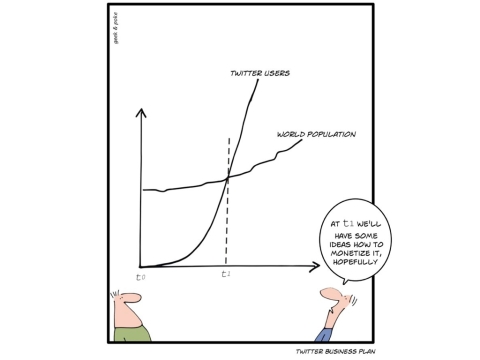
I don’t think Twitter is a Pointless Waste of Time, but a lot of people do. If you do think Twitter’s pointless, why do you? Have you tried it? Over the next couple of slides I’m going to talk a bit about the impact that Twitter has had on events and the reasons why I think it’s useful.
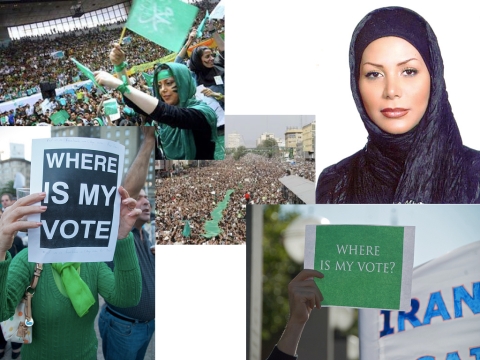
In the aftermath of the Iranian election, the US government intervened to change Twitter’s maintenance schedule so that it wouldn’t be down during the day in Iran. Twitter allowed Iranians to communicate with the outside world and express their distress at the rigged election. The governent’s reaction to this did not help their case.
I was working in Shanghai during the summer, and when the riots started they shut down Facebook and Twitter (at the time, I wrote this post). When I was there in 2007, you couldn’t access Wikipedia – but this time I could. This makes me think that the government is no longer afraid of information – it’s afraid of the conversation.
What's the Connection Between the British Parliament and an Irish Pop Star?
As a Brit, I tend to follow the news over there and the other week two things happened. The first one that a law firm got an injunction to prevent a newspaper reporting from a question to be asked in parliament regarding some toxic waste and a firm called Trafigura. The newspaper (the Guardian – read their story here) could only report that they couldn’t report anything about the MP asking the question or the question itself. However some smart people soon worked out what the question was and soon #trafigura was trending – causing the very awareness that they had sought to prevent.
The seond thing that happened was that this pop star died, of a heart condition. However he was gay, and with his husband at the time so it was enough to get some vile columnist in the Daily Mail to write a homophobic diatribe about him. Her name was soon trending as people expressed outrage (interestingly the Wikipedia article on Jan Moir consists of little more than the story of this).
I think what these two events show, is that Twitter provides a forum for people to express their frustration with all kinds of things – whether it’s concern over restrictions of reporting on parliament or just celebrity gossip. It also captures what people are getting angry, or excited about. Trending topics can answer what’s hot right now – Apple trends whenever it has an announcement, Windows 7 and even Ubuntu 9 were trending on their release.
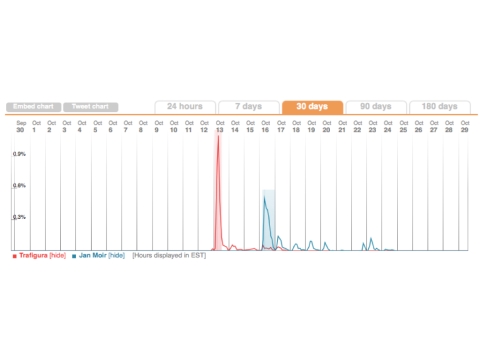
Trend Graph for #trafigura and "Jan Moir"
Trendistic is a service that allows us to graph how often words are occurring in Tweets. We can see that #trafigura rapidly became popular and disappeared again quickly once the injunction had been lifted. “Jan Moir” has a wider curve, and there was another flurry of mentions when she released an apology a week later.
Information Gathering
Image from iStockPhoto
Information gathering is the best use I get out of Twitter, and I feel it’s something that it would be hard to replicate anywhere else with as little effort. Follow leaders in your field, or just people who work in a similar area to you who tweet interesting stuff they found, or people who inspire you. I get so much information this way, and it doesn’t take very long to go through it. I’m literally crowd-sourcing my news! And if someone I’m following tweets too much or I lose interest I can un-follow them. Lists are going to make this even easier.
Ambient Awareness / Ambient Intimacy
Image from iStockPhoto
Ambient Awareness is like the Facebook newsfeed. It’s passively letting information about your friends lives come to you. But on Twitter, people often update more often – so if it’s someone you’re really fond of it can be better than Facebook for staying in touch with their lives. Two of my good friends live in London and I love the little bits of their lives that I see on Twitter and we definitely use ambient awareness to stay in touch. I was having a lousy day last week and I tweeted about it and one of my friends sent me a message just saying “*hug*”. When another friends released his work project (Google Sync) and it hit the trending topics, it was really nice to share his excitement about it in real time.
Twitter is amazing for overhearing what your customers are saying about your business. There was actually a paper published earlier this year analyzing brand sentiment on Twitter. Businesses (and non-profits, like @kiva) that get it are on Twitter seeing what’s being said about them and taking part in the conversation.
I wrote more about customer relationship management in this post.
Conversations on Twitter
Image from iStockPhoto
I think conversations are a great way of measuring engagement on Twitter, and this is what I’m working on at the moment. If your a brand, how engaged are you with your community? If you’re an individual, how engaged are you with the people you’re following? Are you passively absorbing content or are you sharing, adding value? If you’re a spammer, no-one’s talking to you!
Who's Following You?
Image from iStockPhoto
It’s possible to have a large number of followers by either paying for them, or by following people in the hopes they’ll follow you back (and unfollowing those that don’t) until eventually you have several thousand people “following” you.
But are they listening? Or are they just spammers? If they were listening you’d expect at least some of them to be talking to you.
Is Anyone There?
So I decided that follower/following counts were basically meaningless, and wrote a program that will graph your conversation network (more on that in this post).
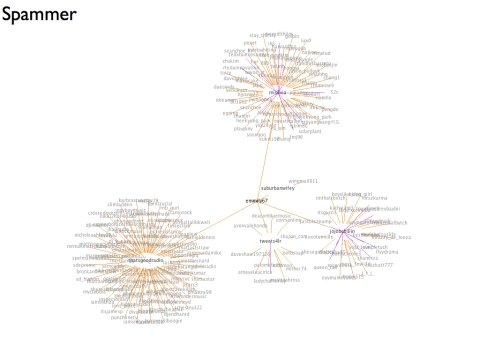
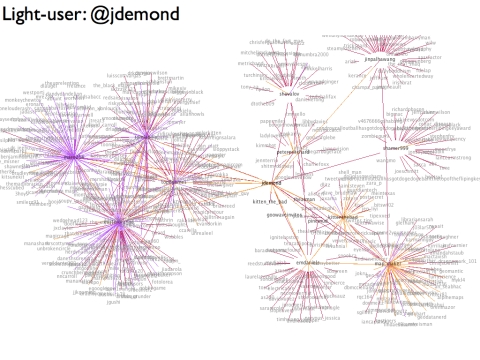
And it’s fascinating, because someone’s graph really says a lot about the kind of user they are. Are they a power-user? A regular user? A spammer? A light user?
My Conversation NetworkSpammer Conversation NetworkPower User Conversation NetworkModerate User Conversation NetworkLight User Conversation Network
It’s nice how you can see the different networks that he’s a part of here. I hope to use a clique finding approach to draw out this kind of information for bigger and busier networks.
Monday was Democamp 12, I heard about it in the morning and managed to get a ticket (someone dropped out). It was really a great evening; I met some really cool people and won a model plane.
Events: Betidings and Twegather
First up presenting was Betidings. The concept is that you have a calendar of events that you’re interested in, and you can follow other people and events they add to their calendar will show up for you as well. So with very little effort I now have a schedule of events in Ottawa and I can see what days I’m free and what interest me. The downside – I was living in contented ignorance about the Girl Geek Dinner on Monday, and now I’m gutted that I’m missing it! I think it’s worth checking out, you can see what I’m interested in here.
This is still in the very early stages and is more of a proof of concept than a fully fledged application but I think it’s worth a go – the more data there the more useful it will be. And it’s a nice way to share stuff you’re interested in without forcing it on people. I guess it could potentially be for events what Twitter is for ideas and content. Not sure everyone got this though – one jerk said the user interface sucked. Not quite in the spirit of democamp! The UI isn’t fully there yet and I’m not a big fan of the colorscheme but they’re actively looking for feedback and welcome any comments to @betidings.
Twegather (not yet public) was created through TeamCamp – read about it here. It’s an event system using Twitter, you’ll be able to create an event using @WhoWantsToGo.
Crazy Planes
The planes were what I was talking about in this tweet. A full article on it is this one, by the lovely @loudandskittish. I thought these were awesome because to me they illustrate the programmer mindset applied to something not-programming. I’m definitely going to be taking mine (and hopefully a few more) to my Holiday Science Lecture in December!
Twitter Procrastination Tool: BattleTwip
This is kinda cute! Battleship on Twitter, played against everyone. Created by 76Design, you can follow @battletwip and play via Twitter when the next game starts. They also have a really awesome looking web interface which we saw a preview of, but as far as I can find it’s not up yet.
Advertising: Shiny Ads
Shiny ads is an alternative to Google Adsense. It allows you to attract your own advertisers, gives them the tools to make their ad or upload it and then you can approve it (or not) and earn a much better rate for click-through. Wasn’t so relevant to democamp – although most people had websites, they seem to use them to either promote their (non ad-based-web-) business or personal brand.
Overall
Great experience, great people, great opportunity to interact with the Ottawa tech community and it’s nice to see what’s up and coming. I love the vibrant tech scene here! Can’t wait for democamp 13 – wonder if I could present my graphs…?
I’m giving a presentation at Carleton for my Seminar course on October 30th. Title and abstract is below – slides coming soon!
Title: Conversation 2.0: Twitter
Abstract: The advent of Web 2.0 changed the internet. It went from an information medium to a communication medium. Recent developments have made that communication increasingly real-time. Services like Facebook and Twitter have made it possible to passively monitor real-time updates on your friends, whilst Google’s recently released Wave service aims to reinvent email – and make it more real-time. These changes have had a very real effect on the way we interact – with each other, with brands, our political system, and with the press. The presentation will discuss what Twitter is and its effects. There will also be a demonstration of how we can graph users “conversation networks” and the conclusions we can draw from them.
The class I TA for has to create presentations in Powerpoint using transitions and music. A million miles from Presentation Zen, hey? There are some good examples of stand-alone presentations using transitions and music though – caveat is, stand-alone is an important point. If you tried to present with so much movement behind you, your audience would be pretty distracted.
Back in August I submitted a proposal for the Holiday Science Lectures at the University of Ottawa. I blogged about it at the time here. I’m really excited, because it’s been accepted and I will be presenting it this December!
50 word (50 words! How am I supposed to sum it up in 50 words? Oh well, I had a go) synopsis is below:
Art, Life, and Programming
Code is like a paintbrush, and the Internet is the world’s biggest art gallery. Invented just 20 years ago the Internet has changed everything. Less than 24% of humanity has access to the Internet; there is more change to come. What can we expect technology to change in the future?
Thanks to everyone who looked over my slides and my proposal!
There’s a count down in my head for a presentation I need to give in early September. I’ve been thinking about how I want to do it – I need to show I’m serious about what I’m doing and can be trusted. I’d been thinking about a formal document along the same lines as a business plan and a Keynote presentation. Which seemed a little too formal, but I definitely want to err on the side of too formal. Then I came across this idea by Seth Godin.
Read it. I think it’s a phenomenal idea and moreover – it’s exactly what I was looking for.
Cookie Consent
We use cookies to improve your experience on our site. By using our site, you consent to cookies.