My friend Maggie tells me I’m an introvert. Not because I’m shy, or because large groups make me nervous, but because I don’t get my energy from being around people. I was surprised by this, because I guess I’ve always considered myself to be extroverted and so I asked another close friend and he said that was nonsense because I’m happy to be the center of attention and the life of a party.
It doesn’t really matter which of them is right – introvert, extrovert – it’s is just a label. Thinking about it, I’ve decided that I need to be both. Too much time alone makes me angsty, but I don’t think someone who was truly an extrovert would love living alone as much as I do.
When my life is very social, though, I do get to these points where I desperately need to be alone. Too much stuff going on, too many people makes me stressed. When I get to about a week without any “Cate-time” I will literally block off time in my calendar to make sure I get it. I got to that point last week.
Perhaps it’s not really about introvert vs. extrovert. Perhaps the real problem I’m having, is being a maker living on a manager schedule. Hour by hour blocks and lots of meetings and jamming about pitches and posters might be manageable, but then my personal life is on manager-time as well… and it’s too much. It means that I get to the point where it’s mid-afternoon on a day when we’ve spent all that day working on our pitch and I feel strongly that if I have about half an hour before I’m going to crack from too many people, too much talking. From the article linked above (emphasis mine):
I find one meeting can sometimes affect a whole day. A meeting commonly blows at least half a day, by breaking up a morning or afternoon. But in addition there’s sometimes a cascading effect. If I know the afternoon is going to be broken up, I’m slightly less likely to start something ambitious in the morning. I know this may sound oversensitive, but if you’re a maker, think of your own case. Don’t your spirits rise at the thought of having an entire day free to work, with no appointments at all? Well, that means your spirits are correspondingly depressed when you don’t. And ambitious projects are by definition close to the limits of your capacity. A small decrease in morale is enough to kill them off.
My whole team was overloaded like this, and so we called it quits and I escaped and – bliss – had a whole evening of maker time, which I spent coding. It’s interesting that most of the technical people find the pitching stressful.
I would have thought I would be OK, since I do a fair amount of public speaking. However, there are two things that make giving talks by myself different:
It’s one aspect of what I do where I do my best at the time and try and improve for next time, sure, but good enough is fine. Because I won’t teach that exact same class again any time soon, or give that same talk.
The talks I give alone are either are made in maker time – in fact, require maker time to create because it’s all about connecting the dots and inspiring.
In what we’re working on, we give the same pitch nearly every day. Each time we have something new to work on. We have thrown out my section and started over on it more times that I can count. It’s exhausting. The idea might need maker time, but the pitching and the discussions and the hammering away at it until it shines – that’s manager time.
So I’m going to make a conscious decision that as my work-schedule moves to manager-time, I’m going to shift my personal life to maker-time. It satisfies my need to be alone, and my need for unstructured time in which to create. Coding distracts me from the stress of pitch-pitch-pitch.
Strange that the final stretch and living on manager-time is the biggest stress I have. But good to know.
How about you? Do you live on maker-time or manager-time? How do you cope when you’re on the wrong one?
One of my closest friends works at another large tech company, and all summer we’ve been having conversations that go like this:
ME: I’ve had such an awesome day! I found out about this awesome thing and made some progress on my awesome project. I love my job! How was yours?
HIM: Good! I finally hunted down this bug and I am a Java-optimization ninja.
And then, we have to find something else to talk about. And it’s completely understandable – but nevertheless, hard to be so passionate and excited about something and not be able to share that with the most important people in your life. It’s the same with blogging about it – not being sure what I could say, I haven’t been saying anything.
However, last week I had an epiphany. The technical project is perhaps the least interesting part of Extreme Blue. There is a reason why they call it a “leadership development program”. Yes, they take people with strong technical skills and you’re pushed that way, but you’re pushed in other ways and taught so many other skills too.
It’s All About the Pitch
The most important thing we work on is the pitch. At the end of the summer we’ll go to Armonk and we’ll have 4 minutes to sell what we’ve been working on. At first that seemed impossible, but the truth is that if you can’t explain the key concepts of what you’re doing in that short a period, you don’t understand it.
We’re down to 3:30, and looking for really compelling things for that last 30 seconds. Not the ideas that make our case – the ones that hammer it home so that people watching us can’t doubt that what we’re doing has potential.
As a programmer, or a technical person, it can be hard to accept the idea that the pitch is more important than the actual work. However, without a business case, there is no technical work. Our job is to prototype and demonstrate value. So our team is embracing that idea.
Ask
If we have a question, or someone who it would be helpful to talk to, saying “I’m Cate and I’m in Extreme Blue – do you have a moment?” has almost invariably got me what I need. This is awesome, and a refreshing change from university culture. Obviously, you don’t want to be annoying or too pushy. But if you need to, ask – it’s stupid not to.
Leading Through Vision: Effective Communication
Everyone in EB has shown leadership. So just because you’re invariably in charge for every university project, doesn’t mean you will be here. If you have a team of four and everyone is trying to lead but has a different agenda, that won’t work. Defining a collective vision that you’ll work towards and letting everyone lead some aspect seems to be working for us.
Communication is so important. Initially, the MBA and I were communicating in what may as well been two different languages. Now we both make an effort to speak the same one.
Constructive Criticism
The other day, we gave our second demo. Afterward, we were waiting for our mentor to come give us feedback and it came out that we all thought that we had been most inadequate. It’s tough, because every day we try and do better and after each thing there’s something to work on. But this kind of feedback is so helpful for practicing relentless improvement and being the best we can be. The same is true of feedback from each other – we’re on the same team, and we only want to help each other improve.
Time Management and Scrum
We are trying to do scrum, but it’s hard because of the exploratory nature of what we’re doing. When I have a clear task that I need to do, it’s easy. When I have something more experimental that I’m playing with, it’s hard. When things start crashing I’ve a propensity to just give up on planning until things are working again. It’s a process – I’m learning about how much leeway I need to build in and how to plan better. But I’m not there yet.
When I was doing my undergrad in Edinburgh, in around my second year, I was at a ceilidh, and a guy asked me out on a date. And I said, “sure”. Then, he asked my roommate if I was single, which was a little bizarre. And finally, he tried to “get to know me”. We were walking down the Royal Mile and he asked me, as everyone does when you’re a student, what program I was in. And I said, “Computer Science”.
And he said, “I don’t believe you, you’re too normal”.
And we then proceeded to have a disagreement about this, with me saying, “no, I am”, and him continuing to find this incomprehensible. Of course, this is Scotland and we were students, so he was drunk, but still.
Perhaps the most bizarre aspect of this, was that I found this almost flattering. I mean, I had recently been dating another compsci who, when trying to pick women up, would tell them he was in “Social Anthropology”.
Credit: flickr / Laughing Squid
The stereotypical image of a programmer, is a skinny guy who doesn’t wash or go outside enough. And don’t get me wrong, I’ve met a few of those. But how did we get here?
Credit: Wikipedia
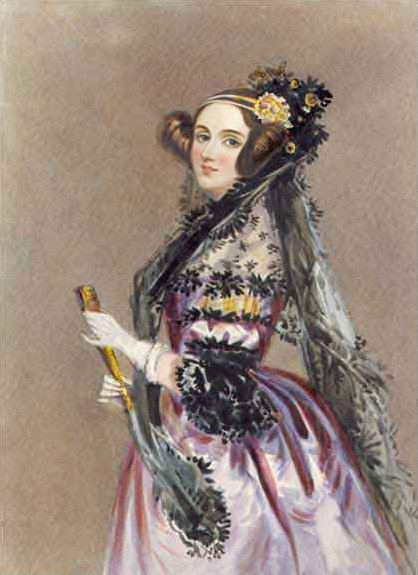
The first programmer was Ada Lovelace – she wrote code for a computer which did not even exist yet.
Credit: Wikipedia
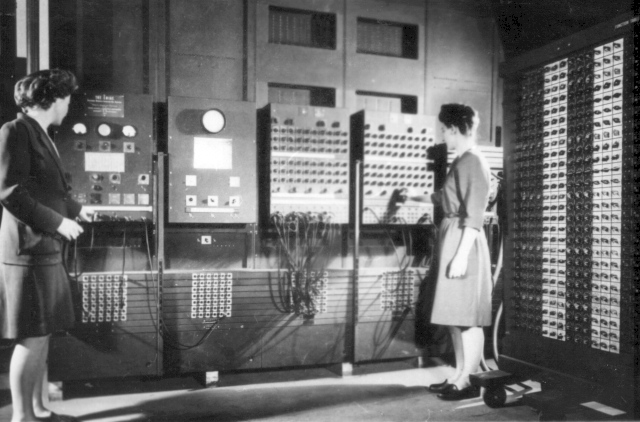
During the second world war, the US invented the ENIAC to calculate missile trajectories. It had 6 programmers, all women, who worked out how to use it without a manual – and their contribution has been historically under recognized (ENIAC Programmers Project).
And yet here we are today, I’m reading a book called “Coders at Work” – profiles of 15 programmers. There’s one women. She’s an IBMer.
So computer science has a terrible image problem, and that’s probably why we have to lie to get dates. But even more than that, we have a communications problem. We don’t communicate the value we bring well, which is why admitting to a degree in compsci will end a conversation. We also have not done a great job of speaking human. And that’s why, I think, we have software like Windows Vista and ridiculous tangles of privacy settings like those for Facebook.
Picture taken by me at the Museum of Science and Technology in Tokyo, Japan
You know that expression, “be the change you want to see in the world“? I try to live by that. And I would like all programmers to speak human, fluently. And so I’m trying to be that change through talks like this, and programming workshops, and blogging. I want to make a dent in this communications problem, it’s a passion.
Second passion – users. I think your computer should make your life easier, not harder. As an industry, we can do better at this.
Third and final passion – information management. We live in the age of information overload, there’s so much great stuff out there that it seems like if you don’t have information overload, you’re doing it wrong! I think that we should be able to help people better manage the information they have, and to condense it so that meaning can be extracted from it. This is something I’m currently working on in my project at IBM.
So, why is this talk called “Art, Life and Programming”? I think it could also be called “Programmers Create Change”. Art is great example that illustrates this because technology gives us new ways to create and distribute, to the point where we need to reconsider what Art actually is. Programmers can be artists, and artists can be programmers.
Yes, sculpture is art, as are paintings, and photographs. Art is a product of human creativity, and there are various medium we can use for it, so let’s talk about some new things, as well.
We Tell Stories is a project that uses the web rather than the traditional medium of a book. This enables another dimension to the story, one of the stories is interactive (your choices change the story), whereas another is recounted through Google Maps.
PostSecret is a community art project, where people write secrets on postcards, and send them in. They’re collated by a man, Frank Warren, who collates them into a series of books and speaks at universities all over the US. Every Sunday, he publishes a blogpost called “Sunday Secrets”. This combines the traditional medium (post and books), and a new medium (blogs).
I Want You To Want me visualizes data from dating sites, it, “explores the search for love but also the search for self in the world of online dating”.
See the video below.
I really love this project, it’s a great source of inspiration to me in my work and I think illustrates beautifully the intersection of programming and art.
This video shows the evolution of special effects in cinematography. Because the movie studios are often at the edge of computer graphics work, it illustrates the evolution of 100 years of technology.
Through human history, there have been various inventions and discoveries that have fundamentally changed things.
The first was probably fire – it’s suggested that the reason for the sudden growth in the size of the human brain was a result of early humans cooking meat.
The combustion engine brought about great changes in production and human mobility. It’s made it possible to flit between continents, the way we take for granted today.
Another was the printing press, which allowed for the easier sharing and distribution of information. Before the printing press, everything was hand-written – very time consuming. The church got very angry about this development, and tried to fight against it saying that people would use it for pornography. However, ultimately they couldn’t stop the advance of technology. To show how utterly futile this attempt was, consider that in order to get enough copies of their reasons why the printing press was such a terrible thing, they had to use the printing press – because scribes couldn’t copy fast enough. I think what they were really afraid of – and with good reason, as it turns out – was information. We see similar reactions today from some industries and some religious organizations when it comes to the internet. In general, when someone in a position of power says that they’re trying to save people from porn, I distrust it – like the catholic church they’re afraid of information. Hopefully their efforts will just just as futile.
Model of the Internet
Taken by me at the Museum of Science and Technology, Tokyo, Japan
The internet is another such invention, and we’re just at the beginning of the changes that will ensue.
I wrote this talk for kids, to inspire them, but you guys all know exactly what changes I’m talking about – because you’ve lived through them too. And I think if we can just take a moment here to reflect on that, we’ll be amazed.
I had a really important day at work a few weeks ago, and so I went in early – before 8 am – to get a jump on the day. And my computer had turned into a brick overnight. It would not turn on. IBM has amazing tech support, so after lunch I had a brand new machine but for that morning, I was completely useless. Without a computer, I am completely redundant. That was a strange feeling, but one that I think is increasingly the case for many of us. We’ve all heard those quote about there only being a market for 5 computers (disputed) and how much RAM we might need. Wow were they wrong! We’re more and more dependant on our computers, and an internet connection that it’s hard to cope without them.
Timeline for the Evolution of the Internet
We can see here that the internet was created about 40 years ago, and email shortly after. The internet as we know it really starts with the invention of the “World Wide Web” over 20 years later, though. The internet is the infrastructure, and the web is the software that runs on top of it. Many people don’t understand the difference, but without the web the services like YouTube, Wikipedia, Facebook, and Twitter would not be possible. Now, we’re at the start of the mobile web – by 2020 it’s predicted that more mobile devices will be accessing the internet than computers.
I think we’re just at the beginning of this change, and there are a number of reasons for that. The first is – innovation. Programmers are not done inventing the web, and other leaps innovations, such as good machine translation will give people in developing countries amazing resources to improve their education and quality of life. The second is access, because only around a quarter of the world’s population has access to the internet. The third is demographic – in western countries, we’ve just about reached the point where everyone who wants to be online is – the people who hold out are mostly older. So when services, particularly government services can be only offered online, things will change. Finally, I think censorship will ultimately fail. This will be a big change in and of itself, but I was in China last summer as the government shut down Facebook, Twitter, the news… When people there and in Iran have free access to everything that is going on, the world will be different as a result.
One of the huge changes that programmers have brought about, through the creation of software, is the possibility for everyone to create content. This is so new, because if you think about it – before we used to distribute everything in books and newspapers etc, which have much higher costs of distribution. This development is something that impacts many people every single day.
The content users could create used to look a little… plain and dull and required some know-how.
Now, very little knowledge (if any) is required and designers can create beautiful looking web pages, that showcase their artistic sensibilities as well as their content.
In fact, the creators of I Want You To Want me used blog content to make another installation – this one online – called “We Feel Fine”.
So there’s a lot of stuff that’s going to change, and one of those things we can say with a good degree of certainty, is that newspapers are going to die out. Some of the brands will remain, but we’ll access them in a different way than on giant pieces of paper.
Some people are getting very angry about this, but it’s pointless to cling onto a dying business model. Innovative companies will survive. Those who waste time complaining probably won’t.
But innovation doesn’t just mean the destruction of old things, there will also be new things that are created. Tactile computing, like tablets and tables will become mainstream. Communications will evolve through services like Google Wave. And eventually we’ll have house cleaning robots! (Sooner the better!)
Binary
Earlier, we talked about how programmers weren’t perhaps what you expect. Code isn’t either. Programmers used to program using series of 1’s and 0’s punched into cards (crikey!) but that’s not the case any more.
Program code has got more and more high level, and some languages are actually quite readable by humans! Some programming can even be done using drag and drop.
Programming is really just a way of thinking. More and more people are becoming programmers, some of them without realizing that’s what they’re doing.
You can learn to program using The Sims – isn’t that awesome? It’s a great initiative called Alice.
Warcraft World Editor
Image used with permission of Kelvin Schutz
More and more video games come with programming capabilities, Warcraft is another example.
There are also programs such as Game Maker or Fusion that allow you to create video games without writing any code – you just have to learn to think logically! If you want to do something useful instead, Automator for mac is essentially drag and drop programming.
Remember this?
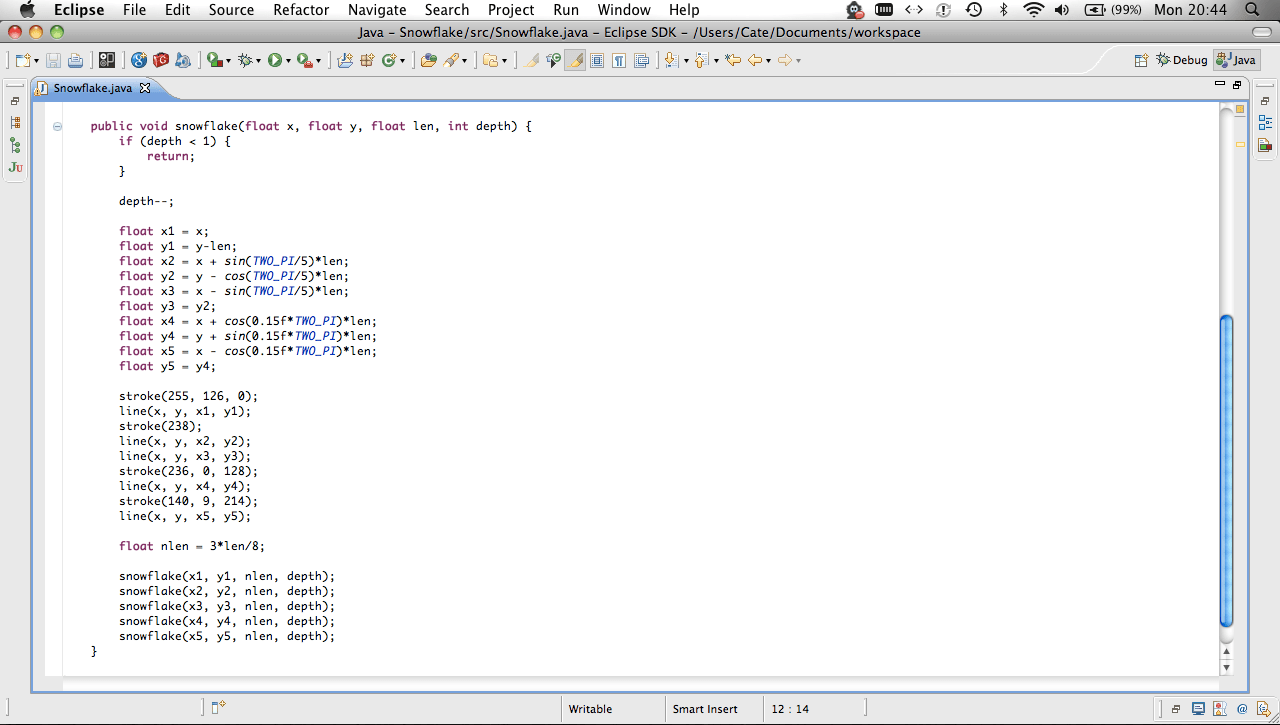
This is relatively simple to create, and doesn’t require much code. It’s recursive, which means we split it into the same problem again and again and again – until we reach something really small and easily solved.
Here's the Code
That’s pretty short, hey?
Click on the images to enlarge.
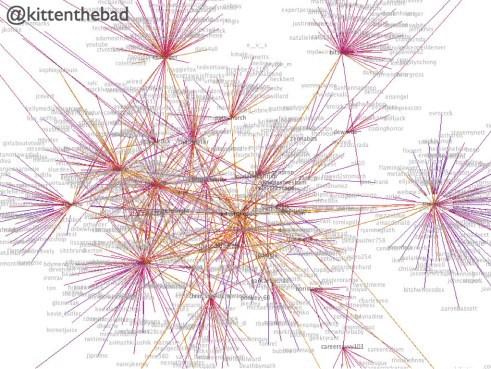
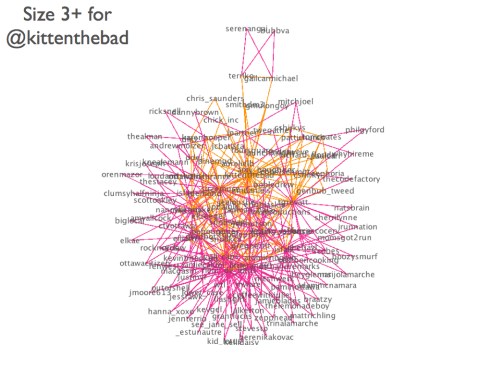
This is something I’m working on currently, what I try to do is take some of the huge volume of information we’re presented with every day and make it into something that’s both pretty and useful. For instance, this shows the size and interactions in my Twitter network.
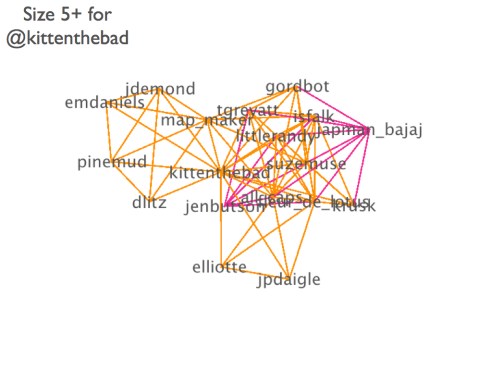
We can also write programs to extract important information from the noise. Here, this graph picks out my core, central network.
The “hard” part of the code is just 6 lines!
Imagine how difficult it would be to create these things by hand!
Technology has changed our lives considerably relatively recently – we have new and impressive “hardware” and creative and innovating programming. This is just the begining – there’s much more to come.
Technologists – hardware designers, programmers – are at the center of what we will achieve next. However, whilst computers and technology are a part of everything I’ve talked about, what’s perhaps most inspiring is the human capacity for innovation and our reaction to change.
I’m super excited that I’ve been asked to speak at the next Girl Geek Dinner. I have a couple of talks prepared and so the plan is to modify one of them – the underlying theme to everything I’ve been talking about (and doing) lately is about how technology is changing things, and how can we better organize data such that it’s more useful (and meaningful) to us.
Alternatively I can try and create something new. What would you like to hear about? All of these will need to be cut, so if you have a preference, what aspects of that talk are particularly of interest to you?
Introduce myself: my name is Cate and I’m a second year Masters student in Computer Science. There’s all these different parts of Computer Science, but how I like to describe myself is that I try to create things that answer the questions that people haven’t thought to ask. What does that mean? Well, you could call me a data-junkie, but I really prefer meaning-junkie.
Credit: iStockPhoto
Let’s talk a little about information overload. Who here suffers from it? Yeah, I do too. And it’s a real problem, but what also interesting is that it’s a recent problem.
Not that long ago, really, the only information humans have came from the Bible. And then the printing press was invented, and the church got really angry about this and tried to stop it.
Of course, they failed. And the amount of information humans had access to increased rapidly. It became worthwhile learning to read! And before too long there was a life-time’s supply of reading material – and more.
Clay Shirky writes about this, and how the internet has brought another such revolution. And again we have the gatekeepers complaining, trying to hold technology back – and failing. And we have more content produced every day, than we can hope to consume in a life-time.
WOW!
And with this volume of content – of information – we have to find ways to draw out the meaning. And that’s what I like to do.
OK, so what has this got to do with Twitter? Well one of the huge changes that Web 2.0 has brought about is that it has changed the way we communicate. Twitter is both a source for sharing and finding information, and a source for conversation. And – a place for conversation about that information. And I know some people think Twitter is completely pointless, but there are many people getting huge amounts of value out of it – because of the simplicity, the flexibility, that I don’t think we can discount it. The diagram is a work in progress, but what it shows is an idea of how the way we communicate, and share, and organize ourselves socially is changing. And people can complain about these developments, and disparage them – but they’re not going away.
Influence
In the old order, we knew who was influential. They were the gatekeepers – the people who controlled the newspapers, or the elected officials, or celebritites.
In this new reality, people who are not gatekeepers can become influential. I’m sure you can think of some great examples.
And, let’s talk about the wider sense of influential. People have always been influenced by their social circle, but now you can have people who you never interact with physically, who are still part of your social circle and still influential to you.
And the gatekeepers, well they have competition. The Breaking News Twitter feed wasn’t created by MSNBC – they were late to this party, they didn’t see that this would be important.
Credit: iStockPhoto
So, what makes someone influential on Twitter? Is it hundreds of followers?
I’m going to say no. I’ve seen spammers with thousands of followers, and if you look a little closer it becomes pretty clear that they are not influencing anyone. So I think that destroys the idea of followers as a measure of influence, at least at the <5000 end of the scale. And even at the higher end of the scale, there was a blog post by Anil Dash saying that being on the suggested user list did not make a significant difference to the number of retweets, clicks, or @ mentions he was getting. Which suggests it doesn’t really apply at the top end of the scale, either.
Really, if someone’s influential then people will be engaging with their content. So most of the influence measures, like Klout, or Twinfluence, consider that – how much is someone being ReTweeted is a key aspect. And then, I think there’s also going to be the aspect who who this influencer is influencing – clearly, influencing other influencers has a bigger impact than just influencing uninfluential people.
Looking at this kind of influence is going to be the topic of my next paper, so these ideas are still evolving, but I’d love to hear what you think about this.
Engagement
Engagement follows influence, because I think that engagement is how those of us who are not famous, become influential. We engage with out network, and share stuff that’s meaningful, and this builds relationships and trust. This trust is crucial. Clay Shirky gave a talk on how the Internet runs on love, but there’s a huge amount of trust there, too. It’s why I follow someone in Google reader – I trust that if they think it’s worth sharing, I’ll think it’s worth reading. It’s how services grow by word of mouth, I get value from Twitter and (some) people trust that if I do, they potentially will as well and it’s worth giving it a try.
There are different levels of engagement, and that’s expressed in this diagram. And what’s interesting to note, is that when we use Twitter (and other services like Twitter) we probably move between all these levels of engagement with people. At the centre, there’s the direct message – because that’s the most intimate (private) form of conversation. We can’t measure this. Then, we have engagement through conversation, or retweets. That we can get through the public API.
Next, is listening, or lurking. That’s when we read, but don’t respond. This is interesting, because how do we quantify this? So yesterday, for example, I put out a link to a blog post I wrote which got two tweets – but 53 clicks. My most popular recent link (to the page where I put my graphs) got 51 tweets and 444 clicks (of the bit.ly link). That suggests there are a lot of people lurking. And this is just a rough quantification of that.
People use lurking as a derogatory term, but I think lurking is crucial to services like Twitter. In this case, lurking is quietly paying attention. Don’t we need people to be doing that to make it work?
The outer circle is ignoring. And whilst we all might retreat to that section from time to time – in order to manage our information overload – only spammers will be there always, pushing their own content but never absorbing other people’s.
Credit: Geek and Poke
This engagement through conversation is quantifiable – we can graph that engagement, get a sense of it using tools that are standard in graph theory. That’s what I’ve been doing, I submitted my first paper recently and it’s called “Following the Conversation: A More Meaningful Expression of Engagement”. Because, let’s think about it, you can write code (or use someone else’s code) to automatically follow and unfollow people until you have thousands of followers – who aren’t listening to a word you say. But you can’t create a conversation like that. You can’t really spam that too well.
Credit: Geek and Poke
If you’re not a spammer, you’re just kinda boring… most likely you’re not getting a huge amount of engagement, either.
Here’s my graph. This is every one who I talk to, and who talks to me, then everyone who they talk to who talks to them. What does it show?
It shows what I’m putting out – people who I’m mentioning, or retweeting. It also shows what I’m getting – who’s retweeting or mentioning me. It also shows those people who I have reciprocal relationships with. Those are the three colors of the links.
And we can start to compare, and we see that people have different graphs. Some are more hectic, some are much smaller. And the level of interconnectedness changes too; some people have very dense graphs, whereas others may have a larger network but it’s more distributed.
Cliques: pulling out the most important part of your network
So these graphs quickly get a little hectic. However, there has been a lot of research into finding cliques within people’s social groups and why that is helpful, and we can do the same here.
So, what’s a clique? A clique is a completely connected sub-graph. So, if I talk to person A and person B, and person A and B also talk, then A, B and I are a clique.
If you were to try and remember all the people you know, it’s likely that you’d do it through chains. So, “Oh, there’s Uncle Bob, and he’s married to Aunt Ann, and they have a daughter…” and so on. So if we graph this, first we’re moving a lot closer to how you think about your network, but secondly we’re picking out what I call your core network – the people to whom you have the strongest ties. And the people who have strong ties to people you’re close to, who may be good recommendations for people to talk to. These are the people connected by the pink connections in the graph.
If we raise the threshold – the minimum size – for the cliques, we get closer and closer to the denser core of the graph. The biggest graphs I’ve seen have been cliques of 8, but they are all on my website – feel free to take a look.
So What?
Some of these graphs are pretty dense, but they are less dense than the follower-following network. Really it’s about pulling out those connections that are sufficiently meaningful to us that we take the time to interact with them. Another study found that this limits out regardless of the number of people we’re following – and it’s a similar story with Facebook. Cliques have been found to be a good way to identify communities on the web, and my current findings are that that is a similar case here.
What Next?
Now, we want to see what people within these cliques are talking about. A lot of what I do is limited by the Twitter API, which limits the number of requests I can make. Now they’ve raised the limits, I want to graph influencers with the same kind of timeframe as regular users (typically around a week) – my current graphs for influencers are over a much shorter time period, for Clay Shirky for example, it was about a day. I’m also going to create graphs of influence networks – just picking out those tweets that look like a retweet.
Next Thursday, I’m giving a talk on my research to people from the communications department. Outline below.
When we talk about how we quantify success in social media (and Twitter), we need to consider how we’re defining engagement. Does someone following us mean that they are engaged with our content? Maybe – but maybe not. We only have to look at spammers with > 1000 followers to see that our current metric for success (number of followers) is severely lacking. I think @ mentions are a far better measure of engagement – it shows people are responding to, and/or retweeting your content.
How can we express this? We can view each @ mention as an edge on a graph, which we can visualize. Whilst our network of followers/following can be massive, typically for a social network (this has been demonstrated on both Facebook and Twitter) the number of people we interact with is just a small fraction of our network. What information can we gain by pulling out this network, and the cliques within it? Potentially it can tell us a lot about engagement, and make some smart suggestions for growing our network, too.
On Twitter? Have you requested a graph yet? Get yours here.
Should I switch to mac? Is it hard to get used to?
Yes, switching to Mac was the best thing I ever did and does wonders for my productivity. I have found it much easier to develop on Macs than on Windows.
Are there places children shouldn’t go on the internet?
I think this question is answered really well in Don Tapscott‘s Grown Up Digital. The short answer is – yes, but adding blocks is not the way to stop them. They’ll find a way around it! There are risks to restricting their access too much, too.
What do I think about the idea of the Semantic web.
I’m sure we will see the improvements the semantic web is supposed to offer, but I make no prediction as to whether they will come as a result of the semantic web, or something else (like improved NLP).
What are your predictions for new technologies?
The only prediction I will make here is that we will be surprised.
What programming languages do you think will be big in the future, and how do I prepare?
Prepare yourself for change – learn an OO language, a scripting language, and a functional one. This will make it easier for you to learn the new languages that will come along.
(If you’re interested in learning Java, I will be running more workshops in the new year – contact me or note in the comments if you want to hear about them as they arise. I may also run something on the basics of Haskell, if there’s demand. If you’re interested in learning Ruby, check out Ruby Tuesdays at the Code Factory).
Why is it so hard to access BASIC on Windows 98?
Because few people use it and Microsoft has opted to make it difficult for your average users to get to the few development tools that are available as standard.
I think this is one of the reasons why I see more and more developers using Macs, because it comes with many programming language compilers (Java, Python, C etc) as standard and to get to them, the developer just need to fire up a terminal.
Quantum computing.
I’m sorry, I don’t know anything about this! Try Wikipedia.
What’s Java?
Java is a programming language, taught widely and used in many applications due to it’s system independence (i.e the same code should work on a Mac, a Windows machine, or on Unix).
It is also possible to use Java code in web applications. For example, Processing is built on Java and makes it easy to create applets which are embeddable in your web-browser (see mine).