Tag: decisions

  • Ground Decisions

    Ground Decisions

    Credit: Unsplash / Bao Menglong

    Often, when we talk about automation, we talk about planes. We say they fly themselves, which, sure – and technically the largest planes can even land themselves, if the airport has the equipment (it’s mainly used for bad weather). However most takeoffs and landings remain manual. My pilot friend also points out that many decisions (fuel is a big one) get made on the ground.

    The other thing my pilot friend pointed out is that pilots are in for any decisions they make. They are not just flying the plane; they are in the plane. Contrast this with the surgeon, who performs the surgery, and walks out of the operating room afterwards, regardless of the patient outcome.

    In this analogy, VCs are surgeons. Developers are pilots. And the hype-men… travel agents selling plane tickets, mainly.

    The problem with much of the hype around AI is that it’s not meeting the people who actually do the work where they are at. We’re not being clear about what’s takeoff, what’s landing, and what the ground decisions are.

    The cracks are starting to show. I’ve seen various bits and pieces, but nothing captures it better than Luca Rossi’s summary of CircleCI’s State of Software Delivery 2026 data: elite teams nearly doubled throughput YoY, median barely moved. 81% use AI, so the differentiator is not the tooling; it’s infrastructure. Teams with CI pipelines under 15 minutes in 2023 are 5x more likely to be top performers today.

    I am fascinated by the software factory model — Dan Shapiro’s Level 4, where programmers are less programmers and more managers of AI agents and tasks — and the challenges of retro-fitting it onto an existing engineering organisation. It’s been a lightbulb moment for me – I feel like I finally get why the layoffs happened first, and why the productivity gains have failed to materialise.

    I think the answer lies in the ground decisions, or the open questions from an organisational perspective.

    How does the developer tooling calculus change?

    With teams of developers, we used to know the things that were useful for a team of 20 but not 2, and the things that made sense at 200 but not 20. That calculus seems to have changed fundamentally for two reasons. First, headcount is not (or shouldn’t be) a good proxy for productivity. Second, tooling itself is easier to build.

    Concrete example: every organisation eventually evolves to have a design system. Few start with one. But if you were building a web app today, would it make sense to start with a design system from day one? The answer might be yes.

    How do budgets need to evolve?

    Historically, dev team budgets are mainly salaries and some tooling. But StrongDM, who built one of the first real software factories, use $1K/engineer/day in token spend as their benchmark for whether you’re doing it seriously.

    Firstly, how do you factor that kind of ongoing cost in? Secondly, is managing more complex budgets and ROI going to become a bigger expectation of engineering managers? And what does it take to get good at that?

    What does skill definition look like now?

    It’s clear that a different skill composition will be more valuable in this model. My predictions are that judgement – understanding what to build and why, what is good to ship (aka takeoff and landing) – and feedback – providing clear direction and iterating well – will be bigger differentiators, and earlier in someone’s career than before. What people call prompt engineering is just problem definition and refinement – skills that have always mattered, now moved to the front.

    What does this mean for hiring and onboarding?

    Skill definition leads neatly into these two problems: what do you evaluate, and how do you onboard?

    In hiring, most of the conversation has been about the ways AI generates noise from candidates and heartless automated rejections from companies. Which is a real problem, but not the most interesting one. Beyond that: once there’s a human in the process, are the skills being evaluated the best predictors of success in this new model?

    Similarly with onboarding: having hired many people over the years, I used to have dialled in what good looked like at key intervals — 30, 60, 90 days. But in this model, what does a good trajectory look like when AI can both accelerate and abstract from understanding the systems?


    I have my own concerns about AI, I’m not going to pretend otherwise. But I also think the adoption curve is inevitable, and I’d rather help engineering leaders navigate the reality in front of them than relitigate whether we should be here at all.

    Coming back to the pilot analogy:

    • Takeoff – what we build and why
    • Landing – shipping and the decisions around it – what’s actually good enough to meet the definition of done?
    • Ground decisions – the open questions above.

    What am I missing? What’s your definition of take off and landing, and what are the ground decisions that are changing in real time?
  • Decisions

    Decisions

    Credit: Joe Groove

    Recently, someone asked me for my “Leadership philosophy”. My initial reaction was to panic, but after taking a deep breath and a bit of time to think, I came up with this answer:

    “My job is to make it easier for people to make good decisions.”

    What does that mean?

    Firstly – that my job is not to make decisions. Sometimes (often!) it is, but it’s important to think about when someone else should be able to make the decision and how to change it for next time.

    What do people need to make decisions?

    • Context: What is the information around the decision they need to understand? As you rise up the org chart, you end up with a broad amount of context,so think about what you need to be distilling and passing on.
    • Scope / Responsibility: This is clarity about the scope of the decisions people can make, and what they are responsible for.
    • Timeframe: What timeframe is being optimized for.

    Local / focused decisions can help teams move faster in the short term, but have higher costs over time – e.g. optimizing for features over infrastructure that would make more features easy. Shifting this requires:

    • Enough shared context such that people can identify possible overlap.
    • Clarity about how and when a broader scope can make sense.
    • Understanding of where it’s critical to just deliver vs where it’s possible to justify longer investments (i.e product market fit vs iteration).

  • Empowering your engineering team with an effective decision-making process

    Empowering your engineering team with an effective decision-making process

    My latest for LeadDev…

    A common area where managers fail to scale is in decision-making.

    The two extremes are: being responsible means making all decisions and enabling a team means staying out of details and letting them make decisions.

    Both of these are bad. One is controlling and fails to scale for obvious reasons. The other fails to scale because it pushes all the work onto the team, creating variance and evading responsibility. Managers in this category will be fine as long as they have high-performing individuals making good decisions, but they won’t know where to begin with people who can’t make good decisions, or how to address issues when things go wrong.

    Continue Reading…

  • Space and Time

    Space and Time

    danbo buried in sand
    Credit: Wikimedia

    The list of things I’ve learned this year is pretty long, but one thing I keep coming back to is: if you want something different, you have to create space for it.

    And so I have tried to deliberately create it (with mixed results) but above all be mindful about what (and who) I let in, and what commitments I take on.

    It’s easy to say no to “bad” things. But it’s hard to say no to things that are good-but-not-great. I’ve been trying to celebrate saying no, create a reward cycle there.

    Last week I had cause to consider what I’ve been doing since leaving tech. I was on a podcast, and it’s one of the things we talked about, I hung out with a friend who just embraced funemployment, and I was thinking about what is next for me.

    Perhaps this is a long-winded way to say, I’ve completely come around to something I never thought would be me – leaving the old thing, without knowing what’s next.

    Because if you have a job that uses up most of your emotional energy, how do you figure out what’s next whilst doing it?

    And time. One thing I’ve observed over the course of a year is that the reasons I left, different ones have loomed larger at different times. The things that were most stressful to me in the last weeks disappeared pretty quickly. When a number of women left and talked about why, those reasons loomed larger. Really they were all a product of one reason: it was time.

    But it took time to figure out what should be next. What’s petty and what’s fundamental. What I want to do. What I care about.

    A year ago I would have made different decisions than I made last week. And this is always going to be true, hopefully. Because you learn and you develop and different things seem possible. But also we make different decisions from a place of panic and fear than we do from a centred calm. We make different decisions when we focus on our strengths than when our confidence has been eroded away.

    As a driven over-achiever type person, the idea that I might “opt out”, give myself space and time was a terrifying one. But nothing I have ever done has been so revelatory, or worthwhile.

  • Thousands of Miles and There You Are

    Thousands of Miles and There You Are

    Danbo enjoy viewing Tokyo Sky Tree
    Credit: Flickr / Takashi Hososhima

    I read a novel recently about this girl who spends a season in each of the four corners of the UK. Written before Eat Pray Love, it’s part of that genre – about travelling to find yourself.

    I hear some people hate Eat Pray Love but I personally adored it. Maybe it’s time to re-read it. Anyway. It’s a tremendous privilege to get to “find yourself” and it’s an obnoxious phrase but it reoccurs for a reason.

    Maybe because in the business of our day to day we have no time to really discover who we are – we are too caught up in what we do. But when you step outside of your day to day, when you go to a place where you know no-one, where being alone is not a temporary state but a way of life, there you are. All distractions are gone and there you are.

    I love to travel. I love exploring the unknown. I love the different foods, landscapes, the idiosyncrasies of different cultures, the things that are still, somehow, the same. I love the grandeur of the mountains, the calm of the water. I love the bustle of the city, the airport, the slightly terrifying exhilarating peace I find when there is no other human in sight.

    I treasure the experiences I’ve had the things I’ve learned and I dream of new experiences, new adventures.

    If this year is in some sense my own Eat Pray Love. My own opportunity to find myself, the way that I rebuild my confidence and figure out what the hell I am going to do with the rest of my one wild and precious life… where do I go next?

    I’m not much given to romantic notions. It has been said that I don’t have a romantic bone in my body. They were probably right. But I had this idea that I would find my One True City, what I have called my Forever Place. There were moments where I thought I might have found it, but each time I have managed to fly away.

    I love Berlin. Could it be my forever place? Maybe I’m letting go of that idea, and I think, given reason to, I could make my home anywhere. But with no compelling reasons to be anywhere, I still can’t decide where my home should be for April and May.

    Explore
    Credit: Flickr / sⓘndy°

  • Relaxing

    Relaxing

    Relax /2
    Credit: flickr / Gianluca Neri

    Currently, I’m taking my first vacation since I started work in January. It is basically my first vacation, ever (I think it’s not really a vacation if you’re still in the education system, because of The Guilt). There is nowhere I should be, and nothing else I should be doing, than this.

    It’s nice to take a break.

    I read a blog, ages ago, by Penelope Trunk (I think), saying that if you like your life you shouldn’t want to take a vacation from it. And I did think at first that it would be nice to just stay put. I flit about enough anyway, that flitting about is what I do, and thus doing more of it is not a break from the norm. But, if I didn’t have a flight to catch, I would have ended up continuing to work last Friday. It would be easy to do other, non-work work too. This way, I’m free.

    My boyfriend and I are with my parents, taking a tour of Nova Scotia and heading to Prince Edward Island. One night in Halifax, two in Lunenberg, one in Wolfville, a night in Picktou. Then, four days in Charlottetown. I don’t like repacking my suitcase every morning, so I’m looking forward to being somewhere for longer.

    I’ve been reading a novel a day. Along with chunks of non-fiction (finished one, read another, started third). It’s nice to be away, chill out, be by the sea.

    But – it’s not what I would choose for a break, if I were organizing things. I’d choose a city or a spa. A city – because I wish I lived a city life, and unfortunately that is not an option just now. It’s nice to go and visit. A spa, because I would like to have a more relaxed existence, where I made more time for exercise and, frankly, had more spa treatments.

    My idea of a vacation would be to go and spend time in the places I wish my real-life had more of.

    That being said, it’s nice when someone else decides and organizes things. One, because then I don’t have to decide or organize, but also because you get a different experience than the one you would have picked.

    Which might sound like a weird thing to want, but this is why I like other people choosing me jewelry. I find myself buying similar things, over and over again. The ones I love most are always a bit more unexpected, that someone else choose for me, and I wouldn’t have chosen for myself.

  • Grownups Make Choices

    Grownups Make Choices

    Bill Drummond's under-bridge graffiti
    Credit: flickr / Dubber

    For the cool-down at spin class, the instructor put on some Andrew Lloyd Weber, I think something from Phantom of the Opera. Yes, it was pretty random. But, for me, something of a blast from the past. It was a song I used to sing, back when I had singing lessons. And then as I wondered out of spin class I thought about what an awesome workout spin is, and if maybe I would enjoy having riding lessons – the one kind of lesson that I wanted, but didn’t get when I was a kid. I had music lessons (piano, trumpet, singing), took gymnastics, dance, swimming, and tennis. Evenings after school were busy.

    I toyed with the idea of starting singing lessons again now, thinking it would be something different, and it was something that I used to enjoy. Riding lessons would be cool – my boyfriend goes go-carting at the weekends and I think it’s good to have an outside hobby here in the summer. The problem is the usual one – hours in the day, and that I’m already struggling with what and how to balance the passion I pursue outside of work – community stuff? Exercise, since I should be able to kickbox again soon? Writing? Lego video games (OK that one is not a serious contender). I’m getting really into spinning again, and wondering (as I did before when I was really into spinning) whether getting a spin instructor qualification could be the kind of crazy-audacious goal that I could pursue. The other thing I struggle how to balance is social/non-social activities. We have hot breakfast at work now, which is awesome, but it means that I don’t have Cate-time over breakfast a couple of days a week, and I’m feeling the lack of that.

    In the interview for the profile (the one I’m trying to be quiet about for now), I was talking about the advice I want to give to high school girls. In this, as in the OSBR article, I am fixated on choices – keeping choices open. I don’t think the problem is that women don’t choose to be entrepreneurs, or engineers, or scientists – I think the problem is that the choice is not a free one. I worry about how gender-stereotyping in respect to math takes choices from girls, because they come to think they are bad at it, when they are not. Research shows that female math teachers who are anxious about math pass that anxiety on to their female students, but not their male students. That anxiety surely reduces the choices that girls feel they have. Research also shows that women pay a penalty in likability for success, whereas men are more likeable, the more successful they are.

    And so I talked about choices, and making sure you have as many as possible. However, there’s a flip side to having choices, and that is the responsibility to make them. I worry that in my non-work time, I’m trying to do too many things and the result is that I’m doing none of them well. I’m reluctant to add new things to the mix whilst that is the case. How much worse would it be to spend all my time like that? At work, I’m ruthless in cutting things that won’t help me be awesome at being a better engineer – email once a day, minimal meetings. In my “free” (ha!) time, it’s hard to be ruthless like that because I don’t know what my focus is.

    Over breakfast with a fellow doer of things, and inspiration, we talked about the conflict between those that talk, and those that do. It’s easy to talk about a lot of things, it’s hard to do even a few things – let alone many. Some people think the idea, or the name, is important; I don’t get that. I have a lot of ideas of how to spend my time, many things which I would be happy to do. My friend is the same. The decision of what not to do is important, because wanting to do everything so often seems to mean actually doing nothing. The question is – what will  you double down on? What will you commit to? What will you cut?

    So – I’m going to hold off finding a singing teacher, or signing up for riding lessons. Maybe I’ll start by buying the equipment I need in order to increase the number of spinning classes I can attend (bike shorts!) and see how that goes before I make any big plans. That I have choices to make, means I’m lucky, so I’m mindful to take advantage of this good fortune, by choosing, committing to, and doing.

    How about you? What are you doubling down on? And what, as a result, are you putting on ice (for now).

  • Usability Impacts Decisions

    Petrol Station
    Credit: flickr / muehlinghaus

    My boyfriend and I both hate filling up the car with gas. We live 3 blocks from one gas station, and 4 from another. The first time we went to the one 3 blocks away, and it was a giant pain as we tried to work out how to use it. The credit card terminal on the machine doesn’t seem to get the fact that we don’t have an airmiles card, and so we have to pay inside. The second time we filled up there again, and again it was a pain.

    The next time we needed gas, we went to the one four blocks away. By contrast, it was easy. We were actually surprised by how painless it was. I doubt we’ll go to the one 3 blocks away ever again.

    As computers become more ubiquitous, and systems to replace human interaction more prevalent, there will be more and more situations like this – drive an extra block because that gas station is easier. Pay an extra couple of dollars on your grocery bill because that store has a better self-checkout system. (Not only is the self-checkout at the grocery store I go to a usability nightmare, but the staff are obnoxious and patronizing each time it doesn’t work – it’s infuriating).

    Bank websites often have terrible UI’s (I blogged about that ages ago) but as I ponder switching banks one issue is I don’t know what their online banking system will be like. It could be better, but what if it was worse…! Why aren’t they investing in usability, and then showing off how easy it is to bank online? That you can bank online is not enough information – of course you can bank online! It’s 2010!

    If software is a restuarant, the functionality of the application is the food. The usability is the service. Great service + great food = great restaurant. Great food + terrible service = good food, but I’m not sure I’d go back again. How many people walked out because the server was ignoring them and they couldn’t get a table? How many fantastic dishes went untried because the customer pondered what to order and the server rolled their eyes and yawned?

    I think in this analogy – filling up your car, banking, grocery shopping – these are fast food. There’s no big differentiation between the functionality of one, or it’s competitors. Usability is potentially the differentiator, so don’t encourage your customers to drive an extra block – that’s just stupid.

  • Decisions

    Decisions

    I have a confession about almost every big decision I’ve made. Going to Edinburgh, working in the US the first time, training in China, coming to Canada.

    Someone else suggested it to me.

    The other big things have mostly been opportunities, that I’ve said yes to.

    Each one of these has taken me outside of my comfort zone.

    With the end of my masters in sight, I’m seeking out advice and suggestions on what to do next. I’m drawing up a list of companies to apply to and opportunities to take advantage of.

    I think I’m average, but the ideas I get from the people I know, suggest they don’t agree. The opportunities that have presented themselves to me lately, force me to acknowledge that even if I am average, I’m at least presenting myself and pushing myself outside my comfort zone in a way that is not. I think this is how you become not-average, but I’ll tell you when I get there.

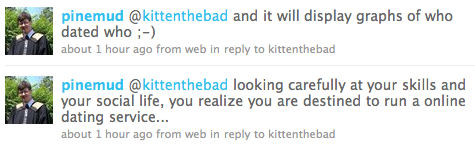
    Here’s the suggestion I received today:

    Suggestion from @pinemud
    Suggestion from @pinemud

    I guess we’ll see if he’s right.

    Seek out people who you respect, who believe in you. There are just 24 hours in each day and you need to sleep – don’t waste them on people who run you down.

    Trust the suggestions from those people – even if you’re not sure you’re as capable as they think you are. There’s likely a reason why they believe in you.

    Say yes. Sometimes you’ll fail, but that too is a learning experience.

    Keep saying yes, even when you fail. This is how you eventually succeed.