Tag: book

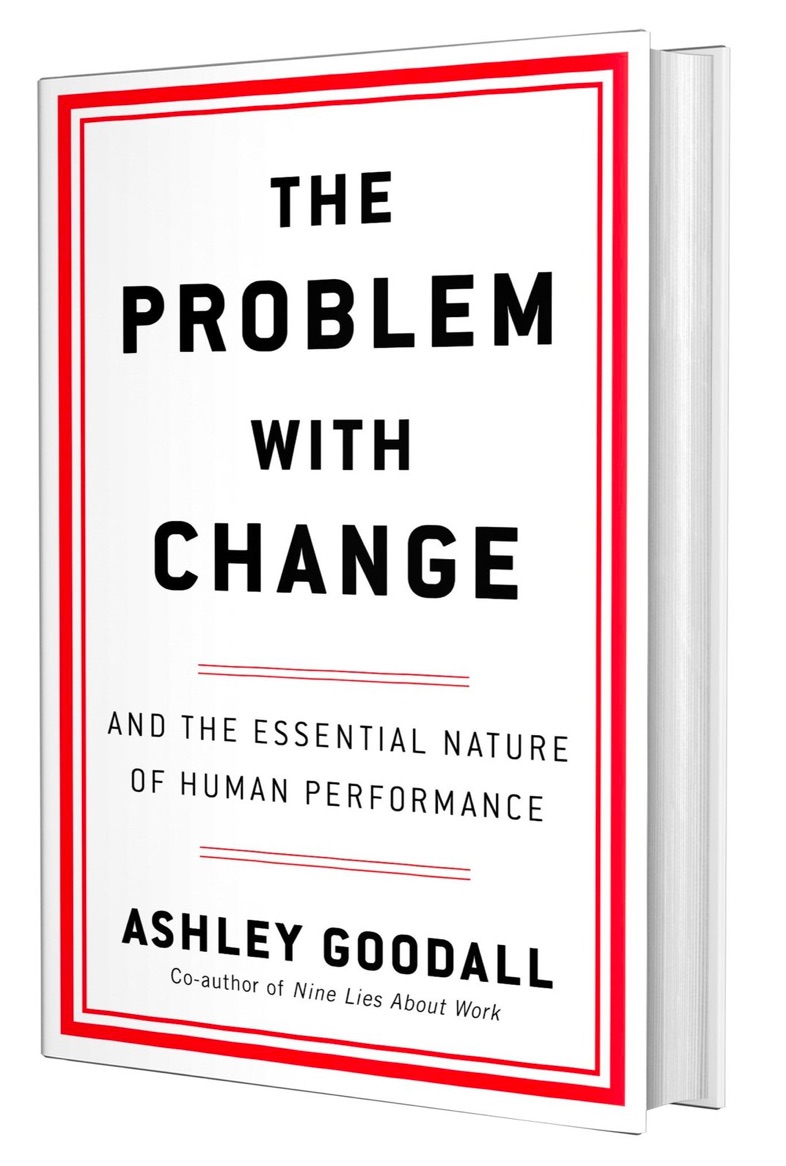
  • Book: The Problem with Change

    Book: The Problem with Change

    I think the thing I enjoyed most about Ashley Goodall’s The Problem with Change is the author’s cynicism about corporate America. In places it’s a little bit of a diatribe, but what can I say, I love it. I love it all the more that it comes from someone who successfully navigated the Byzantine ladder of advancement that is Corporate America – this is someone who succeeded in the system enough to add extra weight to the deconstruction of why the system itself is nonsense.

    The core thesis of the book is that there is too much change for change’s sake, and a lack of evidence that backs that up as driving effectiveness. In fact the opposite. Human flourishing and human productivity are entwined, and the things that make the best conditions for that are themselves quite human.

    • Make space – don’t control people, create the conditions for effectiveness.
    • Forge undeniable competence – understand strengths and unique value, and how it delivers value.
    • Share secrets – belonging is not driven by corporate values statements but by information that is specific and more meaningful.
    • Be predictable – leaders who are consistently defined by the people multiple levels drive more impact.
    • Speak real words – remove corporate jargon and buzz words and be clear about what is.
    • Honor ritual – ritual is a core way to create belonging, and consistently is the most important aspect.
    • Focus most on teams – teams are the units that drive results (and also the strength of the team is one of the strongest predictor of engagement scores).
    • Radicalize HR – HR needs to align with employee flourishing rather than business metrics.
    • Pave the way – look at making the paths people do take easier, rather than defining new paths.

    Some things in the list are easier to implement than others; it’s not the most directly actionable book. But it gave me many things to think about, and was worth the time to read.

  • Book: Trust Your Canary

    Book: Trust Your Canary

    I started reading Trust Your Canary (Amazon) to better understand the concept of “incivility” which had come up as part of some of our DE&I work.

    It was pretty helpful around that, but probably the majority of the value I got out of it was in the first few chapters. It also made me consider things that had been normalized working in relatively “uncivil” environments for the majority of my career. However, I found it hard going for a number of reasons – to be fair to the book, a big one was it was just one long trigger about a really toxic work situation.

    I’m unclear how helpful it actually was in the end. The guidance was both too abstract and too concrete – in the abstract, it was unclear what to do with it. In the concrete, many of the examples were so egregious, that it was unclear how to apply such things back to a more “normal” level of incivility. It was also heavily office based, with much discussions of union reps etc which made it read like a book about another era.

    If you’re looking for depth on the concepts of incivility, it could be worth reading the first few chapters. But generally I don’t think it’s worth the time.

  • Book: Let’s Talk

    Book: Let’s Talk

    Let’s Talk: Make Effective Feedback Your Superpower (Amazon) was so good – I read an interview with the author, ordered it immediately, read it soon after, and was already recommending it to people a few chapters in.

    It’s a book about feedback, which, cool, plenty of them, and plenty of conversations about feedback. The thing that’s different here is that it’s not simplified processes or models – it’s a book about how people respond to feedback and how to work with people’s normal reaction to help them effectively work with the feedback you have for them.

    Some key takeaways:

    • Side with the person not the problem – this is huge, it depersonalizes the feedback and puts you on the same side as the person you’re giving it to, better positioning you to help them address it.
    • More positive feedback, it makes people feel seen – I love this, and have believed this for years – great to have the research and external source to back it up.
    • Listen first, it makes people more receptive – again, something that I have tried to practice for a while, it’s good to have the validation and encouragement and something better to offer other people than my own opinion.
    • Create the space to neutralize defensiveness – builds on the previous two. If someone’s feeling defensive (like they don’t feel their hard work or strengths are recognized, they haven’t had the opportunity to explain), they are less likely to hear you. But beyond that, if you’re going to give someone really tough feedback, this is about creating the space and being willing to walk through it with them.

    At the end of every chapter, there’s a useful summary that will make it easy to refer back to, and at the end there’s section on how to do deliberate practice. It’s so helpful, and I highly recommend it.

  • Book: Good Strategy/Bad Strategy

    Book: Good Strategy/Bad Strategy

    I loved Good Strategy/Bad Strategy (Amazon) and learned so much from it. What really stood out to me was the depth required in defining strategy, and the way of thinking that takes that depth, and constructs a long term trajectory built on proximate objectives – the next steps that seem totally possible from where we are now. This was the kind of book I was recommending even before I finished it, I definitely think it’s worth the time. I’ve included many quotes below, all emphasis is mine.

    Early in the book he gives the example of Napoleon, who split his ships into two columns, destroying 2/3 of the other fleet with no loss to his own.

    Good strategy almost always looks this simple and obvious and does not take a thick deck of PowerPoint slides to explain. It does not pop out of some “strategic management” tool, matrix, chart, triangle, or fill-in-the-blanks scheme. Instead, a talented leader identifies the one or two critical issues in the situation—the pivot points that can multiply the effectiveness of effort—and then focuses and concentrates action and resources on them.

    He is damning on the sub prime crisis, and specifically about Lehman brothers taking on more risk without mitigating it.

    Being ambitious is not a strategy.

    These two examples in the opening nailed – for me – the idea that strategy is unrelated to ambition, and charisma – it’s not how motivating the presentation it is, or how grandiose the claims… it’s about what it actually is, the reality it exists in, and the effects that unfold.

    A good strategy does more than urge us forward towards a goal or a vision. A good strategy honestly acknowledges the challenges being faced and provides an approach to overcoming them. And the greater the challenge, the more a good strategy focuses and coordinates efforts to achieve a powerful competitive punch or problem solving effect.

    Damn!

    Unfortunately, good strategy is the exception, not the rule. And the problem is growing. More and more organizational leaders say they have a strategy, but they do not. Instead they espouse what I call bad strategy. Bad strategy tends to skip over pesky details such as problems. It ignores the power of choice and focus, trying instead to accommodate a multitude of conflicting demands and interests. Like a quarterback whose only advice to teammates is “Let’s win,” bad strategy covers up its failure to guide by embracing the language of broad goals, ambition, vision and values. Each of these elements is, of course, an important part of human life. But, by themselves, they are not substitutes for the hard work of strategy.


    The section on bad strategy was gripping and recognisable – such a clear articulation, so pointed, so damning. I was taking pictures and sending it to friends, as it so clearly articulated things we have complained about.

    The definition of bad strategy is on point.

    Bad strategy is long on goals and short on policy or action. It assumes that goals are all you need. It puts forward strategic objectives that are incoherent and, sometimes, totally impracticable. It uses high-sounding words and phrases to hide these failings.

    As is the failure mode. This is such a good articulation of something I have been calling “failing managers blame”.

    When a leader characterizes the challenge as underperformance, it sets the stage for bad strategy. Underperformance is a result. The true challenges are the reason for the underperformance.

    Why we fail to create strategy:

    The essential difficultly in creating strategy is not logical; it is choice itself. Strategy does not eliminate scarcity and its consequence—the necessity of choice. Strategy is scarcity’s child and to have a strategy, rather than vague aspirations, is to choose one path and eschew others. There is difficult psychological, political, and organizational work in saying “no” to whole worlds of hopes, dreams, and aspirations.

    I was particularly fascinated by the distinction between leadership and strategy, and charisma as a driver of bad strategy – I’m sure we all have examples of bad (but charismatic) leaders, however some of the most strategic leaders had no charisma. Whilst leaders have to get people through the change than strategy entails (charisma is helpful here), the strategy itself is figuring out what purposes are worthwhile and possible to accomplish. This has to be grounded in reality, not wishful thinking.

    I do not know whether meditation and other onward journeys perfect the human soul. But I do know that believing that rays come out of your head and change the physical world, and that by thinking only of success you can become a success, are forms of psychosis and cannot be recommended as approaches to management or strategy. All analysis starts with the consideration of what may happen, including unwelcome events.

    Good strategy is about reducing ambiguity such that people can actually deliver.

    Phyllis’s insight that “the engineers can’t work without a specification” applies to most organized human effort. Like the Surveyor design teams, every organization faces a situation where the full complexity and ambiguity of the situation is daunting. An important duty of any leader is to absorb a large part of that complexity and ambiguity, passing on to the organization a simpler problem — one that is solvable. Many leaders fail badly at this responsibility, announcing ambitious goals without resolving a good chunk of ambiguity about the specific obstacles to be overcome. To take responsibility is more than a willingness to accept the blame. It is setting proximate objectives and handing the organization a problem it can actually solve.

    I found this piece on timeframes helpful. I am now somewhat obsessed with proximate objectives – such a helpful description of a way of thinking.

    Many writers on strategy seem to suggest that the more dynamic the situation, the further ahead a leader must look. This is illogical. The more dynamic the situation, the poorer your foresight will be. Therefore, the more uncertain and dynamic the situation, the more proximate a strategic objective must be. The proximate objective is guided by forecasts of the future, but the more uncertain the future, the more it’s essential logic is that of “taking a strong position and creating options,” not of looking far ahead.

    Gilbreth’s building techniques as an example, “business process transformation” or “re-engineering”. I love this articulation – it really ties into my thoughts on the judicious application of process, and the need for empathy.

    Whatever it is called, the underlying principle is that improvements come from re-examining the details of how work is done, not just from cost controls or incentives.

    The same issues that arise in improving work processes also arise in the improvement of products, except that observing buyers is more difficult that examinings one’s own systems. Companies that excel at product development and improvement carefully study the attitudes, decisions, and feelings of buyers. They develop a special empathy for customers and anticipate problems before they occur.

    This definition of “culture” is not an interpretation I have thought of or heard before, but was immediately helpful in the way I consider and approach things.

    We use the word “culture” to mark the elements of social behavior and meaning that are stable and strongly resist change.

    The importance of context – this is so critical, and explains why so many leaders who move to a new context fail – because they don’t acknowledge the context, and just try and do the same again.

    A good strategy is a hypothesis of what will work based on functional knowledge and your knowledge of your own business – this is a crucial insight. Many people find success in one area, and then fail in the next because they apply the same strategy in a different context. Good strategy is only good in context.

    Treating strategy like a problem is deduction assumes that anything worth knowing is already known—that only computation is required.

    There was a whole section on why we have to question our ideas and consider more than one, which I think is really important – the first idea often seems like the one that will work, but I think the first idea is often the one that is just the easiest to contemplate.

    Thus, when we do come up with an idea, we tend to spend most of our effort justifying it rather than questioning it. That seems to be human nature, even in experienced executives. To put it simply, our minds dodge the painful work of questioning and letting go of our first early judgements, and we are not conscious of the dodge.

    Finally, the section on keeping your head and heard mentality was really helpful – the example of re-enforcement in financial markets where optimism begets optimism and problems beget panic is a good but extreme example – human emotions are contagious, and this happens in less measurable ways elsewhere, too.

    I really recommend it – I learned a lot. It gave me tools, and also confidence to call the strategy I already do what it is.

  • Book: Love Sick

    Book: Love Sick

    love sick.jpgI read Love Sick on the recommendation of my friend Natasha. I found it an interesting and at times helpful read, but whether or not it’s interesting probably depends on the person.

    It’s about the way people experience love, mostly as told by literature, illustrated with comparison to mental illness. It’s heteronormative, and not exactly balanced in terms of gender representation even then – skewing towards the experiences of men. Caveats aside, I found it interesting as a kind of… academic deconstruction of an intensely emotional experience. I felt like it gave me context and some kind of idea of what healthy romantic relationships look like – or at least what to avoid.

  • Book: Dear Ijeawele, or A Feminist Manifesto in Fifteen Suggestions

    I bought Dear Ijeawele, or A Feminist Manifesto in Fifteen Suggestions (Amazon) by accident trying to buy We Should All Be Feminists, but I have no regrets because I loved it, found myself reading it going yes yes yes and so what follows is not a review so much as a strong endorsement that you should really read it, too, and a collection of quotes that stood out, emphasis mine.

    Feminist premise: I matter. I matter equally.

    “That absurd idea of ‘men will be men,’ which means having a much lower standard for men.”

    “Be a full person. Motherhood is a glorious gift, but do not define yourself solely by motherhood. Be a full person. Your child will benefit from that.”

    “Everyone will have an opinion about what you should do, but what matters is what you want for yourself, and not what others want you to want.”

    “If we stopped conditioning women to see marriage as a prize, then we would have fewer debates about a wife needing to cook in order to earn that prize.”

    “Please see Chizalum as an individual. Not as a girl who should be a certain way. See her weaknesses and her strengths in an individual way. Do not measure her on a scale of what a girl should be. Measure her on a scale of being the best version of herself.”

    “Gender roles are so deeply conditioned in us that we will often follow them even when they chafe against our true desires, our needs, our happiness. They are very difficult to unlearn, and so it is important to try and make sure Chizalum rejects them from the beginning.”

    “But here is a sad truth: Our world is full of men and women who do not like powerful women. We have been so conditioned to think of power as male that a powerful woman is an aberration. And so she is policed. We ask of powerful women: Is she humble? Is she grateful enough? Does she have a domestic side? Questions we do not ask of powerful men, which shows that our discomfort is not with power itself, but with women. We judge powerful women more harshly than we judge powerful men.”

    “We condition girls to aspire to marriage and we do not condition boys to aspire to marriage, and so there is already a terrible imbalance at the start. The girls will grow up to be women preoccupied with marriage. The boys will grow up to be men who are not preoccupied with marriage. The women marry these men. The relationship is automatically uneven because the institution matters more to one than the other. Is it any wonder that, in so many marriages, women sacrifice more, at a loss to themselves, because they have to constantly maintain an uneven exchange?

    “In every culture in the world, female sexuality is about shame. Even cultures that expect women to be sexy—like many in the West—still do not expect them to be sexual.”

    Teach her that to love is not only to give but also to take. This is important because we give girls subtle cues about their lives—we teach girls that a large component of their ability to love is their ability to sacrifice their selves. We do not teach this to boys. Teach her that to love she must give of herself emotionally but she must also expect to be given.


  • Book: The Gifts of Imperfection

    Book: The Gifts of Imperfection

    51W08ZSkHSL._SL250_A book recommendation at the perfect time is a gift. That’s what The Gifts of Imperfection (Amazon) was for me when my coach recommended it. It’s hard, as a result, to describe what I got out of it – I read it in 3 (weekday, working) days – in this place of yes yes yes this is what I needed to hear right now thank you. Two things I want to pull out of it. We don’t achieve more by being too hard on ourselves. It’s good to be motivated. It’s counterproductive to beat yourself up. One thing I’ve caught myself doing lately is telling myself that I don’t have time to eat yet. I’ll keep faffing around when it’s lunchtime and I’m hungry because I think I need to get some more things done first. Or I’ll delay finishing work and eating dinner and working out because I have more I think needs to be done. But I never achieve that much when I’m hungry… I’m trying to say “that can wait” and shutting my laptop in search of food and fresh air. It’s not been detrimental to my productivity. The second is a question – what does brave look like? She takes the example of criticism. Is it brave to respond to criticism by responding to it? Or is it brave to respond to criticism by sitting with it and understanding why it makes you feel how you feel? The answer is it depends on you and the criticism, and leaning into the feelings even when they make you uncomfortable will make it clear. There’s a metaphor in the book that has stuck with me. We’re by a swamp, and that swamp is our shame. On the other side is where we want to be, and we think we can get there by edging around it. It’s easier, and faster, and better – and possible – to get there by wading through the swamp.
  • Book: The Coaching Habit

    Book: The Coaching Habit

    coaching_habit.jpgThe Coaching Habit (Amazon) is a really helpful book about asking questions. It starts with the premise of offer less advice, and ask more questions (which obviously I am bought into). I also like the concept of “the advice monster”. It probably belabours the point a bit, but it’s a short read so that isn’t too irritating.

    The first question is “what’s on your mind?” – a good way to open a 1:1. Then you have three directions you can potentially take the conversation in: project, people and patterns.

    The second question is “and what else?” – see where that takes you. Don’t ask rhetorical questions in order to passively dispense advice. Stay open.

    The third question is “what’s the real challenge here for you?” – this gets you to the centre of it (one question I really like to ask in 1:1s is “what are you most worried about?”)

    Questions should start with “what”. For example, the fourth question “what do you want?” – this is the go to question when conversation is not productive and you’re not sure why. You can also say what you want.

    The key to a question driven interaction it to get comfortable with silence – give people time to think.

    The fifth question is “how can I help?” Or more bluntly “what do you want from me?” Important to be mindful of tone with that one! (I like to ask “is there anything I can help you with” towards the end of each of my 1:1s).

    The sixth question is “what are you saying yes to?” and the other side of that, “what are you saying no to?” – this gets to actively choosing priorities.

    It’s important to acknowledge answers to questions. It’s not an interrogation!

    The last question is “what was most useful here for you?” Offer what was most useful for you in return. This can help you improve. It sounds scary though – I will have to psych myself up and try it!

    Main caveat – I’m following a reading list lately which means the writers are less diverse than I usually aim for. This book cited men I think exclusively, including a man giving a talk that mentions a study… which I recognized as being by Sheena Iyengar (a blind woman of color) whose name wasn’t even mentioned (watch her TED talk – it’s amazing). The book recommendations at the end were seemingly all by men. It was definitely a helpful book but possibly missing context about the other 50% of the population. Maybe that’s why the act of asking questions instead of offering advice seems so radical.

  • Book: Scrum

    Book: Scrum

    4180zdv6JCL._SL250_.jpgScrum: a Breathtakingly Brief and Agile Introduction (Amazon) was as brief as the subtitle promised. A friend recommended it as a good primer, and as my understanding of Agile comes from university and osmosis, I bought the book and gave it a read.

    I appreciated how succinct it was, and feel like I have a good grasp on what Scrum is (and isn’t) now. It felt expensive for a ±20 minute read, but perhaps I was paying for the time I didn’t spend reading extra unnecessary verbosity.