Author: Cate

  • Your Customers on Twitter

    Twitter has a load of random uses. So far, I feel they fall into 4 categories: making things tweet, ridiculous, heart-warming and innovative.

    Making things tweet: an office beer tap, pets, plants, unborn babies, laundry machines, electricity consumption meter, the oven, a chaira rocket, a house, your server.

    Ridiculous: promote your brothel (Twitter might perhaps be a slightly too public medium for this to be that effective), “punk” your followers, send prayers to the “prayer wall” (believers would likely disagree with my categorization here), have a baby.

    Heart-warming: Foodies exchanging “twifts” on Twitter, averting suicide, #blamedrewscancer, proposing on twitter, honoring Dumbledore.

    Innovative: Restaurant reviews, test for paranormal abilities, burglars can use Twitter  to find out when you’re away and rob you (note, it’s the burglars being innovative, not the tweeter), reporting 311 (non urgent issues like potholes etc), travel tips, track down stolen bikes, sell your house (if you’re @Biz), explore sentiment, monitor the response to flying Air Force One over the statue of Liberty.

    It has some practical business applications too. Again, I’ve tried to split them into categories.

    Communicating: as a replacement or complement to job boards, a public message to your nemesis (Microsoft to Google), your competitor (Coca Cola and Pepsi), and the competition you describe as “a cancer” (Microsoft again – perhaps they changed their mind?)

    Promoting: Twitter is a natural platform for contests and giveaways, and it’s share of the marketing budget is growing, american eagle is one example, for a small business it can make a huge impact, other small business users using twitter for marketing. Real estate agents and even an individual selling her house have been using the service too. Pepsi now include their Twitter handle on the can.

    Money-making: traders use Twitter to help read the markets, sponsored tweets, affiliate fees.

    Interesting article on 10 ways Twitter will change business is this one (from TIME). Quote:

    As Twitter grows, it will increasingly become a place where companies build brands, do research, send information to customers, conduct e-commerce and create communities for their users. Some industries, like local retail, could be transformed by Twitter — both at one-store operations that cater to customers within a few blocks of their locations and at the individual stores of giant retail operations like Wal-Mart (WMT).

    I think the biggest potential of twitter is to hear what you’re customers say about you to their friends. If you know what your word of mouth is… that’s phenomenal. There’s an interesting paper studying this.

    Businesses have no excuse not to be on Twitter. See all the crazy things people are doing! Getting on there and tweeting the odd promotion or bit of company news shouldn’t seem like a big deal. Now, I make a point that when I have a mediocre experience somewhere – I tweet it. For instance, I had something really gross at Cora’s the other week, followed by lousy service when they mentioned “next time”. Buddy, there will be no next time! So I tweeted
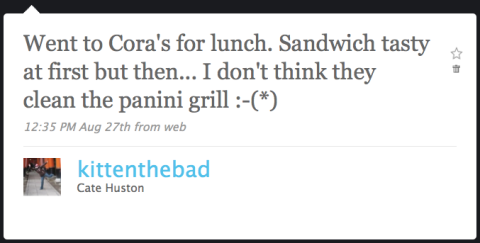
    Brunch at Cora's was a mistake

    No response – but who cares? To be fair, when I have a great experience with a company I tweet it too. @Zappos were really good, and I twittered as much.

    My supervisor has been having some issues with the Ning social network he set up for his class. They’d tried various means of reporting the problem – no response. I said, Twitter it. So I (and two of my office mates) did. Response:

    Response from Ning

    They get it. The opportunity to know what word of mouth you’re getting – big deal. And for customers – the opportunity to ask the question, flag the problem, and get a quick response? Isn’t that what CRM is all about?

    We’re still waiting for Ning to resolve the issue, so we’ll see whether it translates into action. But still – a response is a start. If you want to see a company getting it wrong, search on “purolator” to see a stream of customer frustration. Their empty twitter account suggests they’re doing nothing about it.

  • Relationships 2.0

    I had an argument with a friend yesterday. He’d been a little economical with the truth and I found out and was angry. I found out via Facebook – of course. Facebook knows everything.

    This propelled me to write this post I’ve been thinking about for a while. The thrust of the talk that I will give in December is how much computers and the internet have changed the way humans live. Perhaps the thing that has been changed most is our relationships.

    If the web is now a communication medium, what more powerful way to change our relationships than to change the way we communicate? I know someone who broke up with her boyfriend by changing her relationship status. My boyfriend and I mostly keep our interactions off Facebook, but we do argue on Twitter from time to time – to the amusement of our friends. Of course, I’ve also seen people playing out their breakups on Facebook, using it as a medium to exchange those messages, you know, where he tries to explain that it’s over and she begs and pleads and promises everything to make him come back.

    One of my friends is dating someone who I consider toxic and try and avoid. Now that they’re “Facebook-official” I can’t use the reasoning that it’s not on Facebook and therefore can be ignored anymore. Wow. Taking a step back and looking at this objectively – I’m amazed that this is how we interact now. My friends and I have our share of drama, but I don’t think that as a group of 20-somethings we’re that out of the ordinary.

    Admittedly most of my knowledge of dating in the pre-Web 2.0 era comes from Sex and the City. But did people use to look up the people they go out with using Google and Facebook? Pick people up via mutual friends on Facebook? Analyze their date’s Facebook profile with their friends? Pick people up on dating sites? Check out the exes? Facebook increases jealousy in relationships, well yeah. Of course it does! What other medium can you use to obsessively stalk and obsess over your recent exes’s new girlfriend? Note – this was not my behavior, but the behavior of someone I knew. She was obsessive after her breakup – and Facebook helped every step of the way. She’s not alone, though – there was an article in September’s (UK) Cosmo written by a guy who’d found out that his ex had got married (via Facebook). He was quite upset, but is continuing the stalking – looking for baby pictures.

    When I last broke up with someone I quit Facebook for a month. I also started checking my email only once a week (after reading Tim Ferris’s The 4-Hour Work Week) and I happened to be working in the US (I’m British, most of my friends are too – this was before I moved to Canada). So I literally didn’t talk about how upset I was for a month. By getting rid of Facebook, I could just put dealing with it on hold for a while. I was working about 70 hours a week – it was helpful.

    However it got me thinking. We used to take our dumped friend’s phone when she was inebriated. Change “his” number to ours to stop the obsessive calling. What do we do now? I changed someone’s password, once, to stop the stalking. Others thought it a step too far, but it seemed to help (albeit temporarily). Our friends could be our will power before, but how do we do that now? I wonder if there’s a business model in a 3rd party service that locks you out of things, archives the romantic emails and the pictures until you (and a trusted friend) confirm that you’re no longer a nutcase.

    On a more upbeat note, you can also use Facebook to help create relationships – basing your dating profile on your Facebook profile and having your friends vouch for you. Niche dating sites are doing well, there’s even one that’s more of a matchmaking service (although results seem to be mixed). So it’s not like Web 2.0 is just destroying relationships – it’s creating them too. It’s just a lot of change.

    Some people still meet the normal way. I recently introduced two people last week, they’re getting on well so far! And in India it’s common to meet your partner at work – some companies even have internal dating sites! And, of course, if it doesn’t work out there are plenty of blogs by and for the dumped.

    It’s not just your boyfriend or girlfriend though. What about our friends? Like I mentioned above, I don’t interact with my boyfriend much on Facebook but I definitely interact with my friends. I use it to plan and organize events for my local friends and keep in touch with the ones I’m away from. I’m a big fan of ambient awareness or ambient intimacy, I like to know what’s going on with my friends that I don’t get to see that often any more. Sure, some people are less interesting than others but I can turn them off any time I want. There’s a really interesting NYT Magazine article about ambient intimacy, it’s long but very worth reading. Of course, there are mixed opinions – the alternative view. For younger people, “real” friends are on Facebook, apparently – due to ease of sharing and the level of interaction.

    What about, though, the people you’d like to just fade out of your social circle. In the past if someone pushed it too far, you could just “forget” to invite them to things. If you delete someone’s number, they’re never going to find out unless you run into them (and you can always claim to have got a new phone / had a problem where all your numbers mysteriously disappeared). Whilst Facebook doesn’t broadcast when you “un-friend” someone, if someone catches on they can definitely tell. Unfriending is this more active step to dropping someone from your social circle – but it’s so necessary, because there’s so much information on Facebook that if you don’t they will know what’s going on, maybe assume they’re invited. There’s not much overly personal about me on Facebook anymore, but even so – there’s enough that I’m just not comfortable with someone I don’t like having access to it. De-friending, or Un-friending is this whole new area of privacy and etiquette that there’s no consensus on yet. Will there ever be, though? We’ve probably always managed our relationships differently. Just now with the popularity of services like these, it’s harder to hide how differently.

    Sometimes I feel like Facebook is awful. In some ways, I kinda hate it. I hate how gossip propagates, how quitting it for a while is a big deal. I hate that some people don’t just fade away as you thought they would. I hate the whole area of un-friending, but think it’s necessary. I hate the opaque privacy settings. I’m a little weirded out by how it’s normal to start a conversation by, “So how’s <<X>>? I saw <<Y>> on Facebook…”. But here’s what I hate most – that I can’t live without it, because it’s so great for keeping in touch, because for those people I want on my Facebook there’s this great medium for us to interact and invite our other friends to interact with us. Because weird a conversation starter as it is, it’s a conversation starter. And I love having conversations in the real world, too.

  • Unlikely Source

    I was reading a paper today, about mashups. It’s fairly interesting, and you can find it here (you’ll need an ACM account, sadly). It explores how end users feel about mashups. What kind of value do they see in them and would they create them if they had the knowledge?

    I read something a long time ago about men and women having differing attitudes to applying for jobs. Men have a more “have a go” attitude, whereas women read the requirements and evaluate themselves against them (and are more willing to find themselves lacking). And yesterday, in our meetings about WISE we were talking about this – about how women judge themselves more harshly.

    These sections of the paper struck me.

    “When we examined users’ ratings as a function of the demographic and online activity measures summarized earlier, we found a relationship between Difficulty and Gender, with women judging mashup creation to be more difficult than men (3.38 for women; 3.04 for men, t(219)=2.60, p<.01). This relationship held even when self-reports of computer expertise were used as a covariate. In contrast, ratings of Usefulness were not related to demographic or online activities variables.

    The gender effect on predicted difficulty of mashup creation is consistent with other reports of gender differences in EUP. Several studies have shown that women report lower self-efficacy for spreadsheet debugging and that this seems to inhibit their use of novel features [1]. Another study found that women had less confidence in their success on a web development project [10]. These researchers have theorized that males may be more likely to overestimate their ability to solve new problems, and that this may be one source of the differences in confidence and self-efficacy.”

    “For instance, men rate themselves more highly than women in both Computer Experience (t(223) =7.09, p<.001) and Technology Initiative (t(222)=7.12, p<.001).”

    “We found it particularly interesting that neither Gender nor Computer Experience played a role in predicted Mashup Frequency, although at the same time we must keep in mind that Difficulty judgments were strongly related to Gender”

    “The observation that female users expect mashing up to be more difficult than males is consistent with other studies of gender effects in EUP. Unfortunately, the self-perceptions that promote these differences may also inhibit women from exploring new EUP technologies like mashups. Given the relation of hobby activities to likely mashup use, perhaps one direction for future work is to create data feeds and services that specifically support women’s hobbies and interests.”

    So I guess this confirms what many of us know – women often underestimate their capabilities. In what other ways are we selling ourselves short?

    I find this almost inspirational. Last week when my proposal got accepted they asked me if I could do it in French. I told my supervisor about this, this morning. He said I should have said yes and that he would help me. After reading this paper I emailed them saying I could present in French as well. I’ll be terrified, but underestimating myself also means I don’t push myself. So I’m going to make a conscious effort to push myself more, starting with this. Wish me luck!

  • Deleting My Xing Profile

    It’s hard sometimes to manage your social networking presence. I have three main ones that I use (aside from this blog) – Facebook (friends only), Twitter, and LinkedIn (professional). I just added a fourth – Brazen Careerist – mostly because I read Penelope Trunk’s blog avidly. Realistically though, I have way more – Wakoopa, LastFM, 43 places and others that I’ve probably forgotten about.

    I signed up for Xing because I was trying to get in touch with my roommate from boarding school after I lost the card with her email address on it. Now she’s seen the light and joined Facebook, and I have no use for it. So I was trying to delete my profile, there’s no point having another profile on a site I never use, which duplicates the functionality of ones I do! I’m fairly confident that data protection laws mean you have to be able to delete your profile, but in practice it can be hard to work out how. In the end I settled for maxing out my privacy settings but when I got an email from them today (suggesting I upgrade my account!) I noticed a useful link that you can use to ask for help.

    So I did, and I was impressed by the quick reply. In case you want it too – to delete your Xing account, go to https://www.xing.com/app/user?op=cancel.

  • Perseverance

    On Wednesday I was getting on my bike, when my kneecap briefly rotated around the side of my knee. It was seriously painful, and I keeled over, bike with me, and my bike frame landed on my hurt knee. Ouch.

    I got picked up (literally, I was in the road) by some kind strangers and called a cab to take me home (this is why people have cell phones! I’m so glad I got one). My boyfriend was close by, thankfully, and he came and rescued my bike and got me into the taxi. At this point, I pretty much couldn’t walk.

    My friends and I were meeting at a restaurant nearby my apartment, but one of them called me (D) and he set off for my apartment building to rescue me. The taxi driver got me out of the taxi, and another of my friends (coincidentally) arrived outside my apartment and he was trying to support me with one arm and push his baby with the other. Then D turned up and we all got inside.

    Finally I was at my apartment, covered in a dust, gravel, a bit of blood, and lots of tears. By this time, I could put a little weight on my knee again (I’ve done this before, at first it’s agony but after a while it’s just swollen, stiff, and painful).

    So that’s 3 strangers, 2 builders, my boyfriend, a cab driver, and two of my friends. 9 people. And little me having a stupid accident – again. And then 3 more friends showed up at my apartment, and my friend who’s been here visiting us and everyone’s saying, don’t worry Cate, we don’t have to go out, we’ll get takeout etc. And I washed my face, found a clean t-shirt and said – no, we’re going out. We have a reservation, and damnit when I concussed myself and went to hospital I was skiing 2 days later (and took my CSIA Level 1 the same week). In fact the 2nd (trying to learn to snowboard), third (idiot hit me) and fourth (took flight and landed on head) times I concussed myself I was skiing again the following day. I trained in martial arts in China, and when my master beat me I didn’t give up and go home (I got off lightly because I’m a girl, but still – it hurt). When I went over my handlebars after making some poor judgment in my bike riding, I walked for a bit, sure, but I made it to the end of the 46 miles. In fact the last few times I did this to my knee, I strapped my knees up, added a load of duck-tape… and went skiing.

    Physical perseverance is easy. It is easy to push yourself to train harder, and the more you push yourself the easier it gets. It’s easier not to, of course, but mental perseverance is much harder. It’s easier for something that’s abstract to be more overwhelming. It’s easier to let it overwhelm you.

    I’ve been getting a little overwhelmed lately, and what I’ve started to realize is that I need to take the same attitude that I do when I’m skiing, kickboxing, biking, or otherwise injuring myself.

    1. Delegate. 9 people got me home the other day, it’s not a shameful thing to let people help you when you’re physically hurt, so why do we not ask for help when we need it for more abstract things? I’ve been trying to get this WISE chapter going and at first I was doing stuff myself because I thought it was easier than asking someone else to help. It’s not! Now we have a great team, and I ask them to do things. I still have a lot to do, but more is getting done overall. It frees me up for stuff that is important, but not critical – like putting together our website.
    2. Progress is progress. If I’m injured I might still ski, but I probably won’t take that double black mogul run. I’ll still go kickboxing when I’ve hurt my shoulder, but I’ll moderate what I’m doing so I don’t injure it further. When you’re feeling overwhelmed it’s easy to just stop and not achieve anything, but crossing some smaller and easier tasks off The List mean you’ve still done something and the bigger task will hopefully seem more manageable tomorrow. Or just do a little bit of the bigger task. A friend told me a story about his dad, he came home and found his dad had eaten this whole cake. When asked, he said, “I ate it in little pieces”. The meaning I want to take from that story – chipping away at things works!
    3. Sometimes you need time off. This morning, I said to my boyfriend that I might just strap up my knee and go kickboxing. He said, “that’s a stupid idea”. And he’s probably right. I’m still thinking about it though… as a grad student I have all this guilt, I feel like I should be working all the time and it’s just not possible. Taking Sundays off has been making a big difference to me, it actually improves my productivity. I’m refreshed on Monday, and get more done during the week because I know that very little will happen over the weekend. By having a goal to finish work by a certain time so that I can kickbox, or go out with my friends I focus better. Having a 9-5 job gives you structure, and I miss that. But if I can emulate that, it’s very helpful.

    I’m not sure what I’ve learned in class at grad school is the most important thing I’ll get from it, and I’m not sure being really smart actually helps you so much. I know people who are very smart who’ve opted for mediocrity, or suburbia before 25, or are still at graduate school seemingly with no plan to finish (or publish). Maybe they’re happier, and perhaps personal relationships are more important. I don’t know. I think I’m inclined to agree with this blog post by Alex Bogusky – if you have to be afraid of something, then fear mediocrity, though. But given the economy, and the rate at which things are changing right now (Java is my preferred programming language, but I can’t bank on it being in such heavy use in another 10 years) what’s more important will be the ability to learn, the motivation (and perseverance) to keep learning, and the other intangible skills we learned along the way.

    Semi-related – interesting post from Seth Godin about Positive Thinking.

    Slightly more related – post by Penelope Trunk about the relationship between exercise and career success.

  • Exciting News!

    Back in August I submitted a proposal for the Holiday Science Lectures at the University of Ottawa. I blogged about it at the time here. I’m really excited, because it’s been accepted and I will be presenting it this December!

    50 word (50 words! How am I supposed to sum it up in 50 words? Oh well, I had a go) synopsis is below:

    Art, Life, and Programming

    Code is like a paintbrush, and the Internet is the world’s biggest art gallery. Invented just 20 years ago the Internet has changed everything. Less than 24% of humanity has access to the Internet; there is more change to come. What can we expect technology to change in the future?

    Thanks to everyone who looked over my slides and my proposal!

  • Page Views vs. Engagement

    There’s an interesting article here entitled Audience vs. Traffic. It’s about how engagement is more important that hits, and has an interesting point on the newspaper industry as well.

    I’ve said this before, but as we get more sophisticated ways to measure engagement things will change.

  • I <3 Google Docs

    Check out the video from Google, below.

    I thought it was really cute. Google docs is a great, free alternative to MS Office, but that’s not where the real power of it lies. For collaboration, for any document that anyone else is going to use, it’s such a better alternative.

    During the summer, I was working for a company that was sending spreadsheets about. Seriously. One of my colleagues and I said “this is ridiculous!”, because it was, and put what we needed into a Google doc. Our job was made exponentially easier and it took less than half an hour.

    I’m President of uOttawa WISE (Women in Science and Engineering), and we’re working hard to get things set up for the start of term. There are a myriad of organizational documents, but I think I’ve only emailed one – which was heavy on formatting. I have one spreadsheet on my computer – because it’s confidential. Anyone involved can see what we’re doing, and any new volunteer can be directed to our Google group where she has access to everything she needs to get up to speed. I had to train two volunteers in how to use docs, but given the time and effort it saves us this was an hour well spent.

    Google docs has some little differences from MS Office, and some things are a little trickier – you can’t right-click to insert multiple rows in a spreadsheet, for example. But some aspects of it are actually better.

    The video below is amazing. And those cool moving graphs? You can make them in Google docs, using the Google Gadget Motion Chart. There’s a quick guide how to here.

  • The Social Network Business Plan

    So as I mentioned in an earlier post, I’ve been reading The Social Network Business Plan. The premise of which is that the next big thing will be Social Networks built around products or services, for which there are 18 revenue channels – including subscription, conferences or “get-togethers”, and finally chopping up what people are saying and selling it to companies. He thinks that this will replace advertising and marketing and that the massive amounts of money that used to be spent on such things will flow to the entrepreneurs running Social Networks (but not Facebook).

    He does have a point. My generation have grown up seeing adverts everywhere, and we don’t notice them anymore. I know there’s research in support of this, but I’m not going to take the time to look into it here. Suffice to say, it’s 11am and I walked into university this morning and I’ve spent the last hour on various websites (including Facebook) and my email. I’ve probably been exposed to 20+ advertisements, but I couldn’t tell you what any of them are. That’s not to say advertising is entirely pointless, just that advertisers need to work harder to distinguish themselves. For instance, the Sony Bravia adverts (here and here) really do make me want a Bravia TV (only I’m a student and can’t afford one) and I know that Where The Hell is Matt is sponsored by a company that makes gum – maybe Trident? I even visit the Apple site to watch the Get A Mac ads from time to time, and not just because I’m totally crushing on Justin Long.

    I’ve spent about 5 months in Asia, over the course of 3 trips. And the thing that Westeners find amazing when we go over there is how the streets are lit up with bright, colorful lights all the time (not just November-January, like we do). In the middle of Dalian, China, for example there’s a big disco ball. It’s crazy! But you get used to it, and soon the lights stop attracting your attention and just become normal. It’s the same with adverts, you’ve got this whole generation of people whose attention firms won’t be able to buy anymore – they’ll have to earn it by being genuinely innovative (or finding someone who is genuinely innovative and sponsoring them).

    So I don’t disagree with his premise. Advertising is going to be very different and soon, but I do disagree with his conclusions. A social network might be helpful to self-identify the connectors, the mavens (like Malcolm Gladwell talks about in The Tipping Point), those who influence the opinions of people in their social circle. But I don’t think everyone will be joining one, by any means.

    A subscription model is a big part of the business plan. But of the examples given, each has a differentiation which may make people willing to pay a subscription, which I would argue not everything has. For instance, he gives the example of www.hystersisters.com which is for women to talk about their gynecological problems. A subscription model may work here because women are prepared to pay for privacy, and this kind of deeply personal problem is the kind of thing it’s frowned upon to talk about on Facebook. Similarly with sermo.com which is for Doctors – a subscription buys verification and privacy. There’s been a lot said given the debate on newspapers and the music industry that my generation will just have to start paying for things online, but it’s not that simple. Most likely we will pay if there’s a good reason to (i.e. we need to pay for privacy) but where they’re a free alternative, we won’t. There are a plethora of free places to network on the web, in order to convince someone to pay for something it’s going to have to be really important to them.

    Tipping is another part of the business plan. TipJoy, a company trying to make a business of tipping on the internet went bust this week. The announcement on their blog is here. The most interesting bit is this one:

    We strongly believe that social payments will work on a social network, provided that they’re done within the platform and not as a 3rd party. “Simple, social payments” is *the* philosophy needed to do digital payments right, but once a service groks that, they need only to implement it on their own. We’ve been the thought leaders in this space, we see the hype and excitement, and yet we know very intimately the difficulties in gaining actual traction. The only way to get around this is for the platforms themselves to control payments – then all people wanting to operate on that platform would have to play along.

    So tipping may work, I don’t disagree with that. If I was very into a social network and someone gave me some useful advice and there was a culture of tipping, I would probably do that. But I think he overestimates the revenue from it. Also, something that he doesn’t mention with respect to tipping, is that whilst in North America tipping is common, expected, and a significant part of the revenue for people like wait staff etc this is not the case in other parts of the world. In China and Japan, for example, people don’t tip. I literally had a woman in China chase me down the street to give me the money back after I tried to tip her. And in the UK, whilst we do tip, we know wait staff are getting at least minimum wage, currently 5.73 per hour for workers aged 22 years and older – so we don’t tip anywhere near as much as it is normal to in the US.

    Facebook is written off as a social network trying to make money from advertisements. I think he overlooks it in two respects. Firstly, Facebook has some very valuable data that they’re trying to generate revenue from right now, likely they’ll end up using the aggregate and sell opinions model, so the networks he proposes may be in direct competition with Facebook. Secondly, Facebook doesn’t rely solely on advertising. Facebook gifts are actually a significant and overlooked source of revenue. Now that developers can charge in the apps they build on top of the Facebook platform, that’s another revenue channel – in fact Facebook suggests some business models.

    There is no mention of Twitter. Twitter has so much opinion and information on there, when they start cutting it up and selling it off to interested parties, it will be hard for anyone else to compete. The networks where people will pay for privacy, as I talked about above are likely the only ones with a chance.

    One of the examples he puts forward towards the end of the book is a network for people interested in the environment. There’s this idea that you can run a for-profit, with an affiliated non-profit. I think some things, such as this one, work better as a non-profit period. I expect there are already non-profits out there. One non-profit social network that I’m a member of is Kiva, because I’m keen to support development. Would I pay to be part of such a network? No. It defeats the purpose.

    Finally, even if you set aside the subscription model so there’s no longer that transaction overhead as a barrier to entry, often what I hear from people I talk to is a need to limit the number of social networks they’re a part of. Even with OAuth so there’s not the issue of remembering so many usernames and passwords, will people join a limitless number of social networks? I think there’s an understanding that we put out data out there and with the maturity of the model and the people using it there comes an unwillingness to do so for the sake of it. Each new social network we join has to be evaluated as to what it will add to our social media experience. This means that with time, I think it will get harder, not easier, to launch new ones.