I’m disciplined about scope. Ship the smallest thing that moves you forward. The feature you don’t build is the feature you don’t maintain. When I was running a team, holding the why was the job. Keeping us focused on the things that actually mattered, and away from the things that didn’t.
In Navigating the AI Shift there’s a module where we talk about finding the joy of scope creep, once your core thing is shipped and you can lean into curiosity.
I think this is both the joy and the danger of AI. Everything seems possible, so everything is happening, and you lose sight of the point of it all.
But back to the joy. I wanted to fix our marketing messaging. It had been sitting on my list for… a while, which is a long time for something I’d decided was important.
I hate marketing messaging. But finally, I’d collected all our blog posts, the things we say about running DRI, not the things we write when we’re trying to sell something, and used them to build a point of view that actually sounded like us. It was better. But I wasn’t sure what to do with it.
So I stuck it into Claude design, and entered a few days of absolute madness.
this is what passes for a daily standup in our world
24 hours later, I was rolling out the redesign. New design system, home page, landing page template, all three courses. The messaging that had been stuck was live. A 404 page, just because I could. A “how to expense this” page that Jean rolled out while I was asleep.
24 hours after that, the comparative ugliness of the logged-in views was untenable. So now we have an all new experience, right on schedule for Module 3 of our accelerated cohort.
Objectively, a whole site redesign to unblock one piece of copy is ridiculous.
Practically, it worked.
This isn’t the first time I’ve done this, but it’s the biggest and most visible. I was feeling a bit low and needed a win, and this was my background task that I poked along between a day of too many calls.
The admin portal is just me and Jean. Does it matter? Looking at our previous UX, you would have to conclude: no. But also: don’t we also deserve to have a good experience in what is functionally our workplace? And now the “show cohort progress” item that I wanted but didn’t know how to express, is in.
Jean has the generous read, which is that the creep is productive. Every side quest teaches you where the tools are strong and where they fall apart. The dashboard rebuild went fine. The macOS app I once tried to build for Social Brain, my analytics thing that kept growing until I tried to make it native, did not (yet). I keep learning, I’m getting better at it all.
I’m having a great time.
I had a pause when I realised that Claude design produces very similar sites. I shook it off. Most sites already look the same and it’s clearly better. A designer is not in the budget. Let’s just get it done.
In the course we tell people: find the win, and find the joy. When AI is what everyone else is using and it’s making your work life worse, it sucks. You have to find the thing that makes your work life better. When it’s the stick you have to use otherwise you’ll be laid off, and you might be laid off anyway, there’s no joy there – only fear.
When you shipped the thing you wanted? There’s joy in that.
Lately my wins are getting bigger. I did this in a week when I was feeling low, and I fucking loved it. I learned a ton. The site looks good.
And when the first sale came through on the new look, I thought, oh. Maybe this is why.
We’re really enjoying seeing what people create in our first cohort of Navigating the AI Shift. The next cohort starts June 8, and if you could use help finding the joy of it all, we’d love you to join us.
I have had a beautiful summer. Bookended by two epic trips either side, Hong Kong -> Sydney -> Bali before, and India (Dehradun, Chandigarh, Delhi) after, the summer was peaceful. I prioritized neglected parts of my life. My spine – finally went to the chiropractor, got into yoga, finally learned how to enjoy it. My community – expanded my social circle, prioritized time with friends, including starting a book club (where we just get together and read whatever we feel like reading).
Mybook came out in April, and when I didn’t feel like doing anything other than the day job, when I just wanted to hang out, have fun, I told myself that it was okay. I thought if I enjoyed the summer, made the most of it, whatever would come next would just arrive. I told myself that it didn’t matter if I couldn’t muster the energy to blog, if the single talk I gave felt so exhausting I never prioritized the other talk idea I had. I knew that a large project takes time to recover from.
At the end of the summer I have to question whether that was true. The truth is, that like any large project, my book had multiple endings.
Nearly a year ago, I finished writing. In January, I locked myself away to do the big edit, submitted it, and let it go. In April, I concluded the final copy edits, and it went to print.
In a big project the prospect of the ending is so appealing. It kept me going. “I’ll be so happy when this is done”. Yes. And. I will also miss it. Miss the concrete goals and the certainty. Coming out of a big project I am changed both by the doing of the project, and by being the person who did the thing, rather than the person who thinks of doing it maybe some day. I believe in myself more but also I know what it costs.
The other truth, and maybe this is true of any creative work, putting something out in the world, is not the end of it. It is the beginning of two new phases.
One phase, where you talk about what you’ve done. Try and convince people that it’s worth their time and money to read it. A second phase where you have to ask – what’s next?
I have been a dillitant at the first phase, at talking about it. Told myself, my partner, my coach, various other people, that what I need to do is get back into blogging. Thought about ideas, sporadically, and executed on them, almost never. Some topics I feel like I am out of things to say anything about – a colleague asked me about hiring, and I just told them they would need to read chapter 8 because I wrote down everything and have nothing more to say.
The other truth of a large project, for me at least, is that whilst it anchored me in a sense of purpose, I was able to hide in it. It kept me safe, gave me good reason not to do anything else – focus is important, after all! But two years is a long time to hide. Writing, I felt like I was living under a rock, excavating a piece of my soul. And then, it’s out in the world. I think I’m supposed to dance on the rock, but it feels too high, too overwhelming, too different.
I wanted to believe that creativity would be a product of recovery, but increasingly I think that recovery is about finding the energy to go searching for creativity again, the next proximate objective of my purpose. It is great to prioritize adventure – adventure is so core to my being, my spine – it holds me up and I need it to be healthy, my community – I love my friends and the experiences we create together. But if that’s not enough, if I want more – well then I need to go and find it.
So – after a rough day, where I deeply felt the lack of purpose that had kept me grounded, stayed with me for two years, anchoring me on other rough days, I went looking for what’s next, and randomly took a course. It’s possible the specific course was the perfect thing, or perhaps I just needed to do something, anything, to create some momentum.
So here I am, writing about having nothing to say. Or, more hopefully, about feeling ready to find what comes next.
In the podcast, Gilbert takes people one at a time through their creative block, following up with a call to someone else who she thinks will be helpful. It was so reassuring, after having a long struggle with creativity myself, to hear people echoing the same fears, and finding a way through them.
The book is more Gilbert’s manifesto for what she calls a “creative life”. It’s a little bit out there in some ways (ideas floating around the universe waiting for the right person) but in some ways refreshingly pragmatic. She talks about showing up consistently, and expecting nothing in the way of material success, accepting brutal edits, and letting go of what you put out in the world.
I loved it, really. The book was exactly the pep talk I needed, the podcast the context and empathy that validated my struggle. Definitely recommend if creativity is a topic you’re interested in.
This time a year ago, I felt like my creativity had died of COVID. Died of boredom. Died of exhaustion. Suffocated under the weight of… everything.
In the struggle of this, I felt caught between the should of, I should be able to do this, and the recognition that the world was on fire. I felt called out by all the people using their extra time to achieve incredible things, and comforted by the people who admitted they too could not create in this timeline.
And then sometimes, I would just feel overwhelmed by the sense of loss. Loss of this medium, loss of the spark, the loss of connection – I would joke that I could “barely write a text message”, pointing at the emotion that was much too raw to actually touch.
I used to roam the world and mostly never feel too far from anyone.
Constrained to a 5km radius, by myself, was the loneliest I had ever been.
With another person – a special person, my person – was better, but still not enough.
I could not write. But worst of all, I didn’t want to write. Did not believe I had anything to say. I published just 20 posts in 2020, and my memory is that each one was a fucking ordeal.
So for 2021, I picked the word Habit. Each month I set myself an intention. In my weekly list I tracked my successes, and failures.
It took months for me to even try to set myself a goal of writing. But, each week I published. Every Monday (except one, which slipped to Tuesday, and was the better for the extra time). I started writing on Sunday nights, forcing myself to do it to end out the weekend, sitting in a corner on the sofa, at the counter in the kitchen, as my partner went to bed without me. It got worse when I gave in, and started writing on the Monday. Write and publish – normally late in the night. The habit of suffering. The habit of showing up – reluctantly, begrudgingly, at the last possible moment. The habit of believing in a future Cate and trying to support her, even if it’s just by writing something I think is a bit shit, eaking it out just inside the deadline.
When I was nomadic, people used to find my life so bizarre. They would think that surely all that moving around was disruptive, make it the goto for any sign of stress.
But, when I was nomadic, I was always grounded by habit. I struggled the most in the places where those habits were hard – this is what I remember about Santiago, and why I hated it so. I would create this frame to exist within – the gym, the cafe, the places to explore. I would orient myself in my habits, and pick up where I left off, from wherever I was before.
Far more destructive to my habits was the constant change and inflexibility of pandemic life. The first two months, I took the same walk every day. Then, I got a new job. Then things reopened. My partner moved in. Then things closed. Reopened again, bit by bit. Then we got vaccinated, felt more free. Then we moved. Then the world started to close in, again.
And now I look back over the past year, and I see – the habits were the grounding. They rooted me down, gave me a structure to determine what I cared about, to set my intention. Lowered the bar for myself that I just need to show up, no less, but also no more.
I’m rounding out the year of habit with a three week break from work. It took me the first few days to work through the life admin, but after that, I felt so free. Each day, I do three things.
I exercise. Peloton spin and yoga. The time and breakdown varies, it can be as little as 15 minutes / 10 minutes, but most days it is much more.
I cross-stitch. I listen to podcasts, and I follow instructions.
And I write.
I told myself, that all I expected from myself was to sit in front of a text editor for at least 30 minutes. That producing nothing, producing complete garbage was acceptable, as long as I tried.
It went better than that – much better – but I realized, that the act of sitting in front of the empty text editor is the hardest habit of all. I realized the problem wasn’t that I couldn’t write – I did write, week in, week out – the problem was that I didn’t believe I could, didn’t believe I had anything to say.
The first lockdown, I spent alone. So, so very alone. My friend and I used to go to the grocery store at the same time, just to have some semblance of human connection, when none was really allowed.
When the next lockdown came in, even though I was no longer alone, I realized that that first lockdown had been traumatizing.
The second lockdown, I got a horrific chest infection. Two rounds of antibiotics and a steroid. I barely remember any of it. I missed the whole thing.
The third lockdown, I shut down. Did a lot of crafting. Hunkered down to wait it out.
As we enter into the fourth lockdown, I finally see the spaciousness that can exist when “normal life” is cancelled. Finally, I understand how someone could use this time well.
But, I also see how what we have endured shapes everything around us. I see the hole that is left in the absence of other people, other perspectives, other ideas.
I see that for me, creativity has often meant something to push against, and that I have been existing in something of a void.
I see that I need to come out of the void, sit in front of the text editor.
I see that when I act as-if I have something to say, I can make it so.
I see that it can be easier to write an entire article than a text message. That these two things are, in fact, not comparable.
The way that I existed before the pandemic, there was so little space in my life. I was here and there and everywhere. Working hard in time but perhaps even more so in energy. I used to reclaim space where I could, slotting in a long weekend between commitments for an adventure, making the most of a day before a late flight. Writing in cars, in airport lounges, on planes, in the space between the meetings. Eaking out in bits and pieces, because I needed it, and that is all there was.
The start of the pandemic coincided with a level of exhaustion so overwhelming, that it made it clear that I needed to leave that job.
And then, I never really figured out how to recharge. Spent two months addressing the mountain of life debt that constituted my life. Thought that once that was addressed, I would create space for something better to come. Which, I guess it did, but that was a relationship – the last thing I expected in this timeline. The level of creative exhaustion remained, unchanged.
I kept coming back to the question of what it means to recharge. I did not find a neat answer crafting, on vacation, or in the pool. I could never be sure if the problem was the power source or the faulty battery.
And so, I committed to the habits. The things that ground in the day to day. The things that I know are good for me, even if they don’t always feel that great. The things that I believe in. The things that have worked before.
And finally, I started to want to sit down to write. Finally, I believe I have something to say. My creativity did not die of COVID. It just took a break, got some R&R, did some self-reflection, got ready to do something better – or at least from a better place – than before.
I do not know what changed. But I choose to believe that it is the habits that brought me here. Back above the baseline, ready to expect more from myself – even as the world continues to burn – in 2022.
Something that I was struggling with as 2020 came to a close was that I was leaving the year the same way I started it – feeling burnt out. Whilst things had improved – I had managed to get a better baseline, address life debt, change the situations that had caused me to be burnt out – I hadn’t managed to reconnect with my creativity.
Of course, the pandemic has not helped. Emotionally, the background news of the world being on fire is draining. Practically, I used to write on planes, in coffee shops… I managed a couple of posts written in hotel lobbies or bars, but a hotel stay is an expensive way to blog, and not always possible anyway with the periodic lockdowns. I used to spend a lot of time in art galleries, exploring, finding inspiration. This, too, has not been possible.
I have felt so lacking in drive and inspiration to create; I haven’t known where to begin. My Glowforge arrived in May and it took months for me to even do a test print – let alone anything more. My house renovation blog post moved achingly slowly. A common topic in coaching calls was that I wanted to write, periodically had ideas and yet… consistently failed to do it. Of course, these things often don’t get easier as time goes on, either. Writing is a habit; a practice… my habit was gone.
But as the working year wrapped my coach and I came up with a plan. 12 days off, something creative every day.
I took a broad view of what would constitute “being creative”, simply put it meant something would exist that didn’t before.
Day 1: Flowers
I started with something easy, where the only variable was raw materials. I knew if I bought home enough fresh flowers, I would do something with them. It has been mostly seasonal bouquets at the grocery store lately, but thankfully M&S came through for me. A great selection of both small and large roses, and some exciting seasonal extras.
I made up three vases. The first combined sticks of willow with lilies and eucalyptus leaves. It’s a really large arrangement (around 3ft x 1.5ft) but it’s been a lovely focal point in the kitchen.
The second is the simplest, three colors of small roses (white, deep pink and yellow) in a bowl vase.
The third is another large (not quite as large, ~2×1.5ft) my favourite pink blush roses with cream and some Alstroemeria (what I would call a “filler flower”) to round things out a bit.
Aside from being easy, flowers were the perfect way to start because they became a physical reminder and validation of the exercise. All of the arrangements are still going, and I’m excited to create new ones to replace them as they die out.
Total cost was in the region of €50-60, which is pretty reasonable for three good sized arrangements lasting around two weeks.
Day 2: Cake
Day two I was still not feeling particuarly “creative”, and so looked for something that it would be easy enough to see through if I started it. I settled on making a coca cola cake (this recipe looks similar, although I suggest single cream instead of milk).
It was going pretty well until I made a crucial mistake towards the end. I flipped it, regretted it, tried to unflip it, failed. I piled the pieces that had fallen off on top and iced it, figuring it would taste the same anyway. Unfortunately (or fortunately? for my sugar intake) that was not that great (two more mistakes: double cream because there was no single, and cooking it fully – it’s better slightly undercooked and gooey). I stuck most of it in the freezer, so maybe I’ll be grateful for it one day.
Day 3: Photography
Day 3 was December 25th, and I was still lacking in momentum. My partner and I went exploring, walking a completely new route. I took some photos, and tried some new styles when editing them.
Day 4: Bowl
Made a bowl on the Glowforge. This was following a pattern from the catalog, but the gluing was pretty finicky. I learned some things, bought a different kind of glue, and a few days later, much more easily, made a second one that is a little bit better aligned.
Still! It was an achievement and the first meaningful thing I had made on the Glowforge.
Day 4 was the day that I finally found some momentum and could see how the practice compounds. I photographed the flowers, incorporated the previous days walk into my “usual” walk.
I start making notes about how I’m feeling to turn into this post.
Already this idea has allowed me a broader lens. Instead of “I must write” or “I must use the glowforge” I think more broadly, and pick something I “want” to do, or that fits the energy / expertise I have. The bowl was a print from the catalog, next step will be a print from the catalog on a material where I have to encode the settings. I’m working up to printing some ideas I have from scratch, but I don’t have to start there.
What would it look like to do something “creative” every day, even once my time off is over?
Day 5: Friendship bracelet
During time spent searching around town for materials (more glue, keychains, spray paint…) I found thread for friendship bracelets. I used to make loads of them as a kid, and it seemed like a fun thing to try again as part of this project. I put on a movie and knotted away, by the end I had this. I gave it to a friend who was super touched, and a second friend asked for a thicker one (which took much longer to make), so in all it was a success.
The big project of day 5 was supposed to be a tea light holder, but I messed it up and put one side on inside out. So frustrating!
Question: is it creativity if it fails? I want to say yes, but I think the need to make things successful, to “finish” them, is one of the thing holding me back.
I learned a lot from my failures. Once I realized the tea light holder is wrong, I experimented with removing the protective coating with dish soap and a sponge (works great!) The bowl is not perfect, so I was happy to experiment on it. I ended up using them both to test out the metallic finishes I bought.
Day 6: Owl
I had had this kit for ages, so long I don’t even remember who gave it to me! (Sorry!) But in the mood for something different, I got it out the cupboard and spent the evening constructing it. I messed up a few times but I got there in the end, and I think the result is pretty cute!
I also printed out some leather letters for keychains. Blocked on keychains arriving (after searching Cork for them I eventually gave up and bought online). This was a momentous occasion, as it was my first time using a non proof-grade material in my Glowforge. I had been super anxious about this, but it worked fine. I bought some comparable leather, and used the same leather settings as the proof grade material. It probably needed a little more power, as some of the needle holes needed to be pushed through a bit more, but came out fine over all.
Finally, I took a second go at the bowl: this time with better glue (more precise, faster acting). Much better!
Day 7: Tiny Planter
I had been looking at this design for ages but lacked the required material (thick acrylic). Finally, I decided to try some fluorescent yellow acrylic I had but wasn’t sure about. Again, it wasn’t proofgrade (I love proofgrade, but shipping wood and acrylic from the US to Ireland seems bonkers) my friend Seb recommended a more local supplier and gave me his acrylic cut settings. My plan: print twice, glue together.
Unfortunately, I had two problems. The first was the material was a bit too big for the Glowforge. Apparently you can score (very deeply!) and snap acrylic, but there’s a real risk it will shatter and anyway… I lacked the tools to do the scoring. Thankfully the lovely man at our local hardware store offered to saw it in half for me. The second problem was that the design uses a lot of acrylic, and I didn’t have enough to print twice.
Instead I decided to make a tiny version. I sized everything down to 50%, and… voila!
It turned out adorable so I figured I could get four tiny planters out of the material I had. Unfortunately, I had a bunch of problems with the side pieces snapping off, and being just a smidge too wide for the cut. I think the design would work better at 60% rather than 50%, but I would need to check that. US sizing is in inches and it’s ~1/4″ (thick) and ~1/8″ (medium), but Europeans size in mm and it’s 0.5 (thick) to 0.3 (medium). Imperial “measurements”: why. So inexact and frustrating.
But still, I love it, and managed to produce one extra for a friend! Now to get a tiny plant to put inside it!
Also: experiments with spray paint and acrylic for the tea light holder. Conditioned the leather for key rings. Found some interesting supplies at the art store! Started on another, much wider friendship bracelet on request from another friend.
Day 8: Custom Print
Took a picture, used an app (Rookie Cam) to render it as a drawing, touched it up to remove artifacts (downloaded GIMP!), added a border and made it a PDF (keynote) and printed it. I did a test on some draftboard, and found a step I needed to remove.
Quite excited about this, will go through my archive and see if I can find other pictures this can work for. I think they need to be structurally recognizable, but low detail. This one with the (Skellig) island and the bird is perfect.
Day 9: Keychain!
The keychains I ordered online arrived earlier than expected – yay! I took the leather letters, applied leather conditioner and leather protector, then stitched together with two colours of thread. This was pretty hard and I stabbed myself multiple times with the needle; there was quite a bit of blood. I also ended up unpicking it and restitching it tighter, but in the end I’m happy with it. I like the two tone thread look!
Also: wrote the first WTHIC since October. Continued work on thicker friendship bracelet. Went through photos to create more of the day 8 style prints.
Day 10: Retro Camper Desk Organizer
My biggest piece yet, the Glowforge January design (I subscribe to Premium). It seemed like a good way to start 2021 and the #makedontbreak challenge (my friend Rachael suggested in response to my WTHIC email).
This was so fun! I am really happy with how the metallic paint came out.
Sprayed the tea light holder with a copper spray, so that is now “finished” bar the electronic tea light (which I have searched all of Cork for and cannot be shipped to Ireland from the UK). I’m not totally happy with the finish, so I may respray it again later, but for now but I think it will look okay once the light it in it.
Also: unpicked day 9’s keychain and restitched it tighter. Yet more work on the thicker friendship bracelet.
Day 11: Cross Stitch
Made this piece from a kit a friend gave me ages ago. I think I unpicked about as many stitches as I ended up with, but I’m pretty happy with how it turned out!
Also: letter keychains for my friend and her husband! And, I finally finished the thicker friendship bracelet. 12 threads: never again.
Day 12: Bracelet
This was my most tricky creation yet. I had the idea that it would be fun to engrave my own handwriting on things, like the custom prints from day 8, but why not also a leather bracelet. Who knew how hard this would be.
Step 1: Write on a piece of paper. Attempt to write in a straight line.
Step 2: Use the scanning function on the phone to capture the text.
Step 3: Crop and make the background transparent (I thought this was easy to do in keynote, but in the end used some online service for this).
Step 4: Build up bracelet design in Keynote.
Step 5: Try and turn it into an SVG. Fail. Build it from scratch in Gimp. Somehow still fail to turn it into an SVG. Try various online services. Fail. Eventually find this site and get a reasonable SVG.
Step 6: Upload design to the Glowforge, and carefully select which bits to cut / engrave / ignore.
Step 7: Try on draft board, check size, adjust as necessary.
Step 8: Print on leather!
Step 9: Add thread and turn it into a bracelet.
I am summarizing here, because step 5 was actually around 100 steps and took about an hour but finally I have made something that if not perfect is wearable. I really love the way the handwriting came out.
How I want to improve it: double side it, and edge it with stitches, that will hold the thread in making it more sturdy.
Bonus: yet another keychain.
What I Learned
Momentum builds momentum. Looking back through the whole thing it’s really clear that I started with very little momentum but once I got going it really compounded. The first days I really just eked out one small project a day, but not long into it I was pushing multiple things along, and achieving larger things.
Ambiguity can be freeing. The lack of specificity helped a lot. It freed me from things that had become a chore (“write!” “use the machine you spent a fortune on and years waiting for!”) and focused me on how I wanted to feel – creative. It also set the bar lower on days when I needed it to be lower, and allowed me to get started at all.
Significant change requires singular focus. I had this time off work, but I did not fix my sleep schedule, the house is chaos, and I haven’t been outside every day (normally a core rule for me). I have generally lapsed at everything I would “usually” do, in order to address the one thing that I really wanted to change. This isn’t sustainable long term, but for twelve days? Whatever. And, after over a year of trying to “feel less burnt out” / “find some creative energy”, I actually did, so who cares about… anything else at all. Yes, I’ll have to bring those things back in, and find some sense of balance, but that’s fine – now I know I have it in me to create again.
What now?
The last three days of my project coincided with the first three of the #MakeDon’tBreak challenge, so I’m going to try and keep doing something every day through January [twitter thread]. We’ll be in lockdown all through January, so distractions are pretty minimal, and this seems like a nice way to spend it. I have more prints (like day 8), more friendship bracelets, more keychains, and another (terrifyingly complex) cross stitching kit. Wish me luck!
I realised something earlier this year: if you want something different, you have to create space for it.
Something different requires time, creativity, serendipity. If there’s no space, you never find the new thing, because you’re so busy going from A to B you don’t have time to see it, even if you were looking for it, which anyway, you never have time to do.
Giving myself this year was actually giving myself space. I know I wanted something different, and that I wasn’t sure what it looked like… so here I am with space to explore what that might be.
So I thought, OK, take a break from writing a blog, and see what happens in that space! I thought I would feel more creative, maybe focus on some bigger projects, build up a backlog.
I was wrong.
I had a lot on in June. Maybe blogging doesn’t take up much time, maybe I just used that time badly, but I didn’t find that there was a resulting space which I could use to explore. I just… didn’t hit publish… didn’t write anything to hit publish on, didn’t think of much that I would write if I was going to sit down to do so.
And oh well, failed experiment. And now I come back to trying to write and I feel so blah so uninspired. And I realised that I didn’t just fail at creating space I actually gave up space – filled with other people’s priorities (and, honestly, West Wing), space that I had already carved out – where I do something where each individual act has an impact so small to seem pointless, where the value lies in the habit, the act of carving out time to do something for me that has no clear ROI, no plan, just because I want to.
Anyway. If you want something different, you need to create space for it. But creating space is much harder than I thought.
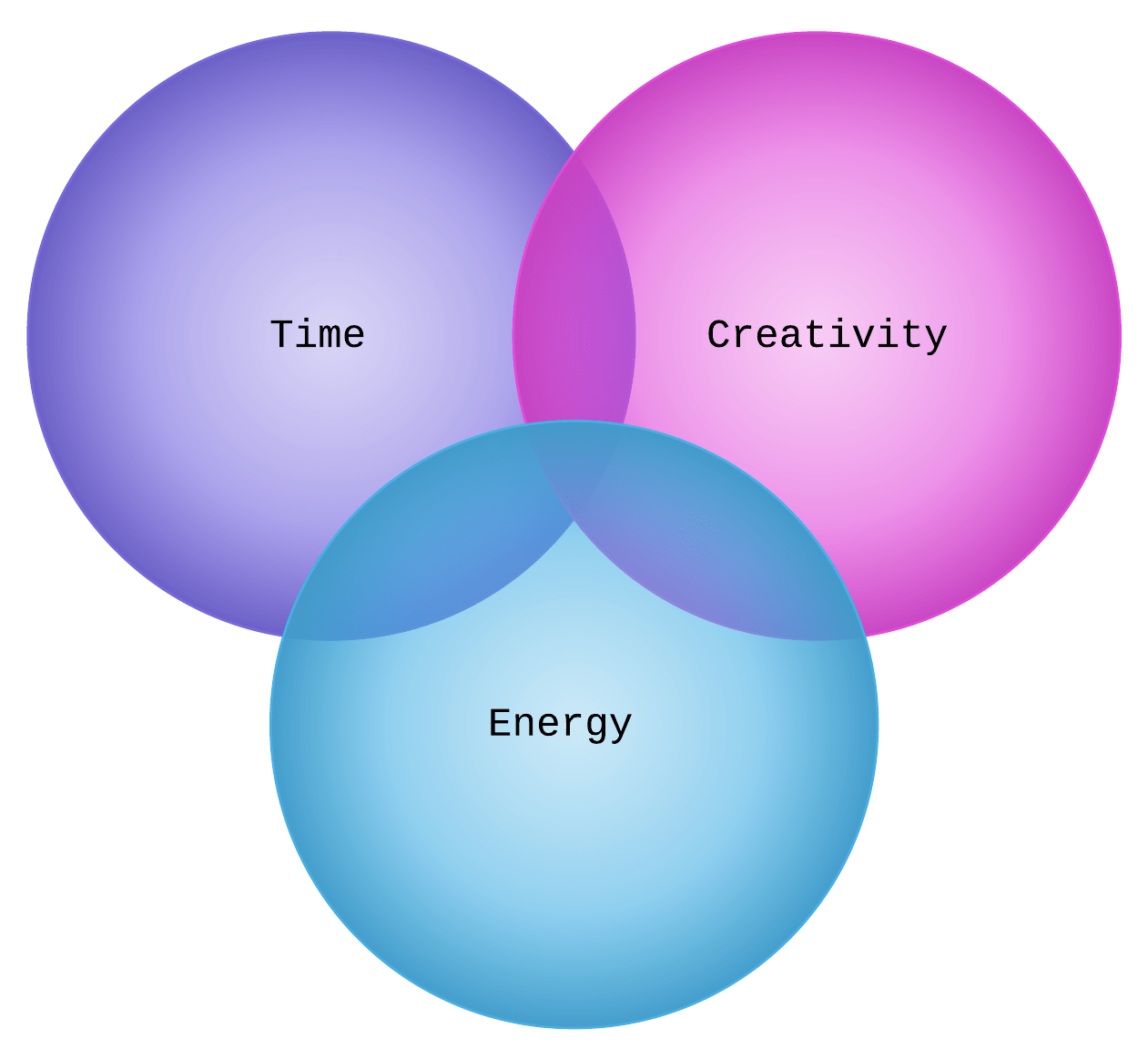
There’s a common myth that makes side projects close to impossible. It’s thinking that side projects can only happen at the intersection of energy, creativity, and time.
That’s a pretty high bar. That intersection doesn’t come around all that often. For me, it’s usually about day 3 of a 3 day weekend.
The UK has 8 public holiday days a year… so that’s 8 days a year. Max.
Say half of these work out, and on each you get 6 hours of solid work done. That’s a whopping… 24 hours a year.
Don’t get me wrong. These may well be the best 24 hours of the year. But, we have 168 hours every week. What if we could carve out 4 of them, every week?
Our side projects might start to move a lot faster… or at all.
Creativity
This comes down to: pick one thing.
If you have too few ideas, well, you only need one.
If you have too many, how do you pick?
Too Few
Jam with a friend!
Solve a problem you face yourself.
Answer a question: “Is it possible to…?”
A university project you wanted to extend?
Some feature of a platform you want to explore? (e.g. as an iOS dev I was keen to make something on Android that took advantage of intents).
Art galleries (an art gallery in Hong Kong encouraged me to start coding on a side project I’d had in mind for a long time).
Science museums.
Go somewhere to think: take a long walk, or go swimming (I solve so many problems and have so many ideas in the swimming pool).
Too Many
What is the closest to done? Finish things first.
What can you build on later (i.e. projects that will teach you things to know in other, more complicated projects).
What has fewer dependencies (e.g. your collaborator has gone AWOL).
What will be most useful to learn.
What is the best break from your day to day?
Energy
Our energy is often sapped by work, especially when our work is not rewarding. We need side projects most when we are close to burn out, but that is often when we have the least energy. Days are often long in the tech industry, and work travel derails personal schedules and habits.
Remember: Energy is renewable.
Some ways to renew your energy:
Remind yourself what you love.
Disconnect from the office over the year (focusing on something else is the best distraction).
Small wins create bigger wins.
Aim for the next minimum shippable improvement.
There’s no need to be secretive.
Where do You Draw Energy From?
At one point, I was going home in tears several days a week. There were a lot of things wrong with my job at the time but here were the big two: 1) not shipping (for reasons outside of my control), and 2) not feeling appreciated.
By focusing on side projects where I had control of the feature set, and the priorities, and all of it, I could decide when to ship. And of course it was a much lower bar, it was “here’s something interesting”, not “here is a new product!”.
And when I started to put things that I was making, and writing, out into the world, people started to notice, and say nice things to me, and about my work, and I started to get the appreciation that I needed, and feel like I was doing things that were worthwhile.
When I’ve thought that what I did all day at work was meaningless, creating things that people found useful redressed this balance. And even if I came home in tears, it helped me get up and do it again the following morning. And over time, it helped me gain the confidence to go and find a better place to be. And when I’ve felt like I don’t have much to say about my day-to-day, I have a story to tell about my side projects, and things that I’ve learned, and what I’ve built.
Time
Giving up TV
Everyone is short on time, and the standard advice is “cut out TV”.
I don’t think this is helpful advice, I think people watch TV because they are too tired to decide what else to do. Because it’s nice to escape. After a long day a great TV series is a way to absorb yourself in someone else’s life, and forget about the things you should be addressing in your own.
Personally my rule is, TV is OK, but not just TV. I watch most of my TV in the gym, it’s a great way to get enough cardio. Especially with dramas, like Covert Affairs. She’s running… I’m running… there’s shooting.. faster faster!
Or whilst writing unit tests. I decide what they should be, then fill in the mindless boilerplate (Java has a lot of mindless boilerplate) whilst Keeping Up With the Kardashians plays in the background.
Because no side project is 100% fun, although I understand my comprehensive unit testing strategy is somewhat aberrational. There will always be some dull, or less demanding tasks. Like setting up your environment, or downloading bits and pieces.
So “I’m tired, I’m just going to watch some TV” can become “I’m tired, I’m just going to watch some TV and do some [task requiring less concentration]”. And somehow, I’ve caught up with the Kardashians and also made some progress.
Even if it wasn’t amazing progress, even if it took twice as long because what is she wearing? Progress is progress.
That One Hour Before Work
The other advice is to find an hour before work. Definitely regardless of whether it is exercise or a side project, there’s something very powerful of knowing that whatever happens over the course of the rest of the day I have already done something that is just for me.
However decisions in the morning are really hard. That’s why if you want to work out you’re supposed to pack your gym back the night before. But then you get advice like “write for an hour in the morning” and the first time I tried this I woke up and drew a blank, “write what?”
Luckily I keep a very detailed task list, which includes blog posts I mean to write. So I just looked at what was at the top of the list, and wrote it. Draft over, I went to work. Then later I edited it and scheduled it.
I live under the continual delusion that Future-Cate is going to be super-human, and I’m continually proven wrong. I’ve learned that Future-Cate in the morning is going to be a mindless zombie, so if I want her to crank out some of the stuff on my endless todo list, I need to make it really, really easy for her.
Because future me, past me, and me as I write this, we’re all the same. We all find starting to be the hardest part. And yet in the throes of creativity, I never remember that. I think “what an amazing idea” as I pace up and down the swimming pool. I’m convinced that I will have it fully articulated within 30 minutes of walking in my front door.
But actually by then I’m asleep and I forgot to hang my swimsuit out to dry, as well.
You can do a lot with one hour, as long as none of it is spent wondering what to do, or looking for inspiration. Make your creative self put their brilliant ideas on a detailed task list, and your zombie self can probably knock one out before 8am.
There is No You in Team
I love being a software engineer. I love making things, big things, as part of a team. I love working with designers, because I appreciate great aesthetics but can’t create them, and I love working with good product managers, who care deeply about and take the time to deeply understand the user so I can trust their judgement and focus on building, coding, testing.
But my side projects, they are all about me. What I want to make, what I want to learn, what I’m inspired by.
And so amid decisions I don’t agree with, be they product or engineering, when some guy shoves me out the way to get what he wants, my side projects are this space on the internet, on my computer that is all mine.
Everything else, it’s just a technique for making progress, and these work! Try them! But really your side project starts in the place where you decide that you want to carve something out that is all for you.
It might grow, or it might fail. But it’s yours.
Failing
I had this idea for a side project, I was sure it was brilliant. Back in 2011. I wanted to be able to visualize a series of photos. I found the perfect layout (the sunflower layout) and then… did nothing with it. Later I returned to it and discovered that extracting the dominant color in an image was much more complicated than I had thought. I learned about different color spaces, the difference between HSB and RBG, and ended making my own image filters. Turned out, the original idea sucked. For starters, it takes forever to run. Secondly, it just doesn’t look as compelling as I thought it would! But making my own image filters became the main project, and later a book chapter.
In so many ways, this project was a failure. Firstly, it’s kinda ugly. Second, it took nearly 3 years.
But in other ways, it was a huge success. I applied some stuff that I’d had no need to apply before (the way images are just an array of pixels), and learned things about colour that I hadn’t previously known. And it was a great topic for a book chapter, and of course I’d had that common goal about seeing my name in print.
It started, on one of those amazing 8 days of the year (although I lived in Ontario, Canada then, so technically it was 9). And really, it was a super fun day. But it ended up where it is because I found ways to carve out some time out of every week, every 168 hours, for the things I wanted to build, and that I wanted to write.
4 hours a week will get you further than you think.
There was a period, thankfully a brief one, when I was spending $100 a week on Kindle Books. I know, shocking. I was reading them too, mostly novels.
I’ve since started tracking my expenditure on books more – limiting myself to a $100 a month budget, which was helping me not purchase quite so many non-fiction books. I’d previously been buying them at about 2x the rate I was reading them, which after 3 years had added up to a 10-20 book backlog. This made me a bit more mindful, and I started using my wish list more, and only buying those non-fiction books I had an immediate need to read. This was also encouraging me to re-read novels I’d loved. It’s better to re-read a good book, than read a terrible new book.
And then I took some time off, went to Bali (where I had a pretty poor internet connection) and read… erm.. about 15 novels. In 10 days. And started having these weird ideas about moving to the countryside. I’d also spent so much time and energy consuming other people’s work, that I completely lacked creativity to create my own. And finally, I didn’t want to look back at my precious time off and say, well what did I do? I read a bunch of novels.
So with some encouragement from a friend (reaction: “You think about moving to the countryside? You ARE reading too many novels”) I decided to – quietly – ban myself from reading novels for the month. In the end, because I started on Australian time, I finished when November ended in Australia, not 11 hours later in Europe.
And it was not as hard as I thought it would be, despite the number of flights (including some long haul, and a lengthy wait in Bangkok) – easier I think because I had overdosed on novels already, and I was relaxed, and didn’t have as much need for my usual methods of “relaxing” – one of which is ingesting novels, whole. Often 2-3 over a weekend.
I watched a little more TV on my iPad, mostly on planes, but not that much more. I actually bought two magazines, which I really enjoyed and required less sneakiness during take-off and landing, although I think reading too many magazines has it’s own set of problems. I think I probably read slightly more online.
I did start to feel more creative, and I wrote a lot. And I read a lot of non-fiction, about 8 books over the course of the month. This made a significant dent in my backlog of non-fiction!
Overall, I found it really helpful. I would definitely do it again, although a couple of days before the end of the month I got excited and pre-emptively bought 7 new novels to read in December, so there was no danger of the experiment being extended!
Sometimes it’s easier to have a blanket ban than try and moderate. So if there’s something that is distracting and being done to excess, maybe a month off is the answer. It’s at most 31 days, so how bad can it be?
For ages, I’ve been worrying about why I was feeling really low on creativity. It’s hard to pin point what changed – was work more demanding? Social life fuller? Too tired at the end of the day because I just do so much more physically (in Canada even with a pretty intense gym regime I was at around 3000 fuel points a day, it’s now 50% higher, nearly as much gym time, much more wondering around).
I just felt like I had no observation to make, no insight to share. And after spending all day every day on the computer, the last thing I wanted to do in the evening or weekend is spend time on the computer.
And so I stopped making for fun, and then I stopped writing, and I kept looking for things that would inspire me. A new book, a new art exhibit, a new adventure to a new place.
Sometimes it would work, I would wonder around, talk to people, feel inspired, but then not manage to make the time to actually do anything with that inspiration. The longer it went, the higher the hurdle was to overcome. If I haven’t written in ages, I forget how easy it is when I find a topic that I’ve already considered a lot, how the words just flow, and with them, if I’m lucky, extra insights.
I found the desire (as yet still un-acted upon) to code for fun, in the strangest place. I didn’t find it in a 2 week computer-free trip to Europe (I took a laptop, packed the wrong charger, and then just decided not to use it). I found it in New Zealand, after a week of no coding, but so much social activity and outreach to women.
The need to write came back to me when I realised my life is currently boring.
All this time, I thought what I needed was something exciting enough that I overcome the “resistance” and carve out the time I needed.
Actually, what I needed was calm.
Cookie Consent
We use cookies to improve your experience on our site. By using our site, you consent to cookies.