The harsh truth is that no-one cares about your idea the way you do.
I tell you this, not to be mean, nor to suggest your idea is not brilliant, or that you are somehow lacking in your communication of it… just because if you think that someone else is going to fill in when you’re lacking, you’ll be disappointed.
There’s a lot of great ideas that don’t come to fruition because the person who came up with them is not pushing them forward. Seriously, one of my friends is an idea machine, but she lacks follow through. This post is the result of a conversation where she admitted, that she thought she’d come up with this idea, connect some people, and those people would take over and make it happen.
You don’t need me to tell you this: that project has not yet got off the ground.
Another friend, who describes himself as a “spark lighter” (love this) and I interrogated her ideas of “leadership”, and it seemed like she was confusing leadership with effectiveness.
Here’s what I think leadership is: it’s being able to articulate a vision. But more importantly, it’s putting in the blood, sweat and tears that are needed to make that vision a reality. It’s accepting that the only person who is passionate enough to take what you’re doing to the next level is you. Ironically, this is the only way (I’ve found) to get people on board and helping you.
Being effective helps (doesn’t it always?), but it’s not necessary. The real challenge of leadership is not managing todo lists, staying on top of email, or mastering interpersonal-communication. It’s putting yourself out there – believing in something enough that you invest yourself in it, and don’t let up until you make it happen. Honestly, I don’t understand how a person who won’t do that for their own idea can think someone else will.
If you want to be more effective, read 7 Habits. If you want to be a leader, recognize that it’s not making lists – it’s doing something. So, pick an idea that has the potential to keep you up at night… and start making it reality.
I loathe email as a form of communication, I do. Having an iPhone has not made me any better at dealing with it, in fact it has made things worse – I can now monitor it in dead time and if there’s nothing urgent then there’s no need to actually check my email.
So, if I can’t reply in 3 sentences or less it waits until I next attack my inbox. I have a goal of once a week, but there are always more interesting things to do so once a month is around average. Normally after I’ve completed something significant I’ll look at my overflowing inbox and try and make some inroads. The thing I use my iPhone for most w.r.t. email? Deleting it.
A truly urgent email that requires me to use a computer might get a response within 3 days. I know, this seems unreasonable and honestly, I don’t get that much email compared to some people. The point is, I get more than I want.
Credit: flickr / Will Lion
Two summers ago, I quit Facebook, didn’t have a cellphone, and only checked email once a week. The effect on my productivity was phenomenal. That was when I created much of the material and ideas that became my programming curriculum that was taught across the US and that I taught in Shanghai. These ideas have since evolved further to and I created this workshop. I’m hankering for another such period of freedom from electronic communication, but I’m not sure I could give up Twitter. Note – my job at that time was extremely social, so it wasn’t like I had become actually reclusive, just electronically so.
Honestly, I think the reason I hate email so much is that primarily what I receive are requests to do things. It’s also more intrusive than the forms of communication I prefer (blogs via RSS, and Twitter) – someone who has my email address can subscribe me to the mailing list for their latest project (grr), they can’t force their content into my Google Reader. The 140 character restriction on a Tweet forces a more to-the-point communication style. Scheduling things, despite the fact that I make my calendar accessible, is something of a nightmare.
And – email is private. For some things, that is totally appropriate and I do love receiving emails from friends as it feels more personal than a Facebook wall post (even if I don’t demonstrate this with a prompt reply). However when I chat on sametime with one of my mentors, Sacha, it often seems to evolve into a blogpost for one, or both of us. Which is great – because then other people who weren’t part of the conversation can participate too and learn from what we’re sharing.
Ultimately, I know I’m going to have to keep using email. I know I can find ways to manage it better – unsubscribe from things aggressively, get blog comments in my RSS reader instead, aggregate my accounts in gmail and use the filtering there.
But – I’ll be honest – I’d probably prefer to hear from you by other means. But, before I sound too anti-social, obnoxious, and ungrateful… it’s really nice to hear from you at all. So if you loathe Twitter, email can be our compromise. Just don’t tell the people asking me for things.
One of my closest friends works at another large tech company, and all summer we’ve been having conversations that go like this:
ME: I’ve had such an awesome day! I found out about this awesome thing and made some progress on my awesome project. I love my job! How was yours?
HIM: Good! I finally hunted down this bug and I am a Java-optimization ninja.
And then, we have to find something else to talk about. And it’s completely understandable – but nevertheless, hard to be so passionate and excited about something and not be able to share that with the most important people in your life. It’s the same with blogging about it – not being sure what I could say, I haven’t been saying anything.
However, last week I had an epiphany. The technical project is perhaps the least interesting part of Extreme Blue. There is a reason why they call it a “leadership development program”. Yes, they take people with strong technical skills and you’re pushed that way, but you’re pushed in other ways and taught so many other skills too.
It’s All About the Pitch
The most important thing we work on is the pitch. At the end of the summer we’ll go to Armonk and we’ll have 4 minutes to sell what we’ve been working on. At first that seemed impossible, but the truth is that if you can’t explain the key concepts of what you’re doing in that short a period, you don’t understand it.
We’re down to 3:30, and looking for really compelling things for that last 30 seconds. Not the ideas that make our case – the ones that hammer it home so that people watching us can’t doubt that what we’re doing has potential.
As a programmer, or a technical person, it can be hard to accept the idea that the pitch is more important than the actual work. However, without a business case, there is no technical work. Our job is to prototype and demonstrate value. So our team is embracing that idea.
Ask
If we have a question, or someone who it would be helpful to talk to, saying “I’m Cate and I’m in Extreme Blue – do you have a moment?” has almost invariably got me what I need. This is awesome, and a refreshing change from university culture. Obviously, you don’t want to be annoying or too pushy. But if you need to, ask – it’s stupid not to.
Leading Through Vision: Effective Communication
Everyone in EB has shown leadership. So just because you’re invariably in charge for every university project, doesn’t mean you will be here. If you have a team of four and everyone is trying to lead but has a different agenda, that won’t work. Defining a collective vision that you’ll work towards and letting everyone lead some aspect seems to be working for us.
Communication is so important. Initially, the MBA and I were communicating in what may as well been two different languages. Now we both make an effort to speak the same one.
Constructive Criticism
The other day, we gave our second demo. Afterward, we were waiting for our mentor to come give us feedback and it came out that we all thought that we had been most inadequate. It’s tough, because every day we try and do better and after each thing there’s something to work on. But this kind of feedback is so helpful for practicing relentless improvement and being the best we can be. The same is true of feedback from each other – we’re on the same team, and we only want to help each other improve.
Time Management and Scrum
We are trying to do scrum, but it’s hard because of the exploratory nature of what we’re doing. When I have a clear task that I need to do, it’s easy. When I have something more experimental that I’m playing with, it’s hard. When things start crashing I’ve a propensity to just give up on planning until things are working again. It’s a process – I’m learning about how much leeway I need to build in and how to plan better. But I’m not there yet.
This is where I live. In this space between what I could achieve in a given day, or week, or month… and what in my imagination I’m capable of.
Of course in my imagination I never kick back and watch a movie with my friend and a bottle of wine (honestly, this rarely happens in reality either… probably why I felt so horrible this morning). I never get burnt out from training hard and sleep for 10 hours straight. I never say “You know, I’m not having a great week but one thing I could control is my hair” and bunk off the things I should be doing to get a haircut. I never get so overwhelmed by “the list” that I have to take time to breathe deeply and try and decide what my priority one is. I never stare at the blank page where I’m supposed to be outlining the plan for my upcoming talk and feel completely and utterly uninspired. In my imagination, I don’t get things to nearly finished, get interrupted and struggle to come back to them.
Other people don’t feature much in my imagination. Whilst I like working with others and I’m pretty social, there’s such a huge overhead and level of unpredictability when other people are involved. I struggle with this because it’s impossible to predict and hard to plan for. Because everyone manages their schedule and their list differently, it’s difficult to know when you should remind someone and when that would imply that they’re disorganized.
I’m the same, as usual when I’m a little stressed out the first thing to go is my email. So if you’ve sent me something that is urgent, or very quick to reply to, you’ll probably have a response. If not – I’m going to level with you here – it could be a while. And so there will be a disconnect if someone has sent me something they perceive to be urgent, but didn’t seem that way to me.
It’s not even February, but my inbox is out of control. I’m so behind on “the list” I can’t get a handle on what needs to be done anymore.
What do I need? A couple of days by myself to pull myself and my organizational system together.
I’m not going to get this.
So what’s the alternative?
Saying no.
To the endless demands that show up in my inbox, I’m sorry but I’m at capacity right now. I expect to get back to you mid-February.
To other things, too. What more can I eliminate? How can I better manage my interactions with others so that they are not time-sensitive? What’s the time commitment above which I should delegate (below which the delegation is more effort than I save)?
Other people are better at this, and I keep finding myself in situations where they say no and it falls on me or a commitment is broken (as was the case this morning). I need to balance my need to be firmer, with the fact that I hate to let people down.
I’ve created my slides for my presentation (abstract) following a Presentation Zen (Amazon) approach. So there are basically no words on any of my slides. I’m going to lay them out one by one, with narration. Let me know what you think!
Title Slide
I’ve gone for a blank template. I wonder if this is too plain and could use some background color? Let me know what you think. The color of the lettering matches the color scheme for my soon-to-be-launched website.
This is where I introduce myself and what I’m talking about. I don’t really like this bit of presenting, so I’ll keep it brief.
The World Wide Web
Image from iStockPhoto
I’m going to start off by talking about the “World Wide Web” and trying to provoke a bit of thought about it. It’s relatively recent, and yet it’s game changing. How many of us could live without it? I certainly couldn’t. Whilst the internet has been around since the 1960’s, the web as we know it (with hyper-linked web pages) has only been around since 1989. But within 20 years we’ve got to the point where the web is basically infrastructure…
… like electricity. For more on how I think the internet is just infrastructure like electricity, running water, or roads, see this post.
Clay Shirky – Why I Ignore 5 Year Plans
Clay Shirky – giving us some needed perspective. I think when we reflect on what’s changed, and how recent it is, we realize that this is really just the start of it. I remember life-before-Facebook but I can’t imagine living without it, even though I’m not always sure that the level connectivity it gives us is a good thing (for more on my mixed feelings about Facebook, read this post).
Near-Universal Authorship
A couple of hundred years ago, all the information your average person had came from the Bible, if they could even read. Now, not only are rates of literacy very high but the internet gives everyone the ability to be a publisher of content too. There’s a fascinating article on this here.
How Web 2.0 is Changing the Way we Comminicate
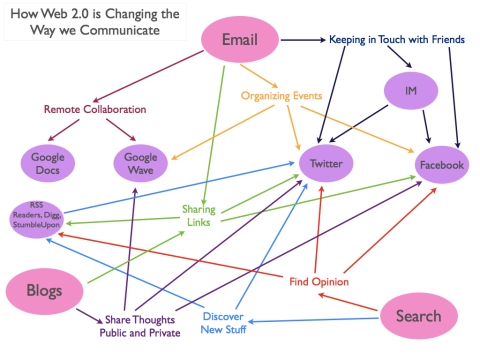
I put this graphic up in this post. What I want to show here is that there’s a shift to newer technologies and that it’s a process. This diagram captures what I’m thinking and finding now, but no doubt in a year it will be different. Also important, is how many arrows are going into Twitter – it’s simplicity and flexibility mean that it’s a great way to do a whole variety of things. There’s definitely stuff that’s missing from the diagram – the thing is to balance what’s important with trying to include everything and making it impossible to follow.
Serendipitous Connections
Image from iStockPhoto
Something that isn’t represented in the previous diagram though, is the possibility of serendipitous connections. By lowering the bar to communication, and through ambient awareness we can have more “weak-tie” relationships. Think about how many people you’ve lost touch with but found (or had find you) on Facebook, or the number of people you “follow” on Twitter but have never met.
I don’t think Twitter is a Pointless Waste of Time, but a lot of people do. If you do think Twitter’s pointless, why do you? Have you tried it? Over the next couple of slides I’m going to talk a bit about the impact that Twitter has had on events and the reasons why I think it’s useful.
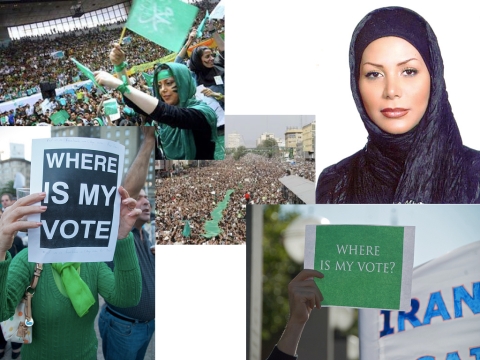
In the aftermath of the Iranian election, the US government intervened to change Twitter’s maintenance schedule so that it wouldn’t be down during the day in Iran. Twitter allowed Iranians to communicate with the outside world and express their distress at the rigged election. The governent’s reaction to this did not help their case.
I was working in Shanghai during the summer, and when the riots started they shut down Facebook and Twitter (at the time, I wrote this post). When I was there in 2007, you couldn’t access Wikipedia – but this time I could. This makes me think that the government is no longer afraid of information – it’s afraid of the conversation.
What's the Connection Between the British Parliament and an Irish Pop Star?
As a Brit, I tend to follow the news over there and the other week two things happened. The first one that a law firm got an injunction to prevent a newspaper reporting from a question to be asked in parliament regarding some toxic waste and a firm called Trafigura. The newspaper (the Guardian – read their story here) could only report that they couldn’t report anything about the MP asking the question or the question itself. However some smart people soon worked out what the question was and soon #trafigura was trending – causing the very awareness that they had sought to prevent.
The seond thing that happened was that this pop star died, of a heart condition. However he was gay, and with his husband at the time so it was enough to get some vile columnist in the Daily Mail to write a homophobic diatribe about him. Her name was soon trending as people expressed outrage (interestingly the Wikipedia article on Jan Moir consists of little more than the story of this).
I think what these two events show, is that Twitter provides a forum for people to express their frustration with all kinds of things – whether it’s concern over restrictions of reporting on parliament or just celebrity gossip. It also captures what people are getting angry, or excited about. Trending topics can answer what’s hot right now – Apple trends whenever it has an announcement, Windows 7 and even Ubuntu 9 were trending on their release.
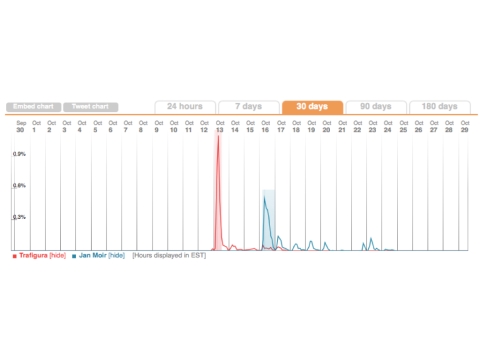
Trend Graph for #trafigura and "Jan Moir"
Trendistic is a service that allows us to graph how often words are occurring in Tweets. We can see that #trafigura rapidly became popular and disappeared again quickly once the injunction had been lifted. “Jan Moir” has a wider curve, and there was another flurry of mentions when she released an apology a week later.
Information Gathering
Image from iStockPhoto
Information gathering is the best use I get out of Twitter, and I feel it’s something that it would be hard to replicate anywhere else with as little effort. Follow leaders in your field, or just people who work in a similar area to you who tweet interesting stuff they found, or people who inspire you. I get so much information this way, and it doesn’t take very long to go through it. I’m literally crowd-sourcing my news! And if someone I’m following tweets too much or I lose interest I can un-follow them. Lists are going to make this even easier.
Ambient Awareness / Ambient Intimacy
Image from iStockPhoto
Ambient Awareness is like the Facebook newsfeed. It’s passively letting information about your friends lives come to you. But on Twitter, people often update more often – so if it’s someone you’re really fond of it can be better than Facebook for staying in touch with their lives. Two of my good friends live in London and I love the little bits of their lives that I see on Twitter and we definitely use ambient awareness to stay in touch. I was having a lousy day last week and I tweeted about it and one of my friends sent me a message just saying “*hug*”. When another friends released his work project (Google Sync) and it hit the trending topics, it was really nice to share his excitement about it in real time.
Twitter is amazing for overhearing what your customers are saying about your business. There was actually a paper published earlier this year analyzing brand sentiment on Twitter. Businesses (and non-profits, like @kiva) that get it are on Twitter seeing what’s being said about them and taking part in the conversation.
I wrote more about customer relationship management in this post.
Conversations on Twitter
Image from iStockPhoto
I think conversations are a great way of measuring engagement on Twitter, and this is what I’m working on at the moment. If your a brand, how engaged are you with your community? If you’re an individual, how engaged are you with the people you’re following? Are you passively absorbing content or are you sharing, adding value? If you’re a spammer, no-one’s talking to you!
Who's Following You?
Image from iStockPhoto
It’s possible to have a large number of followers by either paying for them, or by following people in the hopes they’ll follow you back (and unfollowing those that don’t) until eventually you have several thousand people “following” you.
But are they listening? Or are they just spammers? If they were listening you’d expect at least some of them to be talking to you.
Is Anyone There?
So I decided that follower/following counts were basically meaningless, and wrote a program that will graph your conversation network (more on that in this post).
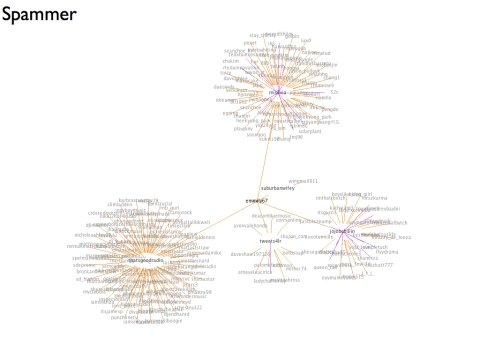
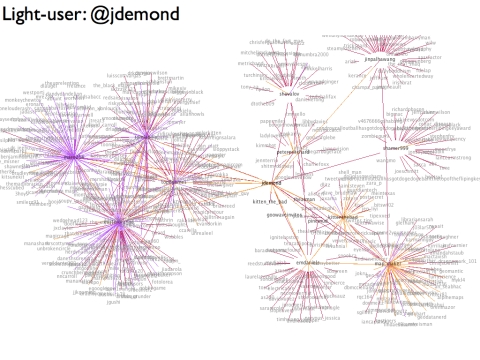
And it’s fascinating, because someone’s graph really says a lot about the kind of user they are. Are they a power-user? A regular user? A spammer? A light user?
My Conversation NetworkSpammer Conversation NetworkPower User Conversation NetworkModerate User Conversation NetworkLight User Conversation Network
It’s nice how you can see the different networks that he’s a part of here. I hope to use a clique finding approach to draw out this kind of information for bigger and busier networks.
Since I started using Remember the Milk my task list is now separate from my email – so email that I mark as “ToDo” items don’t show up in it unless I put them there. I’ve opted not to, and instead made a recurring task every other day to “clear email”.
As a result of this, I’ve discovered two things: 1. not having it on my list means I do other things instead, which is good – clearing my email in one go should be more efficient. 2. I dread doing this task.
Perhaps the thing is, that the people I want to talk to I am talking to – on Twitter, or Facebook, or Wave. So the emails I get are mostly tedious things that I need to attend to for someone else’s benefit. Except that one, and er, that one. And yours if you’re waiting a response from me.
I wonder if with real-time or near real-time communication I’m just getting to the point when something so asynchronous seems weird. I mean, if someone doesn’t respond to a Twitter message within 2 days, that’s it right? You don’t expect a response.
What’s bothering me? Too many services? To much mail, period?
I remember when getting a letter in the post from a friend was exciting. But now only getting a package is exciting, because letters consist of bills and things trying to get you to buy insurance or whatever. I wonder if I’m starting to see e-mail in a similar way. E-mails mostly consist of people asking me to do stuff, and spam.
People are surprised by this, but there was a period that I checked my email just once a week a la Tim Ferris (Amazon). This was during my gap year when I was working and although it annoyed various people – my boss, a guy I worked with, some of my friends… I didn’t have a cellphone and had temporarily quit Facebook as well, so to be fair it was fairly difficult to get hold of me. However, I found myself to be much more productive. I missed email, but realized it’s a displacement activity. I check my email between tasks, before tasks, during tasks when I’m bored or distracted.
Since I went back to university checking my email once a week has become impossible. Worse, though, even checking it once a day is infeasible because I’ve been using email as a collaboration tool, and it’s just not something it does well. I’ve tried to move to Google Docs, but that just means that I create a document, alert people I’m collaborating with by email, and wait. Sometimes I have to email a reminder to get them to look at it and then I’m checking my email – and my Google Docs account. Then maybe we discuss what we’re working on via email, even if the thing we’re working on is in Google Docs. In the worse case, the only thing saved is keeping the working document up to date.
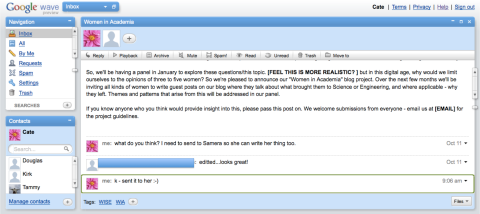
I got my Wave invite early on, and when I used my invitations my priority was to invite people I collaborate with, whether that’s for socializing, WISE, or academically (my supervisor got one, for example – we’re ditching email for Wave). The invites finally came through and I’ve now had my first “Wave collaboration experience” and it was awesome. I have to write an outline/blog post for a project we’re working on. I added our VP communications to the Wave and wrote it, then she came in and made some corrections. Underneath the section we were editing, we had a short conversation about what we were working on.
Then, well, I cut and paste what we’d produced into an email because the other person who needs this isn’t yet on Wave. But still – significant improvement.
Screenshot below:
This is awesome; it’s what I hoped Wave would be good for and I’m finally starting to experience it. I don’t see it replacing email, but I hope that once more of my friends and the people who I work with are on Wave I can replace email with Wave to communicate with them, and email will be reserved for more formal things that I don’t want to be real-time, like university notifications, inquiries from students and job hunting – and I can cut back on checking it, perhaps to once a day? That would be nice!
I am out of invites – please don’t ask me for one.
Cookie Consent
We use cookies to improve your experience on our site. By using our site, you consent to cookies.