Tag: career

  • Interviewing as a Manager

    Interviewing as a Manager

    Credit: Flickr / Marek Kubica
    Credit: Flickr / Marek Kubica

    The final part of interviewing for my last job involved coming to Colombia for 3 days and having 21 1:1s. FYI, this is the kind of thing that immigration finds very suspicious and resulted in me being detained and searched for drugs in Canada. But I digress.

    I firmly believe that people should interview their boss and have got to the point myself where I will schedule a call and up front say “I’m going to interview you to be my boss now.” – I want to understand things like how they will communicate with me, and what I can expect from them. So when I’m interviewing with people who might report to me I’ll encourage them to ask me anything they want to know – and I think I learn as much from the questions asked as they do from my answers.

    The thing is, most people will not ask hard questions in this context. So I wanted people to feel good about me joining, and I wanted to get to know them, so I prepared a set of questions.

    The Questions

    1) How long have you been at [company]?
    2) What were you doing before?
    Note: These Qs helped me get a sense of why people joined – e.g. they followed a friend they worked with before.

    3) What do you think your biggest contribution to the team is?
    Note: This Q (weirdly) helped me discover some things that were happening that I really needed to know about before joining.

    4) What do you think the team needs right now?
    Note: Hands down the best question I asked from which I got the most useful information. People telling me what solutions they wanted surfaced the problems they were having without asking them to complain at me (which given most of them were at least somewhat trying to sell me on working there I might have got less honest answers to). Most interesting was when people working on the same or nearby things had different views of the problem.

    5) What’s your next career goal (if you have one)?
    6) What do you most want to learn?
    Note: Helped me see where the team wants to grow, and the different approaches people want to take. Helps distinguish between people who go with the flow and people who are more goal-orientated.

    7) Did you have a manager you really liked? What kind of things did they do for you?
    Note: Reassuringly their current boss (who I reported to) was a pretty common answer to this. I think most people are not very intentional about the kind of manager they want. At least 2 people asked me this question from the opposite perspective – what kind of manager would I be and what could they expect from me?

    8) Is there anything you think would make a big difference to your happiness at work?
    9) … to your ability to do your job?
    Note: Helpful for people who didn’t have a good answer to 4, or who focused on what other people (or teams) needed not their own.

    The Process

    I had the questions (numbered) on a page, and then I could just number people’s answers in my notes.

    I didn’t ask everyone every question – the goal was to start off a conversation, and if they had questions for me then I wanted those to take precedence. I did ask everyone 1, 2, 4 and 5.

    We arranged it team by team, most recent joined to oldest. I picked this order for a couple of reasons: building up context is hard, and grouping by team makes understanding that context easier. Newer people will have more a more recent perspective of joining, longer-timers will be better able to explain why things are the way they are.

    Unsurprisingly, this many conversations was super exhausting. By day three, between each meeting I was hiding in the bathroom, fantasising about never speaking to another human ever again.

    The Results

    I learned a lot in these conversations and referred back to my notes as I started working there and even several months in. Question 4 is one that I continue to ask in basically every potential job conversation. It tells me so much about what people think the problems are without asking them to frame things negatively. The ordering worked as well as I hoped it would.

    The main thing I would change is to ask more questions about feelings – what do people most like about their job? What are they most proud of? What do they worry about?

  • Real Talk: Women in Tech and Money

    Real Talk: Women in Tech and Money

    This post comes from multiple requests from friends with whom I have talked about leaving tech, and returning to tech, and the way that I started to think about money relating to that. Money is a loaded topic, and I want to be up front here that this is written from a place of financial privilege. I graduated from my undergrad (and dropped out of grad school) without any debt. My first developer job paid well, including stock grants (not options). I inherited some money. I’m also a citizen of a country with public healthcare. I need to work, but I’ve not had to try and create my own financial stability – because I already had it.

    house of fortune
    Credit: Skitterphoto

    Forty-one percent of women leave technology companies after 10 years of
    experience, compared to only 17 percent of men [source]. For comparison, consider that the average career length of a Premiership Football player is 8 years [source]. Premiership Football players make a lot more money, but if you know that part your career is likely to be over within ten years, you (if you are sensible) factor that into your financial planning. Looking at the data, it makes sense for women in tech to do the same.

    Some people call it a “fuck you fund”. I call it sensible financial planning. Bankers who treated their bonus like it was part of their salary ended up in hot water when the markets crashed and bonuses shrank or disappeared. Looking at the stats about women leaving, to me it makes sense to treat every year you last in tech after ten years as a bonus.

    I would love that to be different, and let’s be clear – I work very hard to make that the case, for me and others. But sometimes we play game that’s on, and sometimes we try and make a new game. Until we have a new game, 10 years is realistic – and honestly, optimistic for some.

    Tax and Rent

    The first way in which I changed the the way I thought about money was to realise that my major out-goings were tax and rent. My salary seemed so much more than I could possibly make doing anything else. But let’s do some math.

    Let’s consider a salary of 75K British pounds, which is I think pretty standard for London. And then consider a salary of 50K British pounds (a number I completely fabricated) outside of London.

    Woah! A 25K pay cut! But first – the top 25K of that was taxed at 40%. So the government loses 10K, and you lose 15K.

    Then, rent. The difference between rent and council tax on a 1-bed apartment in London vs another major UK city like Manchester or Birmingham could reasonably be 750 GBP / month. So now you’re paying 9K less a year in rent.

    So now you’re 6K a year worse off, or 500 GBP a month.

    But you move to a place where things are on average 1/3 cheaper (completely reasonable for Birmingham, Manchester or even Edinburgh in comparison to London [source]). So gym membership, food, transportation… depending on your habits, it might just be a wash.

    Then if your job no longer stresses you to the point where you are paying for weekly therapy and / or expensive getaways or other forms of retail therapy… you might even be in profit.

    Salary and Longevity

    The second is to consider longevity. Consider two job offers. Job A pays 20% more. But the company is well known for being staffed by brogrammers. You think you could do two years. Job B seems nicer – they let you work from home 1-2 days a week, invest in your personal development, and there are noticeably more women there. You think you could do three years there, maybe even longer!

    So then the maths (ignoring inflation and payrises):

    Job A: year 1:X + 20%, year 2: X + 20%, year 3: 0 (burnout) = 2.4X
    Job B: year 1: X, year 2: X, year 3: X = 3X

    Then Job B starts to look like a better option financially – as well as emotionally. And that’s not even considering tax.

    Let’s consider tax (at an average of 30%).

    Job A: year 1: 1.2X * 70%, year 2: 1.2X * 70%, year 3: 0 (no tax!) = 2.4X * 70% = 1.68X
    Job B: year 1: X * 70%, year 2: X * 70%, year 3: X * 70% = 3X * 70% = 2.1X

    This doesn’t consider that with a non-regressive tax system you might actually pay proportionally more of your salary in tax when you make more.

    Even though Job A pays 20% more, in this scenario, you’re 25% better off over a three year period if you take Job B.

    Tradeoffs

    This is not to say I think people should always take the lower paying job, or move to the cheaper city. I’m not a financial advisor, and I don’t like to give advice about any topic, least of all this one.

    But I think people should think about costs as well as salary. And salary in real (post-tax) terms. And for women – our best financial investment might actually be in creating longevity in our careers.

    Thinking like this has encouraged me to take more risks in my career, and approach it differently. I stopped being afraid to take an on-paper pay-cut, because I looked at it differently and knew I could end up much better off over the longer term from it. I think I did end up better off financially over the longer term. But emotionally there is just no comparison. Leaving (again) is something I accept as statistically likely, but no longer feel every single day.

    But, like I said at the beginning, financial privilege. And risks are much more palatable when you already have a baseline.

  • Book: What Got You Here Won’t Get You There

    Book: What Got You Here Won’t Get You There

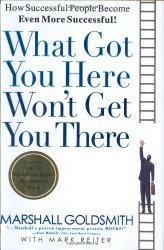
    what got you here won't get you there book coverWhat Got You Here Won’t Get You There (Amazon) initially irked me because it fell under a class of book that I call “Advice for White Men” (my blog post on this topic). It’s about how you can be oblivious to certain characteristics, and never receive feedback on them – and of course all but one of the examples in the book were men.

    My friend Camille observed to me once that men get too little feedback, but women get too much. And definitely one of the things that I’ve found helpful with coaching is sorting through feedback – some direct, and some implicit, and deciding what of it I should take.

    Anyway, even though I don’t think the content of the book applies as much to women, it was still useful, and once I got over my annoyance I found it so. How do you ask for feedback? How do you get someone else bought into you taking it and changing? It also gave me some observations that I could use to talk to other people about taking feedback and changing.

  • Big Co. vs Small Co. & Job vs. Career Stability

    Big Co. vs Small Co. & Job vs. Career Stability

    Credit: @pwnela
    Credit: @pwnela

    I gave a talk at Self.Conference the other week called “Some Things I’ve Learned About Color”. There’s no video, and I haven’t shared the transcript – I will eventually share this content, because people have connected with it and because I think it’s important. But I’ve yet to figure out how to do that. It’s a special talk, and I don’t think a blog post or two is the right format. For now, you can see the live tweets in the Storify.

    The first half is a lightly refreshed version of the talk I closed the first day of JSConfEU 2015 with. About how there are 5 causes of burnout that are not overwork, how these 5 things seem like things that side projects can actually help with, and how that might influence the way we try and involve people in side projects. Through it I refer a really miserable project that I worked on (and the worst manager I ever had), and the side project (that turned into Show and Hide) that helped me survive.

    The second half, I looked at how these five things are likely to be worse for underrepresented minorities in tech, and talked about how I personally left the tech industry, after predicting I would. I talked about rehabilitation – about rediscovering joy in making, about building confidence, the work of learning not to be afraid anymore. And I talked about coming back. The most interesting part of it being the unknown unknowns.

    Since giving it, it occurs to me that this topic ties to another one that I’ve spent a lot of time thinking about since I went to work for a startup. The difference between job security and career security. That as part of leaving a job that was “secure” I built up something better – the ability to be confident that I can get another job. Career security.

    Job security means that you know you will keep getting a paycheck from $company. Career security means that you know you can get another job, and develop yourself and your career in the way that is meaningful to you.

    One thing I’m grateful to from my time at the Conglomerate is that my fear of disappearing – again – keeps me pushing to make sure I stay visible. Women are only as good as their last, most recent, achievement, after all. So I get up at 6am so that I have an hour or so to write code on my side project before my first meeting. I spend Saturday morning in a coffee shop writing. I limited myself to six talks this year, but still – six is quite a lot. I choose this even though it sometimes means harassment, because the alternative – disappearing – is mostly, usually, much more terrifying.

    A big company can offer job security in a way that a startup can’t. But, I think that it’s much harder to have career security there. Firstly, because external visibility is often explicitly discouraged. Secondly, because big companies are incredibly complex systems where most people who exist in them have very little control. Of the six projects I worked on at the Conglomerate, three were relocated to other offices, two were outright killed. The reasons for this were sometimes political, and sometimes the product of poor execution. I look back on these and I could give you a list of things that went wrong, but I could not tell you how I could have had any influence to change those things.

    An extreme example, but on the terrible project that burned me out, we missed a deadline – in my opinion because of poor project management. I said to my manager, the worst manager I ever had, “I’m worried that we missed this deadline”. He replied, “What deadline? There was no deadline.”

    There was a deadline. His refusal to acknowledge failure, to hold the person who was supposed to be running the project accountable, made it clear to me that nothing was going to change. I could bang my head against a brick wall trying to get someone to listen whilst being told that I was being “negative” or “not a team player”, or I could leave. I left. Everything I predicted came to pass. The project was cut down and moved a year later, three people who had remained on the team messaged me to tell me that I’d been right.

    In a large organisation with limited power and constant re-orgs, it’s hard to have career security. One of the reasons why this situation of seeing a project failing and being unable to do anything about it was so stressful to me, was that I knew it would hit reset on my getting promoted, and that as a woman I would be subject to what I always had been – prove it again. That because of entrenched sexism and power dynamics it was much more dangerous to my career to be on a failing project than it was to the manager who presided over it. He, of course, got a more important project when that one failed. Failing upwards in the way that cis-white men so often do. I wonder what he took from that experience.

    At a startup it’s just accepted that you do not have job security. This is the kind of thing that employment laws in Europe in general but particularly in France cause that the startup scene is less vibrant. It’s very hard to legislate job security at the level of uncertainty that startups operate, and this also inhibits the possibilities of 1-person businesses to expand because the risks are so great. I’m a proud European, and very much in favour of robust employment law. But this is one of the consequences of it.

    But, if you are not a cis-white-man failing upwards in the valley, how do you create career security? Some ideas.

    • It’s not enough to be good at what you do, you have to document and prove that you are good at what you do.
    • Be strategic about visibility. I get plenty of Token Women invitations, and I get myself uninvited from almost all of them. People want to talk about “diversity” but very few want to do the hard work of inclusivity. Being known for being a woman in tech and not for my technical achievements does not take my career in the direction that I want it to go in. (Note: I haven’t done the best job of this, but it’s something I’m very aware of).
    • Build your network before you need it. Not cynically – genuinely connect with awesome people over the things you have in common.
    • In the long term, no-one is going to look out for you, but you. Consider what options you are creating for yourself… and what you are shutting down.
  • 2015: Ship

    2015: Ship

    three danbos, holding balloons
    Credit: Flickr / sⓘndy°

    For 2015, I chose the word ship. I did this for a couple of reasons:

    1. Taking some “time out” can easily turn into achieving nothing. It was important to me that I had something to show for my time.
    2. I wanted to bias towards putting stuff out there.
    3. I am very achievement oriented, and this gave me achievements to collect.

    I like the idea of choosing a word to guide the year. Resolutions are easily broken (or worse, forgotten), but a word is more like choosing a theme for the year. I like to choose the thing I want to be noticeably better at by the end of the year. It’s also a way to influence decisions, when choosing between A and B which is a better fit for the theme of the year?

    It took a little while for me to figure out how to focus on “shipping”. In the end it was simple: a text document, underneath each month is a list of bullet points, one for each thing “shipped”. One month just 1 thing (and barely – this was a wakeup call as to how I was spending all my time on client work, and I started being more deliberate about carving out time for my own projects), and one month 6. It’s not consistent, because often “shipping” is the result of months of work, and generally, the number of things shipped rose through the year and was higher in later months than earlier months. I feel like this is a good sign.

    As with all things, I decided there should be a low bar for what it meant to “ship”. Things I “shipped” included:

    • New talks.
    • Alphas / betas / releases.
    • Contracts.
    • Longer form projects.
    • Open Sourcing a library

    Even though I have chosen a different word for 2016 (“scale”), I plan to keep this text document around. It’s a reminder to keep putting my work out there, to take a moment to celebrate Achievements, and when I feel like I’ve accomplished nothing, it’s something to revisit and remind myself that isn’t the case.

    I think the word “ship” gave me all the benefits I hoped for when I chose it a year ago. But as well as helping me celebrate, it made me look at things in a different way – where I deliberately tried to extract what value I could from them and package it in some “shippable” way. Something less ephemeral than Twitter, or blog posts.

    For 2014 I don’t remember if I picked a word but my real theme was “choose life”. That was about digging out of a hole, and figuring how to leave and what life would be like after The Conglomerate. That was a survival word, not an aspirational one. “Ship” was aspirational. “Scale”, even more so.

    2015 Ship List

    (some names redacted, note many of these weren’t solo achievements)

    January

    • iOS Beta
    • First Technically Speaking webinar (w/Chiu-Ki)
    • Visual refresh of Male Allies bingo card (w/Karen, Kathryn)

    February

    March

    April

    May

    1. Technically Speaking 6monthiversary (incl. launched website)
    2. XXX contract
    3. XXX panel work
    4. Project F first draft
    5. Started work on XXX

    June

    July

    • Asked to work on XXX Project I3

    August

    • Show and Hide visual refresh iOS
    • XXX Project I3 delivered
    • Technically Speaking workshop

    September

    October

    • New biz cards
    • Technically Speaking stickers
    • CapOne Hosted Blogger @ GHC
    • Ride – contract

    November

    • Technically Speaking anniversary – t-shirts and mentoring program.
    • Show and Hide Android Beta
    • Launch candidate for iOS Show and Hide on TestFlight

    December

    • Joined Ride as Director of Mobile Engineering
    • Show & Hide available on iTunes
    • Technically Speaking broke 2K subscribers
    • XXX Project I3 released
    • New Android Beta of Show and Hide
  • The Hardest, Shortest, Lesson Becoming a Manager

    The Hardest, Shortest, Lesson Becoming a Manager

    "how does computer programming work" "magic"
    Credit: Abstruce Goose

    There’s something we all talk about in becoming a manager – and that’s the process of writing less code. We bemoan it because it’s hard to let go of that part of our identity. But also because it’s so quantifiable. Today I wrote X lines of code. Today I deleted Y lines of code. Today I implemented feature Z. Concrete achievements are reassuring. Today I left the codebase better than I found it. Good job.

    I too found this a really really difficult thing to let go of. I looked at tempting tasks. A nice feature. A refactoring. And I did not do them. The thing that I have found that helps is framing it as now coding is not the most important thing that I do. But then I get to the end of a day where I did not code, and I ask, how do I know I achieved anything today?

    Get Real About Your Schedule

    This week is a short one, but still – there was a point in it where I was triple booked. I honestly have no idea how I would cope right now if I didn’t have admin help. Ariel rules my schedule. I just look at it and panic.

    Even when I have open time, it’s like 2/3 of a day, half a day. If I have 2/3 as much time of the week that isn’t spoken for by meetings as I did when I was an IC, that doesn’t mean I can write 2/3 as much code. For starters when you code in bits and pieces you spend a lot more time rebasing. Secondly, transition between strategic (what are we doing), coaching (how can I help you) and details (what does this bit of code do) are difficult context switches. And switching in and out of details is the hardest of all.

    When a 1:1 starts with someone sharing technical details with me for ~10 minutes it’s my job to help lift them out of those details so we can work on strategy or coaching. That transition is hard. In both directions. I see it being hard on them, and of course it is also hard for me.

    I had a manager once who decided he would take on an important component in the app I was tech lead of. He did a half-assed job of it, and it took him ages. In the end, it was a really challenging piece, it ended up being rewritten 3x (2x by me) before we got it to a point where it performed well. How do you tell your manager that they are your #1 risk factor for missing your deadline? How do you tell them they did a bad job and the thing they made doesn’t work?

    I forget how I dealt with that – I think I procrastinated on dealing with it and eventually just picked it up and started improving it. I don’t in general believe we learn that much from what not to do, but I won’t inflict that on my team. If I’m trying to write code now, it’s something that me being slow to complete shouldn’t be blocking anyone. Cleanup tasks are a good place to start.

    What Makes the Team Better

    The truth that all managers must accept is that your job is now to make a group of people more effective, over a longer period than you usually consider as an IC. Even if you are genuinely the best and most effective person to take something on, does this make your team more effective 3 months from now? Unlikely. Instead of investing in someone else having context now, you’re postponing that moment to later, or indefinitely.

    And then they will have a fun time untangling your code and it would be great if you were there to talk to, but you’re in a meeting, again.

    The sooner you invest the time in coaching people on what you know that they should know the better it will be.

    One of my first weeks on the job there was a component that is pretty complex, that I have now built twice. Last time it took me ~1.5 days. I really just wanted to write this code, show everyone that I’m a good engineer, and have that win. But after sleeping on it, I took a deep breath, looked at my schedule, and encouraged someone else to do it instead. Would I have done it faster? Honestly considering my schedule, probably not. And now the person who did write the code is in a good position to own that component going forward.

    Does Your Team Need A Manager… or Another Engineer?

    As a manager I have this mental list of things about what does my team need. Things that I’m monitoring, things that I’m trying to fix, things that I’m trying to find for them. It’s my job to understand what is going on and what the team as a whole needs to be effective.

    Maybe you can look at the state of things and say, we have a deadline right now, and what we need is another engineer for the next month. That engineer is me.

    But more likely you look at the state of things and realize that what your team needs is a manager. Because you need to hire X more people. Because Y has a lot of potential but needs some coaching. Because product or design or some other team haven’t given you what you need so you need to go and get it. Because process is important, and the process you have is insufficient or just plain wrong.

    If you team needs a manager more than they need an engineer, you have to accept that being that manager means that you by definition can’t be that engineer. I know some people manage both, but you need to decide if you’re going to suck at one which one that will be.

    I feel bad when I suck at being an engineer, but sucking at being a manager would be a choice I inflicted on other people. That’s not fair.

    So at the end of another day when I feel like I didn’t write enough code and I have no way to quantify what I’ve achieved, I tell myself I was being as good a manager as I know how to be. And that has to be enough for today.

  • Diversity is an Attention Economy and the Economics Suck

    Diversity is an Attention Economy and the Economics Suck

    be the change
    Credit: Wikimedia

    A while ago there was an article about how women got more RTs when they talk about diversity than when they talk about anything else.

    This wasn’t that surprising to women, I don’t think, although it may have been news to some people. Well before this was news, I had been trying to balance what I put out there, and how much is about women (I limit myself to ~1/6 posts), but I can only control the output, not the response. To be honest I think that by volume (this is still ~2 a month) even if not percentage, I put enough out there that is overtly feminist means I am more known for that than anything else. 

    I think about this anytime I see yet another list of women. Why do we have to have lists of women? Because women (often) don’t get included on lists of people. And because it’s share bait. Men hit RT thinking they are improving the visibility of women, and they are, but usually the visibility of women as women and not so much for the awesome stuff they do.

    I think about this when I see a bunch of press about how diverse a founding team is, whilst they struggle to meet their crowdfunding goal.

    I think about this every time I see a product aimed at improving inclusivity, because the truth is that if women and minorities are only feted for and more importantly – paid – for being women and minorities, nothing changes. The market for inclusivity is measured in $M, not $B, and it’s heavily service oriented.

    A few weeks ago I locked down social media because I had refused to back down on wanting a code of conduct, and apparently angry feminists asking for things is something that some people think people should be warned about. It was shitty. It felt really shitty. I wrote about it, and a lot of people shared it. And great, sharing is good. In it though, I included a list of things people could do to help.

    Invite me to speak: I got a couple of invites, this was nice.

    Buy a product from a diverse founding team: This got at least one bitter complaint, I have no idea how many people did.

    Sponsor the newsletter I co-curate: one person (thank you!) reached out to sponsor personally. But no companies  have bought sponsorship slots since then.

    Apparently the end of the year can be slow for this kind of thing, but ever since that whole thing happened, I have worried that I unintentionally sacrificed the sustainability of a side project to a moral stance.

    That’s not a good feeling. I feel an obligation to use my visibility to push for things that others feel they can’t. Did I overestimate my privilege here? My collaborator and I will personally be fine, but do our subscribers eventually lose out on a thing that we know has made a big difference to a number of people? Will this end and we’ll trace it back to this moment, and say, well we had a sustainable thing but then Cate had an opinion and everyone tweeted but there was somehow no more money ever again. Will some time pass and things pick up and we’ll just make a bit less, and it’s not clear how much less. I don’t know. I hope not. But it’s definitely a possibility.

    One thing I explicitly did not include is donate. I hate the cycle of fuck-up-donate-nothing changes. Of course people asked for places to donate to anyway.

    This is why we talk about #GiveYourMoneyToWomen, and by the way, give your money to PoC as well. Give your money to trans/NB people. Give it to LGB people. Exchange your money for products built by people who aren’t cishet white men with regularity and with enthusiasm. One argument I have heard against this, is that you shouldn’t buy something that you don’t really want just because of who the founders are. But actually, this is the entire purpose of the Old Boys Club. And if we who are not welcome in the Old Boys Club do not do this for each other – who will?

    I have spent a lot of time thinking about what male allies do, and I have come to the conclusion that they don’t need to do everything. Some speak up about inclusivity, which is great, we need that.

    But actually I want to see:

    • Paying diverse people for products / services.
    • Hiring and promoting diverse people.
    • Investment in diverse founding teams.
    • Doing the work to create inclusive environments, calling out problematic behaviour (if done in a timely manner, this need not be a major event).

    Nothing changes unless the balance of money and the balance of power changes. Talking and sharing doesn’t change the economics. So next time you’re about to share a list of women and feel like you’ve done your work on inclusivity for the day/week/month/year, move your mouse away from the “RT” button and click on the “BUY NOW” button instead.

    Things I work on:

  • Advice, Mentors, and Questionably Helpful Emails

    Advice, Mentors, and Questionably Helpful Emails

    Foliage Danbo
    Credit: Flickr / zeitfaenger.at

    Let me start by saying: I hate giving advice and I try not to do it. Typically my “advice” falls under two categories (in that order, often deployed together):

    1. Telling people that whatever their reaction (stress, sadness, fear…) is understandable.
    2. Suggesting books or lines of thinking that I have found helpful in related situations.

    Of course the urge to give advice can be overwhelming and sometimes I find myself breaking my own rules. One of my friends was so overwhelmed recently that having had a small degree of success with strategy 1 I found myself telling her what to do. And then I apologised profusely. But at least she told me afterwards it was helpful.

    The thing I really hate about advice, though, is that often people don’t need advice as much as practical help. I would prefer to offer someone practical help than advice, and failing that I buy people books.

    That being said – I have a handful of friends who I started interacting with because they came to me for advice. There are people who did this so well they turned me into a mentor, and then a friend. I am fascinated by people who succeed at this approach, because I tend to go the other way. I become friends with people, and then periodically I will ask them a question. Normally just the one. Because I don’t want to impose.

    But these people stand out because they are the exception, not the norm. Sometimes I get requests that just sit in my inbox for weeks because I don’t know how – or just plain don’t want to – respond to them.

    One thing I’ve taken to doing this year is replying to these requests and explaining that I am never going to get to their request along with some feedback about how they made it. No-one has yet replied to one of these emails, but I like to think that offering concrete feedback on requests is probably more helpful in the long term than some half-hearted and resentful attempt at the request itself.

    So what does a bad request look like?

    • Large or undefined in size – a vague “help me with X”, or a long email where I need to decipher the question.
    • Requires research – asking for something that is not a core expertise. Memorably someone wanted me to watch a (long) video in order to understand their project.
    • Impersonal, generic – it’s not clear why they are asking me, or it’s clear they are only asking me because I used to work for $brandName company.
    • Inconsiderate – the best example here is one a friend gave me, people who ask her to travel across town to meet them because they are “too busy” to come to her.
    • Entitled – this comes up most frequently when someone who I barely knew or haven’t spoken to in a long time jumps in like we spoke in the last month. Bonus: they introduce me to someone without consent.

    Of course no-one goes into these things thinking they are making a Bad Request. And I’ve procrastinated writing this blogpost because I don’t want to seem like a monster, and I don’t want the people who send ~good (we all have off days, including me) requests to feel bad about it.

    Note to people I know: if I reply to your emails, we’re good. If you have my phone number, we’re BFFs.

    So what makes good requests different?

    • Concrete – they ask for a specific thing.
    • Concise – it’s a short email, distilling the essence of the problem.
    • Small – it’s manageable, doesn’t require me to look stuff up they could easily find using their favourite search engine.
    • Personalised – they have done their research on me and their request builds on things that I have written / blogged / tweeted about.
    • Builds a connection – they find a commonality and use it to connect us.
    • Contextual – they consider the context of what’s going on with me. One, this is a great way to open the email. Two, it’s a way to figure out when to send the email.
    • Followed up – they let me know what happened! Periodic updates regardless of whether or not someone wants something is even better.
    • Appreciated – there are a number of ways to show someone appreciation. Supporting projects, sharing work, or recommendations. There’s one person who was an absolute pro in turning me into her mentor, and her friend. My favourite thing that she does? She sends me books. Books that aren’t the kind of things I usually read, but that I end up loving.

    The word “mentor” gets thrown about like it’s a magical pancea. The original meaning, from Greek, is “wise advisor”. The question of mentoring is not is it good (it is), or how do you find one (anywhere), but how to you get someone to want to be your wise advisor? And the answer, I think, is that you make it very easy and worthwhile for them to do so.

    Which is a simple answer, but a lot of work. The thing is though, the people who do that work, are the most worth helping. Because as in so many things, the advice? That’s the least of it. Advice is easy. Execution is hard.

  • A Question

    A Question

    16/365²: Sin ideas
    Credit: Flickr / Andrés Nieto Porras

    There’s a question that I have found myself asking a lot over the last two years: “do you know what a good environment looks like, though?”

    I ask it when a friend comes to me with anxiety about performance reviews. I ask it to the friend who left a bad environment only to end up in another bad environment. I ask it to the friend who is job hunting.

    Most of all, I ask myself.

    “Do you know what a good environment looks like, though?”

    Coping Skills Considered Harmful

    When you consider that it’s possible that you don’t in fact know what a good, or healthy, environment looks like you might also consider what bad environments may have done to you. What coping mechanisms did you learn? And do you need to unlearn them? So far my conversations around this have been focused on communication, but no doubt there are more.

    The other thing to consider is disengagement, an early stage of burnout. Connecting the causes of burnout (other than overwork) to common themes arising from poor inclusivity was eye-opening to me.

    Good Problems vs Bad Problems

    Nowhere is perfect and healthy environments have problems too. In a bad environment we tell ourselves that problems are normal as a way to make whatever it happening seem not that bad whilst our friends look on in horror¹. When faced with the potential of a new environment we work to dig out the problems and worry it is no better because look! We found some.

    But when we think about technology we know, intuitively, that there are Good Problems and there are Bad Problems. Scaling, for example, is a good problem to have! Because it means you have users.

    Wait a moment. Actually that depends on the scaling problem. Scaling proportional to users, solvable by a new or improved tech stack is a good problem to have. Scaling proportional to some exponent of number of users that has no technical solution may contribute to killing your business².

    Nowhere is without problems, but there is a world of difference between conflict arising in an environment of mutual respect and conflict arising from competition in a zero-sum game.

    Personal and Systemic Brokenness

    I always read lots of business books, but since escaping The Terrible Manager these have formed a kind of self-therapy, where I find the concepts and research that articulate the Bad Feelings³.

    There are a lot of things that we do where we in effect conduct experiments on other people’s careers. I’m not a big fan of this, which is in part where my drive to be a good interviewer comes from. Some advice I got recently contained this gem, “managers are like doctors; the important thing is that they do no harm”, and I’ve been meditating on it ever since.

    Here’s where I’m at. Managers exist in a system. A “neutral” manager is like a conduit, they channel whatever is in the system onto the people they manage. Good is good. Bad is bad. A terrible manager will make good bad, and bad terrible. Then would a good manager make good great, and bad… good? That seems like an almost sociopathic skill – a disconnect from reality like that usually has consequences. I suspect a good manager makes good great, and bad constructive.

    Whenever someone complains about a woman manager, I ask about the context. Often it’s something like oh she inherited a really shitty situation X months ago and hasn’t entirely fixed things yet? I suspect that is what the glass cliff looks like up close.

    The consequence of this is that you can’t evaluate how someone is doing independent of the system they are in. A terrible manager is clear, sure, but a neutral manager is a noop that doesn’t really matter if the situation they are in is good. A good manager in a bad situation will still have to make difficult choices.

    Back to that Question

    This question has thus far only begot more questions, but I feel like the questions themselves are getting better… and so I get closer to finding some kind of answer.


    1. I remember when I finally accepted how bad my worst manager was, my friend exclaimed to me “Cate, I’ve been trying to tell you that for MONTHS!”
    2. Think Secret, and the harassment problem that was largely dealt with manually by workers in the Philippines.
    3. The one book he recommended me seemed largely about Having Good Intentions illustrated with a number of sexist stories.