You can ask a specialized, fairly technical question to the world in general…
And get a response from someone who really knows what they’re talking about! (I have books by this guy!)
Made my day!
If you’re interested in JUnit 4 and testing, a brief explanation.
JUnit 4 allows you to create parameterized tests. I.e. you have a test case that you run multiple times on slightly different data. Instead of writing individual test cases, you write one and pass it different arguments. It’s pretty easy.
But, if you’re running tests like this every single test is run on each set of parameters. I thought there would be an annotation, like @NotParam where I could basically tell the test runner, “Run this test once, it doesn’t take any parameters”. But there’s not – good to know!
Introduce myself: my name is Cate and I’m a second year Masters student in Computer Science. There’s all these different parts of Computer Science, but how I like to describe myself is that I try to create things that answer the questions that people haven’t thought to ask. What does that mean? Well, you could call me a data-junkie, but I really prefer meaning-junkie.
Credit: iStockPhoto
Let’s talk a little about information overload. Who here suffers from it? Yeah, I do too. And it’s a real problem, but what also interesting is that it’s a recent problem.
Not that long ago, really, the only information humans have came from the Bible. And then the printing press was invented, and the church got really angry about this and tried to stop it.
Of course, they failed. And the amount of information humans had access to increased rapidly. It became worthwhile learning to read! And before too long there was a life-time’s supply of reading material – and more.
Clay Shirky writes about this, and how the internet has brought another such revolution. And again we have the gatekeepers complaining, trying to hold technology back – and failing. And we have more content produced every day, than we can hope to consume in a life-time.
WOW!
And with this volume of content – of information – we have to find ways to draw out the meaning. And that’s what I like to do.
OK, so what has this got to do with Twitter? Well one of the huge changes that Web 2.0 has brought about is that it has changed the way we communicate. Twitter is both a source for sharing and finding information, and a source for conversation. And – a place for conversation about that information. And I know some people think Twitter is completely pointless, but there are many people getting huge amounts of value out of it – because of the simplicity, the flexibility, that I don’t think we can discount it. The diagram is a work in progress, but what it shows is an idea of how the way we communicate, and share, and organize ourselves socially is changing. And people can complain about these developments, and disparage them – but they’re not going away.
Influence
In the old order, we knew who was influential. They were the gatekeepers – the people who controlled the newspapers, or the elected officials, or celebritites.
In this new reality, people who are not gatekeepers can become influential. I’m sure you can think of some great examples.
And, let’s talk about the wider sense of influential. People have always been influenced by their social circle, but now you can have people who you never interact with physically, who are still part of your social circle and still influential to you.
And the gatekeepers, well they have competition. The Breaking News Twitter feed wasn’t created by MSNBC – they were late to this party, they didn’t see that this would be important.
Credit: iStockPhoto
So, what makes someone influential on Twitter? Is it hundreds of followers?
I’m going to say no. I’ve seen spammers with thousands of followers, and if you look a little closer it becomes pretty clear that they are not influencing anyone. So I think that destroys the idea of followers as a measure of influence, at least at the <5000 end of the scale. And even at the higher end of the scale, there was a blog post by Anil Dash saying that being on the suggested user list did not make a significant difference to the number of retweets, clicks, or @ mentions he was getting. Which suggests it doesn’t really apply at the top end of the scale, either.
Really, if someone’s influential then people will be engaging with their content. So most of the influence measures, like Klout, or Twinfluence, consider that – how much is someone being ReTweeted is a key aspect. And then, I think there’s also going to be the aspect who who this influencer is influencing – clearly, influencing other influencers has a bigger impact than just influencing uninfluential people.
Looking at this kind of influence is going to be the topic of my next paper, so these ideas are still evolving, but I’d love to hear what you think about this.
Engagement
Engagement follows influence, because I think that engagement is how those of us who are not famous, become influential. We engage with out network, and share stuff that’s meaningful, and this builds relationships and trust. This trust is crucial. Clay Shirky gave a talk on how the Internet runs on love, but there’s a huge amount of trust there, too. It’s why I follow someone in Google reader – I trust that if they think it’s worth sharing, I’ll think it’s worth reading. It’s how services grow by word of mouth, I get value from Twitter and (some) people trust that if I do, they potentially will as well and it’s worth giving it a try.
There are different levels of engagement, and that’s expressed in this diagram. And what’s interesting to note, is that when we use Twitter (and other services like Twitter) we probably move between all these levels of engagement with people. At the centre, there’s the direct message – because that’s the most intimate (private) form of conversation. We can’t measure this. Then, we have engagement through conversation, or retweets. That we can get through the public API.
Next, is listening, or lurking. That’s when we read, but don’t respond. This is interesting, because how do we quantify this? So yesterday, for example, I put out a link to a blog post I wrote which got two tweets – but 53 clicks. My most popular recent link (to the page where I put my graphs) got 51 tweets and 444 clicks (of the bit.ly link). That suggests there are a lot of people lurking. And this is just a rough quantification of that.
People use lurking as a derogatory term, but I think lurking is crucial to services like Twitter. In this case, lurking is quietly paying attention. Don’t we need people to be doing that to make it work?
The outer circle is ignoring. And whilst we all might retreat to that section from time to time – in order to manage our information overload – only spammers will be there always, pushing their own content but never absorbing other people’s.
Credit: Geek and Poke
This engagement through conversation is quantifiable – we can graph that engagement, get a sense of it using tools that are standard in graph theory. That’s what I’ve been doing, I submitted my first paper recently and it’s called “Following the Conversation: A More Meaningful Expression of Engagement”. Because, let’s think about it, you can write code (or use someone else’s code) to automatically follow and unfollow people until you have thousands of followers – who aren’t listening to a word you say. But you can’t create a conversation like that. You can’t really spam that too well.
Credit: Geek and Poke
If you’re not a spammer, you’re just kinda boring… most likely you’re not getting a huge amount of engagement, either.
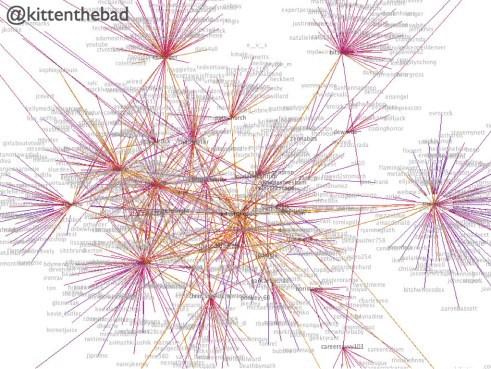
Here’s my graph. This is every one who I talk to, and who talks to me, then everyone who they talk to who talks to them. What does it show?
It shows what I’m putting out – people who I’m mentioning, or retweeting. It also shows what I’m getting – who’s retweeting or mentioning me. It also shows those people who I have reciprocal relationships with. Those are the three colors of the links.
And we can start to compare, and we see that people have different graphs. Some are more hectic, some are much smaller. And the level of interconnectedness changes too; some people have very dense graphs, whereas others may have a larger network but it’s more distributed.
Cliques: pulling out the most important part of your network
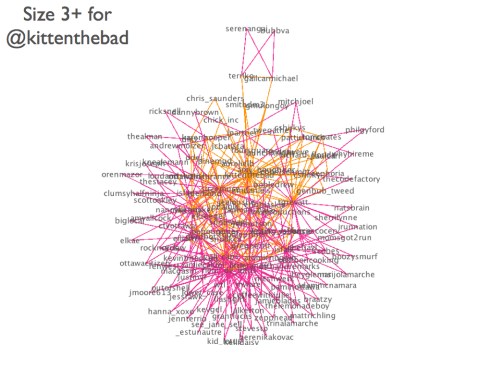
So these graphs quickly get a little hectic. However, there has been a lot of research into finding cliques within people’s social groups and why that is helpful, and we can do the same here.
So, what’s a clique? A clique is a completely connected sub-graph. So, if I talk to person A and person B, and person A and B also talk, then A, B and I are a clique.
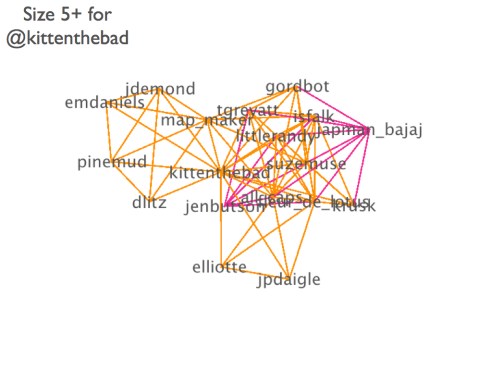
If you were to try and remember all the people you know, it’s likely that you’d do it through chains. So, “Oh, there’s Uncle Bob, and he’s married to Aunt Ann, and they have a daughter…” and so on. So if we graph this, first we’re moving a lot closer to how you think about your network, but secondly we’re picking out what I call your core network – the people to whom you have the strongest ties. And the people who have strong ties to people you’re close to, who may be good recommendations for people to talk to. These are the people connected by the pink connections in the graph.
If we raise the threshold – the minimum size – for the cliques, we get closer and closer to the denser core of the graph. The biggest graphs I’ve seen have been cliques of 8, but they are all on my website – feel free to take a look.
So What?
Some of these graphs are pretty dense, but they are less dense than the follower-following network. Really it’s about pulling out those connections that are sufficiently meaningful to us that we take the time to interact with them. Another study found that this limits out regardless of the number of people we’re following – and it’s a similar story with Facebook. Cliques have been found to be a good way to identify communities on the web, and my current findings are that that is a similar case here.
What Next?
Now, we want to see what people within these cliques are talking about. A lot of what I do is limited by the Twitter API, which limits the number of requests I can make. Now they’ve raised the limits, I want to graph influencers with the same kind of timeframe as regular users (typically around a week) – my current graphs for influencers are over a much shorter time period, for Clay Shirky for example, it was about a day. I’m also going to create graphs of influence networks – just picking out those tweets that look like a retweet.
Next Thursday, I’m giving a talk on my research to people from the communications department. Outline below.
When we talk about how we quantify success in social media (and Twitter), we need to consider how we’re defining engagement. Does someone following us mean that they are engaged with our content? Maybe – but maybe not. We only have to look at spammers with > 1000 followers to see that our current metric for success (number of followers) is severely lacking. I think @ mentions are a far better measure of engagement – it shows people are responding to, and/or retweeting your content.
How can we express this? We can view each @ mention as an edge on a graph, which we can visualize. Whilst our network of followers/following can be massive, typically for a social network (this has been demonstrated on both Facebook and Twitter) the number of people we interact with is just a small fraction of our network. What information can we gain by pulling out this network, and the cliques within it? Potentially it can tell us a lot about engagement, and make some smart suggestions for growing our network, too.
On Twitter? Have you requested a graph yet? Get yours here.
I love Google, I do. I wouldn’t use another search engine and I use a lot of their other stuff as well. But I’ve been following the debate about privacy in Buzz (read this – if you doubt that the privacy issues are a potential problem, and this info for lawyers and journalists with useful instructions for managing privacy – note that Google is in the process of making changes to resolve these issues) and wondering where all my random new followers in Google Reader came from… and now I know.
Developers, we like to make things that are new and shiny, and they we assume that other people will get it because it’s oh-so-simple to us. They don’t. Seriously.
Check out the comments on a post from Read Write Web which ranks so highly for “Facebook Login” that there are a bunch of confused people there wondering why they can’t log in to Facebook from that page. For real. The worst part of my mother getting a Facebook account, incidentally, isn’t what she can see that I’m doing (I’ve not done anything incriminating lately), it’s that now not only do I get phone calls for computer support, I get phone calls for Facebook support. And the privacy settings? If they made sense to people this guy wouldn’t have been able to do this level of analysis.
Throughout my studies of social media, I have been astonished by the people who think that XYZ site is for people like them. I interviewed gay men who thought Friendster was a gay dating site because all they saw were other gay men. I interviewed teens who believed that everyone on MySpace was Christian because all of the profiles they saw contained biblical quotes. We all live in our own worlds with people who share our values and, with networked media, it’s often hard to see beyond that.
I think this is extending to developers and the technically savvy. We’re tweeting, and blogging, and interacting with people who are like us but I don’t think we have a generation of people who are technologically literate, as much as technologically competent, and even that is questionable. What does that mean? It means they use the things we produce but they don’t understand the inner workings of it and they don’t want to.
Wave was supposed to revolutionize conversation, but I still meet people – regularly – who haven’t heard of it. A girl I know was telling me today that her supervisor (a comp sci) hadn’t heard of Google Talk. I wasn’t even surprised by this.
It’s easy to think that whatever you’ve created is the be-all and end all. But we should really know by now that if it’s at all complicated, people will be confused. People will almost never change their behavior because your product is so amazing. If we think otherwise, we’re deluded.
And privacy is too important to screw up in this respect. People complain about Twitter’s controls not being fine grained enough, but it is at least simple – no misunderstanding. Private, public. On, off. It’s a binary choice, of the type that we probably need more of.
My co-supervisor, Michael Weiss, came up with this diagram expressing the interactions we have with people on Twitter.
Direct messaging is the most intimate form of communication, which we cannot track through the API without authentication (and then only for an individual user) as it is private. We have engagement through conversation and retweets, passive listening (also known as lurking) and ignoring. In reality, we probably move between these states over the course of our interactions, depending on how we use Twitter; sometimes communicating by direct message, sometimes retweeting or conversing publicly, sometimes passively consuming, and sometimes occupied elsewhere and not reading the stream. Only spammers, interesting only in pushing their content, will remain always at the outside – ignoring, not consuming other peoples’ content.
 And get a response from someone who really knows what they’re talking about! (I have books by this guy!)
 Made my day!