Tag: speaking up

  • The Bubble in The Swamp

    The Bubble in The Swamp

    Wolf-River-swamp-North-Mississippi
    Credit: Wikipedia

    I watched the GitHub fallout the other week, and was particularly stuck by this tweet, apologising for defending the culture to feminists.

    Don’t we all do that? Say that where we are is fine, but there are these general problems. I think there are two main reasons for that. 1) It’s politically infeasible not to, 2) we actually believe it.

    The first one is self-explanatory. The second more interesting. Because to believe that, it doesn’t actually have to be true. We can rationalise in any of a thousand ways, pretend it’s not really happening, that that particular event wasn’t actually sexist, we just got unlucky. It just happened to be us that got in the firing line. Yet it just happens to be us, or other women (or other marginalised people), a lot. Because if you really believed that where you were was like that, that you had to sprint up a hill whilst guys mosied on past you on the flat, how would you cope? How would you get out of bed every morning and go to work so you could do more, for less than your “peers”?

    What I’ve been thinking about most of all lately, is that it just can’t be true. There cannot be some little bubble of paradise in the sexist swamp. It still impinges.

    And that is without talking about the extra emotional labour of bubble-maintenance.

    The Membrane is Permeable

    We’re not in stasis. The bubble is growing. This means people are going to come in. And here’s the thing; a misogynist surrounded by men, is just a man. Usually, of course there’s the odd one who will come out with a level of objectification that even other (non-ally) men will notice. But sometimes, you learn a lot about a guy the first time they encounter a woman at work, especially if there is any kind of disagreement. And there are totally reasonable things to disagree about! Like code standards or design. It happens. It should happen. If we’re all on the same page, then we’re not really challenging ourselves to build something new and awesome.

    This is why you want women to interview candidates, not a perfect system as people are on their best behaviour when they interview. But if there is any kind of suggestion that someone has an attitude to that interviewer, I’d suggest having them interview again with another woman.

    Just to be clear though, this strategy does not make for an equal experience. Depending on numbers, there may be a significantly higher interview load on the women. And they are much more likely to have bad experiences as interviewers. Not the candidate bombed the interview, although that is never fun. But things like: the candidate hit on her, or patronised her, or just (the classic!) thought she was the recruiter.

    Stereotype Threat

    There’s an amazing book about Stereotype threat, called Whistling Vivaldi (Amazon). But here’s an extremely short summary of the problem I’m talking about. When society sends so many messages telling certain groups people they don’t belong in certain places, anything that reminds them of that actually reduces their performance.

    A big issue for me is when I feel that someone (a man) is patronising me. It gives me massive stereotype threat and makes me really stressed. I don’t mean answering questions and being helpful. I mean things like jumping in before I’ve asked a question, second guessing everything I do, assuming that I don’t know anything about something I’m an expert on…

    And can we talk here about the trope “oh that guy, he’s a jerk to everyone“. Firstly – are you sure? Does he seem just a little more vicious/entitled/whatever when it comes to women? Or anyone he perceives to be an easier target (see also: interns, other marginalised groups). Second, stereotype threat. Does his behaviour re-enforce the message of not being welcome?

    Behaviours that have traditionally been gendered are disproportionately upsetting to women, even when they are inflicted by an equal-opportunity jackass.

    Participating in the Outside World

    For women on the internet speaking her mind, rape threats are an expected response. Going out in the world, and to conferences, personal safety is a major concern.

    Personally, I choose  to take these risks (within reason), especially speaking up online because I don’t seem to get anywhere near as much grief as many of my friends do. But I understand women who make the decision that either of those tradeoffs are not worthwhile, or pick their battles. I stay as far away as I can from the atheist community, for example.

    The Padlock is Sturdier

    In the tech industry, we can joke about golden handcuffs (stock options that vest over time) and gilded cages (the perks that render us unfit for for the adult world).

    But for guys venturing out into the swamp, looking for a change of scene, their restruction in this regard is what are they willing to watch? And, as most men live in blissful oblivion of the issues that women and other marginalized groups face, this doesn’t  seem like a huge hardship.

    For women it’s harder. Better the devil you know. At least they haven’t … yet. Who knows if it will be better elsewhere.

    Here is a good article from a man talking about male privilege in technology, some points of which are very relevant to this. 

  • Staying Silent

    Staying Silent

    TRIGGER WARNING

    Silent, woman! Shh... Don't be so loud
    Credit: DeviantArt / MarielleAxelsson

    There’s a sick cycle in the tech industry, where if a woman say someone assaulted or harassed her but doesn’t name names, she’s probably making things up. But if she does, she’s public shaming and ruining someone’s life.

    I don’t know what people think happens to the life of someone who’s been sexually assaulted. To be clear – they don’t just take it as a complement and move on. The memory fades, but doesn’t disappear, and there are a variety of after-effects – including PTSD. I can’t find statistics on relationship breakdown after such an event, but there’s no question that the effects would cause a strain on any relationship. After what happened to me – a relatively mild occurrence compared to things you hear about, I doubt that I will ever be able to relax in an economy seat next to a random dude again. Luckily, most of my flights that has not been the case – but the result is that business class is no longer pure luxury, but the only place on a plane where I feel safe.

    I hate that that guy took that from me – the willingness to hop on a plane and just think, worse case I’ll take something to help me sleep and eventually it will be over. I have a new worst case, and it’s not 14 hours of discomfort next to a screeching baby.

    And all this push back comes from the idea that women might be able to make this up. I have such a hard time believing that. Personally, I had such a hard time believing it was happening, that I set some bar for being “sure” that was way in excess of what was needed. I know what the statistics say, but they don’t measure what they claim – the article “I am a false rape allegation statistic” will make you cry.

    But to go back to the idea of why I felt I had to be sure, my worse case scenario would have been going away, not having been believed, and being forced to go back there. Safely away from that moment, I doubt an airline would force a hysterical female passenger to go back and sit next to a man she was afraid of, but at the time I was calm. I didn’t know that I wouldn’t be once I went away.

    But this is why women keep quiet. About this, about smaller things – different shades of the view that women are somehow lesser, that their rights and wants are worth less than those of men – inappropriate comments or material at work for example. About someone being attracted to her in a way that makes her a bit uncomfortable, but doesn’t seem to cross some line – do we even know where that line is? Is it when she feels uncomfortable? Or does she have to feel threatened? Or does she have to show that she has some reason to feel threatened? Which given just 7% of communication is verbal, seems like it would be hard to quantify.

    Choosing to stay silent, is choosing to be able to tell ones self that “well, I could have said something”. It’s surprising how comforting that can be. Choosing not to be silent, well, that’s a bit more unpredictable. On occasion things are well handled and she is supported. But that’s not always the case and it’s not like her suffering ends with the end of whatever process is enacted.

    And what if her concern is dismissed, or downplayed, usually by a man who doesn’t understand that men can be physically threatening even when they do nothing – they are bigger, there is a social context (Louis CK on “There is no greater threat to women than men”), or the perceived threat of higher status – in the few (no way all) stories we actually do hear about at work and at conferences, it’s often the case that the perpetrator was more senior to the victim.

    And then, her problem is now exponentially bigger. Because something made her feel uncomfortable, and she went to someone she trusted, who she had reason to believe would help her… and they dismissed her concerns, didn’t want to hear it, chose not to help.

    He doesn’t have to agree, but dismissal is so harmful. He can say, “I don’t agree, but I can see why it would seem that way.” And he can ask, and offer things, that will make her feel safer. There is good reason for her to feel unsafe and take precautions in this industry and in the world.

    There are a lot of subjective things. But how she feels is not one that he can or should argue with. She should feel safe – at work, at tech conferences, sitting next to strangers on planes. And if speaking up about those feelings makes the problem exponentially worse, there is a good chance she’s going to choose to keep quiet… and who can blame her.

    No doubt the trolls will find a way. But decent human beings won’t.

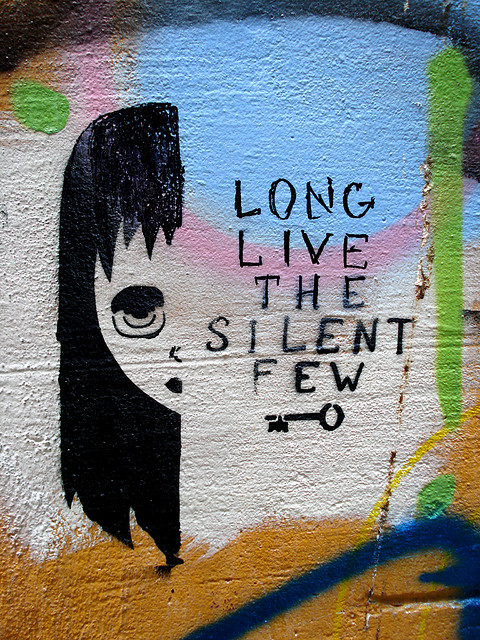
    long live the silent few
    Credit : flickr / Anna Phillips