Tag: rest

  • The Battery

    The Battery

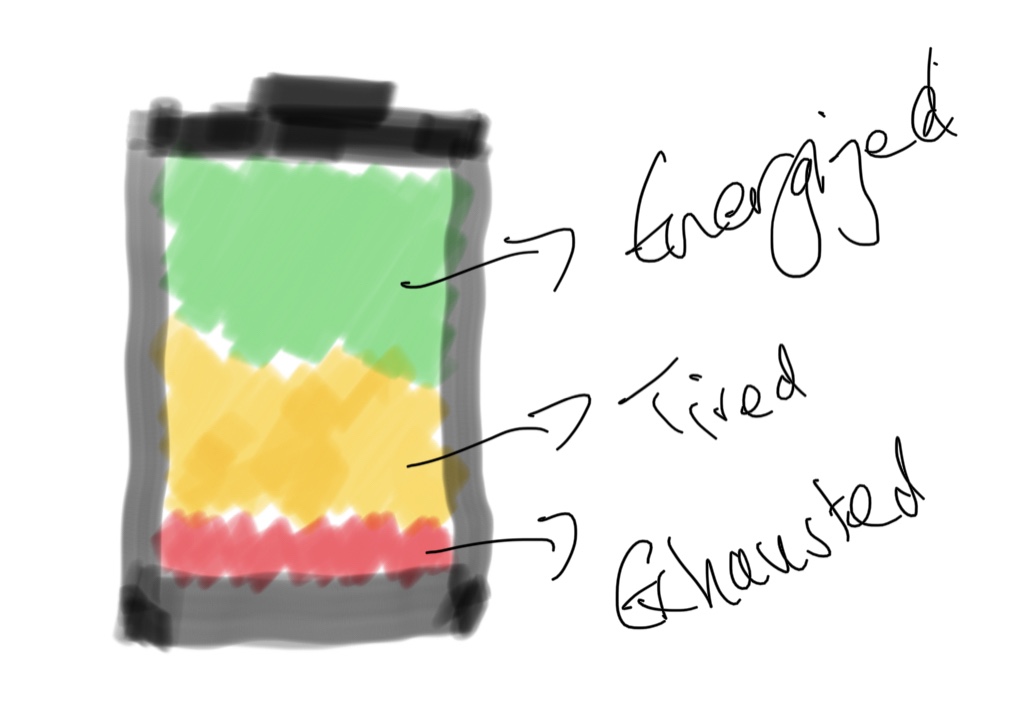
    I keep coming back to what it means to recharge. The metaphor that has been working most for me lately is the idea of a battery.

    In the green, I have plenty of charge. Everything is possible.

    In the orange is the ideal place for “active rest”. But if that’s not an option, I can keep going.

    In the red, everything is a struggle. I am in the human version of “low power mode”. Service is diminished, and I need to be on the charger, or I will keep cutting out.

    Trying to recharge, I operate from three lists:

    • Adventures and real breaks. These happen infrequently.
    • Planned recharging activities, like a date night, seeing a friend or spa trip. These happen a couple of times a week (mostly).
    • Unplanned low effort activities. Picking up a novel from a backlog (note: no decisions), giving myself a facial, watching an episode of something with my partner. These happen most days.

    Of course there are also the things I do when I don’t make an active decision to recharge. Mindless doomscrolling or playing a game.

    It takes energy to plan, so things that require planning need to be arranged in the orange (or green). The low effort no planning activities are actually the most crucial. Decisions take energy, so making those activities as easy as possible is critical.

    Decisions increase the activation energy of a activity. I.e. reading might be recharging, but trying to choose a next book is not (for me). In the red, there is no activation energy.

    Some activities also require significant activation energy. For example, generally, I find writing a recharging activity. But it has a relatively high activation energy. I need to sit at my desk, open up the editor, come up with some kind of idea. The best thing I did for my writing was to reduce the activation energy – I bought an iPad Pro with the fancy keyboard, and I keep it on the sofa, to pick up and write something (anything) when I might not muster the drive (activation energy) to make it to my desk. I drop random ideas into a notes app sync’d across all of my devices, so that at any time I can just go through and see if there’s some idea to flesh out, so I don’t have to think of one.

    The other side of recharging is: what drains you? There was a lot of talk early in the pandemic about how much time and energy people freed up by not commuting, and how they were happier and more effective as a result. I never got the boost of losing a commute, and in this timeline, I feel like I drain more quickly and recharge more slowly. Paying attention to why has been illuminating.

    • Having set times and needing to make phone calls made the activation energy of working out much higher and the quality lower. I leant into Peloton classes instead.
    • Heavy meeting days are exhausting, and it’s easy to think it’s just “zoom fatigue”. The battery metaphor helped me understand that “only” 6-7 hours in length on Zoom used 10-12 hours of energy. I realized that beyond the time on Zoom it was the context switching and lack of breaks. I reorganized my calendar as much as I could, and reframed my expectations for myself to make those days less depleting.
    • People management is more draining when people are stressed / unhappy, which in this timeline was more regular an occurrence. I gave myself more space to manage that, and looked for ways to expand my toolbox.

    One of the core things I’ve taken from this exercise is that when something feels “disproportionately” draining, that’s not automatically me failing at something, but an opportunity to learn something about myself. Getting curious about why helps me understand things more fully – which makes it easier to address them. I’m hardly alone in finding some things oddly exhausting, and it’s always fascinating to see what other people find draining. One question I like to ask is, “if you could change one thing about your job, what would it be?” – the answer illuminates what for them is particularly hard, which is useful to know even if there’s little to do about it.

    The biggest change for me, however has been to accept being at zero. It sucks to be at zero, but fighting and judging it doesn’t change it – actually it makes it worse, because fighting and judging are exhausting activities. Only once I can let myself be at zero without judgement do I begin to recharge.

    If you want to start analyzing your battery, a some things to try:

    • Every day for a week (or a month!), reflect on what was most draining, and what was most rewarding. At the end of the period review, and see what patterns emerge.
    • Make a list of low activation energy activities that recharge you. See if there are things you can do to reduce the activation energy of them – e.g. identifying things to read or watch to reduce decision making, or buying supplies for crafting or facials or whatever is your jam.
    • Make a list of planned activities and see how you can make them more regular occurrences. Schedule standing dates with your friends or partner, or set aside time to book advance tickets or appointments for things you know you’ll enjoy.
    • Think about how you can reduce the activation energy of things that you know you enjoy but sometimes struggle to start.
    • Pay attention to where you are at when you finish your work day each day. If you finish in the red every day, your rest time is likely to be lower quality. What would finishing in the orange 1-2 days a week give you, and how could you make that happen?

    One big difference is for people who enjoy planning, it can be a recharging activity that is self re-enforcing when what is being planned are recharging activities. For people who aren’t planners (it me) planning may be a chore to accept in pursuit of an overall happier life.

    What is personally recharging or draining to you will be different, but the first step is identifying what that is and deciding what – if anything – you want to do about it.

  • How Do We Recharge?

    How Do We Recharge?

    I feel like I’ve spent much of this pandemic digging out of a case of burnout, watching people burn out around me, trying to get ahead of things, trying to inch up from zero but never really feeling like I make it that far.

    I think it’s understandable that people are burning out, left, right and centre. For many of us, the pandemic hits all the causes of burnout.

    And all those things feel so much harder when rest is lower quality. When we are more isolated. When time is monotonous, we feel like we have less of it.

    I work somewhere with untracked vacation, so I keep my own records. I know how many days I took off as vacation, how many days for “life debt”, how many days for learning and development, how many days I was sick, and how many weekend days I worked. All of these numbers are in the “normal, European” range. But if I think about it, I remember two weeks I took off. One in July, and one in September. The ones where I made a plan and went somewhere. Approaching the end of the year, it doesn’t really matter what my record says – I’m tired like the only breaks I took were those two separate weeks away.

    Two benefits of getting away, then. The first is that the change of scene is memorable and changes our experience of time. The second, that it gets us away from all the admin of life. The chores that keep life going but that also sometimes make life feel like a drag.

    I used to think that rest was going away somewhere and doing something else entirely. I thought it was finishing a novel each day. Waking up whenever. Wondering around freely, without a schedule. When I think about what it was like to recharge in the before times, I think about the 10 days or so I spent in Bali, doing yoga until my wrists gave out. I think about a blissful long weekend in Hong Kong. I think about Venice in November, the biennial, the architecture, the fog. I think of that trip to Costa Rica, the sea turtles, the kayaks, the jet skis, and swimming every day. I think of days spent wondering across Barcelona, across Reykjavik, across Copenhagen, across Prague. I think of taking the boat to MONA in Hobart, skiing in Andorra and trips to the spa.

    My concept of rest was “active rest”, like, in the Peloton class where after 15-20 minutes going hard you get a break at 80-100 RPM but “just” 30 on the tension.

    But also I’m biased to remember the active moments. The periods I spent lying down, or days I spent with the program of go to the gym, eat something, and read a book, blur into one. According to my Kindle, I have read 941 books. Not all of them were on planes; I must have passed many days this way.

    I used to have two modes: rushing about at full tilt, and collapsing from exhaustion. Therapy helped me shift to somewhere else, to see myself as worthy of rest, to shift my concept of self care to actually involve care for a future Cate. I’m glad I did this work before life as we knew it was cancelled. This timeline has forced me to reconceptualize rest again. To pay closer attention to what makes me feel recharged, and what makes me feel worn out. To find things that make me feel like time has passed but it was time well spent (like crafting), and pay attention to those things that make me feel time was wasted (like binge watching Netflix).

    A question I ask – myself and others – a lot, is “what makes you feel recharged?” The answers are fascinating, a friend today described the incredible feeling of painting a wall with a brush, feeling like she was accomplishing something, enjoying the moment – even though her husband subsequently repainted it with a paint roller for a better finish.

    I feel recharged when I…

    • … experience something new.
    • … meaningfully connect with a friend.
    • … wake up from the kind of deep sleep you only get from intense exercise.
    • … make something.
    • … finish a book.
    • … bring order to my living space.
    • … relax in the sauna after a good swim.
    • … emerge from the floatation tank.
    • … spend quality time with my partner.
    • … see a raccoon.

    This topic feels really present right now, as almost everyone I encounter seems exhausted. Most of us get something like a break for the end of the year, and it’s worth thinking about the question, what will you do, so that you can recharge for 2020 take 3?

  • R&R

    R&R

    Sleeping coati
    Credit: Deviant Art / CitronVertStock

    To my mind, a good week contains:

    • A day when I don’t speak to anyone.
    • A day when I don’t take the tube.
    • A day when I don’t touch a computer.

    The first two are easy, a day working from home will cover them (something that I have felt increasingly necessary for my mental well-being).

    The last one is hardest. It’s the only way I know to take a real day off, and I am so bad at it. But ultimately, the goal is not 7 meh days, it’s 4 GREAT days of productivity. Maybe 6 meh days is how you start. I can’t be sure, but I know the cycle of “being productive” 7 days a week and never feeling at the top of my game is not the way.

    A real day off requires two things: organisation, and will power.

    Organisation because everything has to be done by bed-time, the night before.

    Will-power, because whatever I realise I have forgotten has to wait 36 hours (max!) until it’s all over.

    I took a real day off yesterday for the first time in… frankly, I don’t remember. I had some grand plans – a Cate-time double bill at the gym! Kew Gardens. In the end, I did neither. I curled up on my sofa and watched a lot of Drop Dead Diva (Amazon), got one (reasonable) workout in, and went for dinner with a friend.

    And of course I remembered things I had forgotten. But you know what? It was OK. And I feel so much better.