I came across this yesterday. “Hope not Hate”, in response to the BNP getting two seats in the EU elections. I loathe the BNP, I do. They’re racist and offensive. But – this is a democracy, and even stupid and racist people get to vote. They exercised their right to vote in electing in the BNP, the people who we should, in my opinion, be angry at are those who did not vote.
It was interesting because the media and twitter (remember #thebnparetwats which was trending not so long ago?) got all excitable about how the BNP were looking set to do well (by which we define, getting a seat at all, anywhere) but the fact that UKIP beat Labour (the ruling party) into 3rd place in Europe, a stellar result for them, wasn’t so widely talked about.
Google released a paper not that long ago, called “Predicting the Present with Google Trends” where they talk about predicting some economic activity and travel to Hong Kong. So I wondered if the trends from various sources would show that UKIP were really doing better, or whether all this agitating about the BNP would have clouded that.
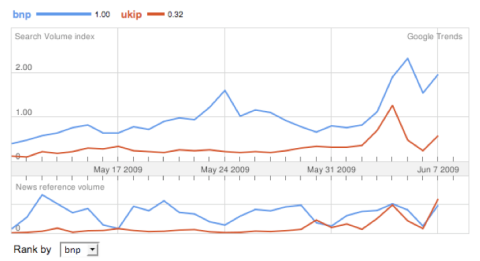
Below is the graph from Google Trends. The top graph shows search terms, and you can see that the BNP was more a popular search term than UKIP, had an early peak some time before the election on May 24th (the EU election in the UK took place on June 4th along with council elections, results were announced June 7th-8th). The general trend for both parties was that search term frequency increased over the period covered in the graph (the last 30 days). The lower graph shows news articles and we can see that there were far more stories about the BNP than UKIP, with peaks following the weekly news cycle. However since results have been announced (June 7th) the curves have converged. Would be interesting to see what’s the case in another week, the BNP may be inherently more news worthy than UKIP as they cause more trouble.
The blog trends from BlogPulse, below, are far less interesting. The curves follow the same pattern, peaking around the announcement of election results. But again, the BNP have a higher frequency than UKIP.

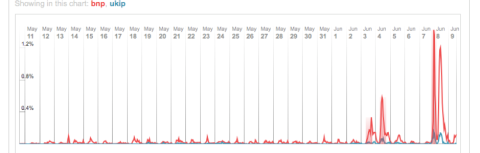
Finally, I graphed the Twitter Trends using Twist. You can barely see UKIP, as occurrance is mostly so flat. The BNP have been cropping up throughout the month, with big peaks around the election day and the day the results were announced, where we can see tiny UKIP peaks too.
It’s so hard to see UKIP on the graph above I’m including the trending graph of just UKIP on Twitter below.
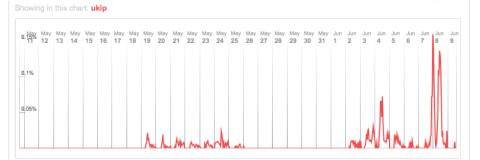
So I think we can see from this, on the internet the BNP have been much, much more talked about than UKIP. And yet – UKIP got 2,498,226 votes to the BNP’s 943,598. Or 16.5% of the vote to 6.2%. 13 seats to 2 (source – BBC News). So UKIP got 2.65 times as many votes as the BNP, and has 6.5 times as many seats. Also note, that with an electorate of 45,315,669, only about 2% of the population entitled to vote supported the BNP. With turnout at just 34%… they managed to have an impact.
So perhaps this is a sign when trends didn’t predict the present, maybe due to the noise from the media getting so agitated about the BNP. But a more hopeful conclusion might be that trends are accurately measuring the level of interest in this party, and the BNP are making an impact, they’re hitting the news and people are talking about them and wondering who they are. And yet, only 2% of the voting population actively went and voted for them. We’ve seen this increase in nationalism all across Europe (and with certain protectionist measure in the US) as a result of the economic crisis. My hope is that this is a short term blip, exacerbated by poor voter turn out. Basically that we can conclude from this that whilst awareness of the BNP is high, the vast, vast majority of people have not opted to vote for them
And – I belive in democracy, whether or not it returns the results that I want. If the BNP are increasing in popularity lets just get out there and make the case for Europe and immigration which is probably in the macro rather than the micro economics. But above all, lets get out and vote.
 I wanted to see this since it came out, but I finally got round to watching The Iron Lady on the plane to Australia. At first I thought I was going to hate it, because it starts with Maggie really old, and clearly losing her grip on reality somewhat. Actually I spent almost the entire time I was watching it feeling quite close to tears.