Tag: harassment

  • All The Shades of Unsurprised

    All The Shades of Unsurprised

    2621849722_759ffec5d6_o
    Credit: Flickr / brett jordan

    We’re all outraged at Uber – again. Because it turns out that the company that tolerates sexual harassment from their drivers, and in the government they work with, also tolerates and enables it… amongst their own employees.

    And yeah, this was really bad, but it’s not like this is just Uber. I’ve heard similar stories from most tech companies and every woman in tech I know has a story like that. Often more than one. We all know that HR is there to prevent the company getting sued, not anything else. The only shocker here is how blatant it was – do they know what retaliation means?

    One HR rep even explicitly told me that it wouldn’t be retaliation if I received a negative review later because I had been “given an option”.

    It’s safe to hate on Uber, because we know they are evil. The challenge is not tweeting something supportive when it happens at a company you hate. It’s how you react when it happens in a company that you’re invested in, to someone sitting right next to you. Many men have sat next to these things, known they were happening, and said nothing. Plenty of white women have done the same to women of color.

    Perhaps we should talk about how even when the disregard for the law is flagrant, as it is here, it’s still better to write a tell-all blog post than to seek legal redress. Women know the consequences for that, and they don’t take them. Who can blame them.

    And maybe we should also talk about what will happen next. Nothing. Uber chose their “high performing” men over the high performing woman, and now they are on some empty PR blitz (HR is going to investigate! LOL) but it means nothing. Maybe they will have a harder time hiring women now. I don’t think any woman I know was willing to work there anyway, so how much worse can that get, really? Uber was built by the brogrammers, for the brogrammers. This is how it’s always been. This is how it will always be.

    Delete the app – great – but it’s still baked into Google maps functionality, so Uber will still be fine. VC bros don’t turn on their own kind because they continue to operate the way they always have.

    And let’s also talk about the bar we hold women to in these situations. You shouldn’t have to be a white woman with a best selling book to expect to be respected at your job. You shouldn’t need to have to document every interaction with your manager or HR department.

    Finally, can we please talk about why men let other men slide on these things? It’s because they identify with the dude who made a “mistake” more than the woman he harassed. It’s because they fear they too could make that “mistake” – people in glass houses shouldn’t throw stones. And so they let him make the “mistake” again and again and again. Please, guys, let that one go. You probably wouldn’t make that “mistake” with every woman who joined your team. I believe in your capacity to be better. This is not about you. It’s about him. There is no “high performing” manager who can’t be trusted to manage women – fully 50% of the population – without propositioning them. Understand that “we’re poly but my wife is more successful than me” is the new “my wife doesn’t understand me”. It’s possible to be poly and not be creepy AF, but this dude failed at it. Let him go. Firing people is horrible, but I could fire a manager like that and never lose a minute’s sleep over it. You can do it, too.

    As an industry, we need to take a hard look at ourselves right now. We have bragged about changing the world, and we have to accept that we have – and not all for the better. The fear of entitled white men does not just prioritize the fear of their litigation over that of the women they harass, it also drives this misunderstood argument of free speech – people can say what they like, you don’t have to give them a platform*. We’ve created things to allow people of similar interests to find each other, and the Nazis, well they have found each other, and they are stronger than ever. We have erased and hidden and diminished sexual harassment and assault until it has reached the highest office. We have encoded a white supremacist patriarchy in the platforms we have built and watched it thrive in the real world whilst disclaiming responsibility.

    It started inside the office – not just of the company you hate – but the ones you like, the one you work or would work for. When these kind of things happened, and nothing was done.

    * Let them RTFM and build their own – all the pieces are out there – this is the beauty of OSS.

  • Discoveries About OSS Culture

    Discoveries About OSS Culture

    Danbo on Flickr II
    Credit: Flickr / Andrés Nieto Porras

    I was hanging out with an OSS-dude (OSS = Open Source Software) for a while, and I learned a couple of things.

    Firstly – don’t try and buy committed OSS types books. It’s a complete nightmare.

    Secondly – I’ve reached a better understanding of harassment and open source. And particularly the pushback, which comes from a place of “we all put up with this”. It’s not that OSS people think this behaviour is acceptable (although no doubt there are exceptions), it’s that they don’t know how to change it.

    Death threats are a common occurrence; he gets them regularly, even if they are rarely talked about publicly, and there are no public meetups around a project he works on in a city because there is a guy who is sufficiently threatening.

    The threats and harassment are – seemingly – trying to assert dominance. The way that men assert dominance over other men is different from the way they assert dominance over women, and the difference in threats reflects that.

    There’s an attitude from some of “I put up with this, so why not you?” and the short answer is no-one should put up with it. Willingness to tolerate threats and harassment is a high bar for a career, let alone a hobby (but 50% of OSS work is actually done as part of someone’s job).

    But as I observe to him, the worst case is it’s a 6-foot dude, how worried is he? He laughs and says, “well I am a 6 foot dude”.

    As someone who is not a 6-foot dude, for me the worst case scenario is pretty terrifying.

    As in all cases where the argument “but [person / culture] is vile for everyone” it’s worth considering:

    • Do some groups have reason to feel more threatened?
    • Is this behaviour historically gendered or racial (even if you are claiming it isn’t this time)
    • Is it possible that people feel more comfortable exhibiting this behaviour to already marginalised people? (Less likely to experience repercussions, because marginalised people tend to have less power).

    In any discussion on Open Source, it’s worth linking to Ashe Dryden’s excellent essay The Ethics of Unpaid Labor and the OSS Community.

  • Flawed Humans

    Flawed Humans

    IMG_4312As I walked through Barcelona, I came across a tiny hidden museum dedicated to Dalí. As I admired the work, I pulled up his Wikipedia page to learn more about the artist. And discovered that he refused to decry the Nazis, and had been kicked out of the Surrealist movement in part because of it (there is far more information about this on the German Wikipedia page).

    There’s a quote from George Orwell, that I often think about in this context,

    “[o]ne ought to be able to hold in one’s head simultaneously the two facts that Dalí is a good draughtsman and a disgusting human being”

    And yet. It has tainted Dalí’s work for me. It is brilliant and yet somehow I am wary of it. The dripping clocks are beautiful but I cannot quite give into it in the same way, with the knowledge that he was so… inhumane.

    Genius is entwined with madness, with selfishness. But we look back and admire the work of artists and mostly don’t discover who they were aside from a genius.

    This extends past art, I think, to the single minded determination to achieve anything.

    Terrible parent. Numerous affairs. Alcoholic. Abusive boss. Serial womanizer. Narcissist.

    A while ago, I realised that in the activist community there are people whose work that we benefit from, but that we might personally not want to be friends with.

    It can be hard to reconcile this with a hero narrative. Personally, I’ve chosen to not criticise other women, to be publicly supportive or say nothing, and privately keep my distance.

    In the years since I discovered this, I have watched what happens to women online and wished we would talk about what it does to you to receive constant threats. It’s amazing what you get used to. I realised when I was leaving the tech industry that someone had called me a bitch and I hadn’t even noticed. I just put it in a box and mentally noted to be wary of that guy. Would death threats also become normal, given enough of them? It terrifies me, what that might do to me. I can’t be sure what that would be. I don’t know that I would like the person who resulted all that much.

    One of the most unfair things we ask of women is that they be perfect victims. I’m not sure how much of an improvement the narrative of a perfect hero is.

    I dream of a day when women can be whole, entire, flawed, human beings. And we can admire what they do, or not, where we can temper our admiration with knowledge of their flaws, if we know of them, and where we can acknowledge that some things come at a cost that most of us are not prepared to pay.

    IMG_4346

  • It’s Not That Big a Deal

    It’s Not That Big a Deal

    odd one out
    Credit: Flickr / Michelle Friswell

    As an Angry Internet Feminist™, every incident I point out has multiple parts.

    1. I notice and say something.
    2. Tone policing, on whether I should have noticed it. After all, it’s not that big a deal.

    Someone uses “he” when they should say “they”? Not that big a deal.

    Mild objectification of women in something that should be professional? Not that big a deal.

    No women speaking at a conference? Not that big a deal.

    Because the thing is, each instance isolated is not really that big a deal. So one sentence wasn’t inclusive? So what. So one guy thought he was funny when he wasn’t? So what. So that one conference didn’t actually get the best speakers because they limited themselves to <50% of the population (usually no PoC either). So what?

    Here’s the thing that people who are telling me what should and should not bother me don’t seem to realize. It’s that I do understand that if it was that one thing, it wouldn’t be a big deal. But it probably isn’t even the only thing I’ve encountered that week.

    Because whatever your feelings about “they” as grammatically less correct, when I sit in a room full of men, and only men, and someone says “he” when they could say “they” I often look around the room, and I’m reminded that I don’t belong.

    Really, I get enough reminders. At the events featuring pizza and beer. When men think I’m lost, or something – anything – other than an engineer. Could you just change that word? Would it really be that big a deal?

    And yes, it just a word, it’s just a tasteless joke. But it’s in your marketing materials and presumably more than one person looked at those. So if that wasn’t a big deal… what will not be a big deal for something less externally facing?

    That guy, urgh that guy, who “jokingly” called his female colleague a bitch. What do you think he’s going to write on her performance review? Maybe that she’s “abrasive”.

    You know, when I left my Prestigious Tech Job to do something different, it wasn’t to be the unpaid, unappreciated teaching assistant of the Feminism 101 MOOC.

    Because these individual items that each taken individually are “not a big deal” have piled up and now I sit precariously atop a pile of tiny rocks, wondering when it will all come crashing down.

    These things do not happen in isolation. The culture that culminates in the death and rape threats (just the most recent example) is built on a culture where women do not get paid what they deserve, where they are objectified, marginalized, and, most of all, ignored.

    Can we talk about humour for a moment? Because I’m tired of these things being “jokes”. This guy thought that rape threats were satire. I will now explain why they are not funny. Humour requires an element of the unexpected, and there is nothing unexpected about a woman with an opinion being threatened with rape. It is an alarmingly normal occurrence. Online harassment is an expected part of being an Angry Internet Feminist™, and it is hard to distinguish between the guy who calls me some obscene word and is “joking” and the one who has intent.

    So we add two factor authentication (did you know, Twitter has it?), and install security software on our websites. I have only experienced the very mildest levels of harassment, but make no doubt, if I was truly under threat, I have a plan for where I would go, and enough air miles and money to get me there. Call it paranoia, if you want. I call it being prepared.

    There is no humour there. There is just yet another woman who is paying the price, in harassment, for having an opinion. For calling stuff out, when she saw it.

    The data says that 40% women drop out of tech careers in the first 10 years. I didn’t know many other women on my university course, but of those I do, I am the only one still building systems and writing code. One is an environmental economist. Another a BA. I hear one became an artist, cool.

    And I’m sure each of them went towards something compelling, to them. I’m sure they each made the decision that worked for them. I hope they have interesting careers and fulfilled lives.

    But they didn’t stay.

    Against the evidence, my generation of women techies, we thought we were different. We thought things were better, because sexual harassment and even assault was no longer a normal part of the working day (although don’t be mistaken – it happens). We thought things would be different, and we just needed to work hard and be awesome. We were wrong.

    I’m reaching this point in my career where I’m starting to see my peers drop out. Make their backup plans. I wrote this article about knowing someday I would leave tech, and so many women said “this is how I feel!” and a couple of men said “wow it’s really bad that women feel this way, maybe we should do something”.

    Because I hear variations on the same story, again, and again, and again.

    It is hard to fix structural equality. And like many hard things the first step is admitting there is a problem. Could you just say “they” instead of “he”? Pay an expert to review your marketing materials? Could you just do the work to get a more balanced line-up at your conference? Stop making “satirical” rape threats? Could you stop telling me what should, or should not bother me? Please?

    I’ll tell you what I think is a big deal. It’s when I watch a woman who I know to be brilliant, slowly lose her joy of making. It’s when I watch her give up caring about her career, and just go through the motions, because frankly showing up every day is hard enough. It’s when I see her leave.

  • Tweeting Shit That Men Say

    Tweeting Shit That Men Say

    Background: Last week was GHC, it included a Male Allies panel (live streamed) and a male keynote event (available to watch online). I tweeted a lot (with others) and wrote a couple of things. The Male Allies panel was followed by a reverse “you talk we listen” event. There was also a Male Allies Focus group which I did not attend.

    I often, in conversation with friends, coworkers, strangers, utter the words “I have to tweet that.” Sometimes people know what that means and sometimes they don’t, but they usually agree anyway, and are sometimes surprised by the response.

    Sometimes I don’ t ask. Earlier this year I live tweeted a date with a misogynist. I didn’t ask him for permission, or for forgiveness. I tweeted an unfortunate comment a guy made advertising a conference (“beautiful women” as an incentive on par with “international airport”, who knew?!). And last week I tweeted things that men said at a conference for technical women using the hashtag #ghcmanwatch, some of which were good, and some of which were… not.

    Tone

    I have this rule, that I don’t criticise women or (by extension) women’s organisations. I make exceptions for this, I might vent to a close friend, and if I think something is actively harmful. But it makes me think twice. I thought the Male Allies panel had the potential to be actively harmful, which is why a week before the Male Allies panel I was tweeting and wrote my thoughts up long form in a (widely read, so much so that the panel introduction mentioned it) blog post.

    But, I err on the side of saying nothing. I know, that the things where I feel the very mildest levels of disagreement, where I look at a situation that I have incomplete knowledge of and like to think I would have made a different choice – and note, this is all theory, we don’t know how we would actually react to that situation, are the kind of things that end in death and rape threats.

    No one deserves to be threatened with rape. No one deserves to be threatened with death.

    Not in Afganistan. Not in places where we send soldiers and declare war. Not in America. Not in the UK.

    This should not be the price that women pay for having an opinion. And whilst it is, I just refuse to participate.

    As an aside, and not to diminish being on the receiving end, but looking at the behaviour of harassers… Harassment seems to be a time consuming hobby. I wonder if there needs to be some kind of rehabilitation program that will find these people better things to do. Like… Knitting. Or golf. Things that don’t require an internet connection. I’d say for their own good but I don’t really care about their well being… just think of the social benefit.

    When all this was happening, my mentions on Twitter were completely blowing up, and there was so much engagement. Which is gratifying, but also in this context a little scary. And repeatedly, I noticed, and was pleased, that I didn’t get harassed. I also gave a talk at GHC – about mobile, not burning the patriarchy – and right before I had more notifications and I choose not to read them before getting on stage, on the basis that if there was something that would really throw me. That day I also didn’t moderate blog comments, remembering a particularly vicious one recently, just in case.

    I want to make two suggestions around dialog. The first is a strong suggestion, I wish we could make it a rule:

    Don’t threaten people.

    Put that in your pipe and set yourself on fire (OK), put that in your pipe and I will set you on fire (no)

    The second is to focus on our own voice in the dialog, and our own message.

    Good Feminist / Bad Feminist

    I got critique, and critique is different from threats and harassment, from both sides last week.

    Some people thought I wasn’t angry enough. I don’t know, I think we have a right to be angry. Personally, though, I have heard so much shit from men in this industry that there is little they can say that elicits more than mild surprise and disappointment. I choose to laugh, as much and as often as I can, because it’s a survival mechanism and because I believe in the power of humour to raise awareness.

    Some people thought I was being too angry and mean. These are the people who will say some version of, “You’ll catch more flies with honey.” I don’t honestly know what catching flies has to do with dialog but if someone wants to try that all I can say is good luck, let me know how you get on (sincerely).

    And some people would say, or insinuate, that I was being a good hell raiser, compare me favourably to those other, more “angry” feminists.

    Don’t do that. I might say “fuck” less than Shanley (who seems to continually lambasted as the “bad feminist; I abhor this), but I still want to burn this shit down. I support her right to be angry. I think we benefit from her delivery. I know we benefit from her insight. Whether I agree, disagree or just choose a different way to express it, I always think that she has a point.

    Most people just amplified and thanked me. And I really appreciated their support.

    #GHCManHate?

    The hashtag wasn’t #ghcmanhate. It was #ghcmanwatch. Watch. We have concerns, but we see you. We are watching what is happening, and we are witnessing, and commenting on it.

    The Satya Nadella comments were so ignorant and unfortunate, I was horrified by them, but the rest of the session he had made some good points, declined to blame the pipeline and had taken a significant amount of time out of his schedule to come and experience GHC. He told a story of failing one of his Microsoft interviews, aged 23, because his interviewer deemed him “lacking empathy” in response to the question “a baby falls in the street, what do you do?” I was surprised by his honesty there, and I liked it. And yes, terrible remark about compensation, however Maria Klawe’s calling him out and telling all the women in the audience how and why to get paid what they are worth, and her honesty about her own experiences was amazing. I’m glad her comments happened.

    What a man says in that context is less damaging that what bad managers are saying in 1:1s everywhere, all the time.

    (What he does is another story, I especially feel for every woman at Microsoft who has reported up into him and not felt they were paid equitably. I hope they are working to address this.)

    I was deeply unimpressed by many of the things said by men at GHC. But I have more respect for the man who shows up and says something stupid than the man who never said anything stupid because he wasn’t there.

    Talking to women who are, or were at Google, we shook our head over some of Alan’s comments but we also give him a break because he has been doing this for a long time, because he has done a lot of good internally that we can point to, and because we know because he tells these stories about stupid things that he has said and being called out on it and learning.

    I hope he never gets on stage and tells women just to work hard again. But I hope he does keep on this dialog, and next time makes a different mistake.

    Glass Pedestals

    A different mistake because none of us are perfect advocates, and perfect allies. Some (predominantly white) men said some deeply flawed things to women. But white women at GHC have used that same platform and been deeply flawed with respect to women of colour (one of my favourite sessions in recent years included Brenda Laural deconstructing the promotion materials for that year and how the women of colour were represented), and also to trans women.

    Because my fear is not that men opt out of this conversation, but that they get so PR’d in response to these gaffes that we don’t hear what they really think anymore. Agree, or disagree (and there was much to disagree with!) it’s illuminating [I liked Jocelyn Goldfien’s post on this topic].

    The Red Carpet

    One thing that comes up a lot when I talk with women about the tech industry is that the grief we get almost invariably comes from men who are… not actually competent. I do not fear brilliant men in the tech industry. They have better things to do than screw me over. I fear incompetent men.

    If we say that there are two major factors: being good, and being lucky. The men we heard from at GHC are both good, and lucky. There’s a smooth red carpet laid out and they are storming along it. But what if you’re only good? Edging along the gap between the red carpet, and the abyss. What if you are only lucky? Those people have time (and incentive!) to try and stop people edging past on the outside.

    So when a man says that he doesn’t think people (MEN!) mean to be unwelcoming and don’t actively try to remove women, what he means is that it would never occur to him to do this. He has never needed to. The good and the lucky are often moving too fast to see that that is what is going on.

    And when a man says that it’s mostly “unconscious bias” and not “major issues” they don’t know how much doesn’t get reported, and, I think, negate the long term effects of “major issues” which can send a very strong message to a marginalised employee that they are not safe, they were never safe, they will never feel safe again.

    And what exactly is major here? Because these things have compound effects. Two equally talented and hardworking female new grads join the industry. One of them has a good manager, who mentors, develops, encourages and challenges her. One has a bad manager who gaslights, ignores, and undermines her. While each thing they do might be “unintentional” and due to “unconscious bias” make no mistake there will not be a minor difference between the experiences of these two women, nor between their career trajectories.

    Bearing Witness

    I was expressing my surprise at the amount of attention I’d got to my amazing friend Leigh, because it at times felt a bit surreal. I felt like I barely commented, I just shared, mostly verbatim, what was being said. She told me, “I think there is power in bearing witness”.

    And I thought about this comment in a broader context. Of what the guy from Facebook (Schrep) talked about, watching what his wife had experienced on her way to being a CTO and noting that he hadn’t had to put up with a lot of that stuff on his way to being CTO. One of the most powerful things men can do is bear witness to what happens to the women around them. One of my male friends, he could storm the Red Carpet but prefers to mosey along. And he observed, and commented to me on the difference between the way a guy was treating me (let’s summarise: badly) and how he treating him (weirdly, saying “it’s like he wants us to go on a date”, because he was so intent on leaving me out).

    Empathy

    I just left my corporate tech job which is pretty cool because I’m building something exciting and now I can say what I really think for the first time in years (my friend Olivia’s observation on #ghcmanwatch, “you have really broken free of your corporate shackles”). Although I confess to worrying that #ghcmanwatch had become a career limiting move and that should I want another corporate job I’d probably need to retrain as an accountant or something.

    Anyway, I’d got very tired of the industry, and we have a certain capacity and energy for empathy, and I felt that mine was being used up. Nerdy boys had become interchangeable to me, I could discern very little difference between them other than perceived threat level. And this was a very weird place to be in, emotionally. I do have nerdy boy friends who I am very fond of, and I did build some strong relationships with nerdy boys during this period but it was much, much harder than it used to be.

    So lately I’ve kinda been recharging my capacity for empathy. (aside: Kronda and Adria Richards have been inspiring on the topic of empathy recently).

    No matter how rich and powerful you are, it can be hard to get up on stage in front of an audience of thousands. It can be hard to hear how badly you screwed up and how much you upset people you are well intentioned to help. I have empathy for that. Someone asked me to tell Alan in the #ghcmanwatch take 2 panel that his “just be great” comment had “incited women to despair” and it was frankly horrible to say that to a man that I like and respect. And I saw that it wasn’t nice to hear it, but he thanked me for passing it on. I have empathy for both of us, there.

    There are many men who will never say anything stupid about women in tech. Because they will never say anything about women in tech.

    But I also empathise with women who have not been paid what they are worth. With women who have been given truly appalling career advice. With women who have faced repercussions for speaking up on issues ranging from the weird to the horrifying. For the women who have tried so incredibly hard to “be great” only to be continually stymied by the System.

    We do need to burn this shit down. There are plenty of men who are not listening to the critique, who refuse to acknowledge the suffering of women and other marginalised people. They haven’t noticed, or they are even actively pursuing a different outcome. The men who are actually tuning in, maybe they don’t deserve the very strongest levels of criticism and it will be hard for them to hear. But I believe in their capacity for empathy. I think they can hear the hard truth, and say thank you, and apologise, and make different, better mistakes, next time.

    Social Media and Power

    I think one of the funny things about the #ghcmanwatch series of events was that it was very much a grass roots storm on Twitter, and it took by surprise people who really don’t use Twitter much or at all. Apparently someone asked “Where do we find this Cate?” and got a response of: “Twitter” (I don’t know if the person looking for me found that helpful).

    And I think it must have been interesting, when Alan pulled together the second session, was as a powerful white man, he needed to attract the attention of women in order to get that dialog going. He had to come to where we were, and find us on Twitter. I’m glad he did, and that the second session was packed despite the last-minute nature if it, and people were mostly there from word of mouth.

    It’s a change of pace and a shift in power. Sure, stand on stage, tell us what you think. But we will comment, we will engage, and we will have our own conversation. We raised concerns about the panel, and frankly many of us felt ignored. But once #ghcmanwatch was trending, it was clear that something was going on that they needed to engage with.

    (in)visible

    Personally, my experience at GHC this year was very weird. My interactions were much more online than in person, far, far more so than other years. I felt like when I was walking around I was mostly invisible whereas almost everything I said online was noticed.

    This year I made as many sessions as I could, and saw a total of 9 men on stage, 2 of them men of colour. I saw far more women speak, but less than 30 (including introductions). Which is a lot, but that ratio of 3:1 women : men is much lower than in previous years where it was more like 10:1. I congratulate ABI on getting 483 male attendees, but was the only way to do that to get so many of them on stage?

    I am speaking at a lot of conferences this year. I’ve heard some fantastic talks, learned a lot, met many wonderful people. Given that this is in the tech industry, many of these people were male. Men dominate the conversation in tech, just by numbers, even when they aren’t interrupting or refusing to hand over the microphone. So GHC had been this respite, where I would get to hear what women had to say. But it wasn’t this year, or not in person anyway, even if it was online.

    Now What?

    Shanley’s book, “Your Startup is Broken” is a fantastic read in it’s entirety and includes particularly relevant essays including “What Men Can Do” and “Fuck You Got Mine”. Buy it and read it.

    Julie’s Ally Series is fantastic and useful, including helpful pointers on “Ally Smells”.

    A really good summary by A. V. Flox of what happened with #ghcmanwatch.

    In depth ThinkProgress article, particularly focused on the reverse panel.

  • Returning To The Stage…. Part 2: Speaking to Dudes About Love

    Returning To The Stage…. Part 2: Speaking to Dudes About Love

    danbo and teddy
    Credit: Flickr / Antoinette van de Rieth

    There was an amazing response to my previous post, it was really gratifying to have people find it worthwhile.

    I wrote it, finally, for two reasons. The first was to take ownership of the experience, to not sweep it under the carpet like it was me that had done something wrong. When you allow someone to silence you, you let them define the story. I was done with that jerk defining that one.

    The second reason was because I kept hearing people talk about women needing to speak up, but either glossing over the harassment, or just ignoring the effects of harassment. There are some women who have been horribly harassed, far far worse than I was, and yet they come back, sometimes they even give talks about it as with Caroline Criado-Perez or Anita Sarkeesian.

    I found it hard to relate to these stories. These women are usually by some definition public figures – journalists, media commentators, politicians. I could deem their experience too far away, too un-relatable. Well they needed to get on stage and speak again, it was their job, a bigger part of their life. As a software engineer I could get away with staying hidden, keeping quiet. An intellectually dishonest justification of a decision born of fear.

    There was a lovely response to that post, people told me that I was brave, thanked me for sharing. And I thought, it’s not really that brave, after over two years. It’s not really that brave, to give a talk at a women’s conference.

    That was the warm up.

    For my next trick, I talked to a bunch of dudes about love.

    I exaggerate slightly – the first in front of 90 people at iOSCon, of whom about 10% were women. The second in front of hundreds of people, a pretty mixed audience, at ModevUX.

    My talk was Distractedly Intimate. You can find my notes here, but the short story is, it’s about how people’s feelings about mobile effect what we should build, about how we love our devices but rarely give them our full attention. I reclaimed the feminine rhetoric, and told stories around these themes of – we are in love, we have changed, we are not really here. I talk about adorable hedgehogs, goats, imaginary girlfriends, and the time that I live tweeted a date with a misogynist.

    I was terrified. This flowery descriptive explanation, became distilled in my head to “speak to a bunch of dudes about love”. In the days running up to the first event, some mansplaining – a common occurrence as a women working in a male dominated field – had me retreating and panicking. The audience was surely going to think I had nothing to offer, and critique me accordingly. Sitting in a room full of men, not relating to the content, I felt sure this was a precursor of what was to come. Surrounded by people, but feeling other, and alone.

    I was blocked on my script. I know, substantially, what I wanted to say, but I couldn’t fit it into my narrative. Denise coached me through it. Then I just couldn’t seem to sit down and write it. Rushing around at work, heading to the gym for a couple of hours instead of sitting down and cranking it out. It occurred to me, as in an elaborate fit of panic-based procrastination, when I chose the 90 minute walk home in the drizzle over the 20 minute tube ride, that I could throw money at this problem. Denise worked my content into the format we’d discussed, and I could breathe again. The problem was manageable. It always had been, but I was stressing too much to realise without help.

    It occurred to me, that it was reasonable to ask them to cover an Uber across town. This would make me dramatically less stressed, as it would be faster and more private that two tubes and a 20 minute walk. They agreed.

    I wanted to avoid the speaker dinner, figuring that it would only make me more terrified. But I went (Denise talked me into it), and had a really good time. The organisers were no longer names on an email thread, but real, warm people, who were positive about my talk.

    I booked the day off work, so that I could focus the morning on last minute bits, going over my slide deck, going over my notes. Double checking my timings. I felt OK about things; I even found time to get a haircut.

    I found myself, in a room full of men, miking up. Trying to get the thing over my ears, and under my hair was a reminder that I would be the first woman on stage that day. Too late now, keep breathing. They found me a different mike.

    I hid behind a pillar as I was introduced, and then came to the front. Looked out at the room, and could only see men. Took a deep breath. It’s too late now, go with it. Started speaking. Got my first laugh. Good sign, keep going. Spotted a woman at the back. A woman closer to the front smiled at me. Keep talking.

    And so I did it, I talked to a bunch of dudes about love. And then a couple of days later, I flew to another country and did it again. Bigger, with tighter timing. Getting dressed that day, I put two items of clothing on back to front, and one inside out. It could have been terror, or jet lag. Thankfully, these wardrobe malfunctions were long resolved by the time I stood on stage, blinded by the bright lights, and tried to make sure my 15 minutes was a worthwhile experience for the people there.

    I was shaking with fear. Probably the entire time. I was thrown by the handheld mike, and the clicker, and discovered that my iPad was too heavy to hold one handed for an extended period – time to upgrade to the air, I guess.

    When I came off stage, a fabulous amazing woman, one of the co-chairs, told me that I had seemed poised.

    I was transported back to the workshop in Oxford. We each gave a word which we felt captured the idea of an eloquent woman. Mine, was poised.

    You can see the comments and live tweets, captured in Storify, here and here. I feel compelled to tell you at this point, that one guy thought there was a disconnect in my narrative. I have this urge to apologise, to write some kind of in depth explanation of how those two things are related, just for him.

    But in the end, his criticism is intellectual, and not personal. And constructive, not an expletive. So I will leave it, and consider it overall, a win.

  • Returning To The Stage… After Harrassment

    Returning To The Stage… After Harrassment

    silence
    Credit: DeviantArt / Thediamondintherough

    I stopped public speaking at the end of 2011. And, 6 months into 2012 I finally wrote about why. I wrote about being more intentional with my time, wanting to focus on more technical talks, and – in the vaguest terms, not really calling it what it was – about being harassed on Twitter as a result of speaking in public.

    There was a lovely comment about a talk I gave on that post (thanks, kind stranger), but I had forgotten it was there. Know what I hadn’t forgotten?

    this bitch is so dumb

    That, I remembered.

    I gave more technical talks, internally. Eventually I started going to safer spaces – female space – and talking about women. I introduced other women, women brave enough to speak about their work, their opinions, their experiences.

    I, was quiet.

    It’s interesting, the use of the word dumb, an ableist epithetic for someone who can’t speak. Who doesn’t have a voice. He used it, to silence mine. To quiet me. There’s a long and proud history of silencing women, that Mary Beard spoke about so eloquently. The refrain goes, that we talk too much, that what we say is driven by emotion and so inherently untrustworthy.

    And yet. It is men who have this reaction to women who dare to speak their minds in public. Whether they Tweet it, blog it, or speak it into the microphone. I don’t pretend to understand it, but it seems like it comes from a place of fear – a fear of an equal world, where women have a voice and use it.

    Is fear not an emotion?

    Not All Women

    I went to see a comedy show with a friend. There were four white male comedians. I observed, afterwards, that it would have been nice to see a woman (or person of colour) on stage.

    My friend tends to agree with me, but qualifies it, tells me, and I paraphrase here for anonymity, “There was a woman last year. She wasn’t very funny“.

    Men are allowed this incredible luxury, that of being individuals, allowed to speak for themselves and not their entire sex. Allowed to represent their own talent, humour, lack thereof. No wider judgement required.

    Judgment

    Standing up invites a certain amount of judgement. It invites judgement about the delivery, and the content and opinions that are offered. For women though, this judgement on women as an entity is an additional overhead.

    Then there is the judgement on their “fuckability” (as with danah boyd). Yes, every so often the male comedian gets heckled for his appearance, usually his hair (or lack thereof) but male politicians, male executives, are above criticism about their physical appearance… in a way that women are not.

    As a society, the worth of women is defined so much more by her appearance, and until we allow women to be worthwhile citizens regardless of how well they conform to conventional standards of beauty, this will continue.

    Rational Fears

    I keep hearing the argument that despite these additional taxes on women who dare to have an opinion in public, women should speak up anyway.

    I disagree. I applaud the women who do speak in public, particularly those like Adria Richards who returned after the kinds of harassment (threats to livelihood and to her physical safety) that I have no words strong enough to express my disgust for. They are incredible.

    But, when that is the risk, the price, for speaking up in public, I argue that it is rational to  refuse to pay it. Amongst feminists in the tech industry that I know on Twitter, a certain level of harassment is expected. It’s appalling, but being appalled doesn’t mean it isn’t normal. Being normal, doesn’t mean that these women get used to it.

    Caroline Criado-Perez famously pointed out that “Don’t Feed The Trolls”, that well known refrain, is victim blaming. She is right.

    A few days after that first series of tweets, as the loop that played them in my head was starting to slow, there was another one. I decided it was better not to know, than to make a connection. What would I do? The organiser had already demonstrated that they would at best do nothing, and this was probably the result of them having made things worse. After that one, though, I felt physically threatened.

    There is a lot of talk about code of conducts, and making sure that women are represented at events, but we are not there yet. And we remain in a place where harassment is normal. Where harassment is expected. If I know that the likely outcome from me speaking my mind in public, online or off, what might my reaction be? To be very careful about what I say, and where. Or to opt out altogether.

    Being Brave

    Approaching two years later, I finally took a look at my career goals and realised public speaking had to be part of The Plan again. I put together a talk, and submitted it to conferences. It got accepted. I agreed to give it at another event. It was on the plan. It was agreed to. It was happening. But, everything was nicely, abstractly, far away.

    It loomed closer and I became more, and more anxious.

    this bitch is so dumb

    I remembered it, more clearly. I thought about it in a way that I had managed not to, since it happened. I thought about how badly the organiser had handled it, and wished I had stood up for myself more.

    But of course I wanted to be nice. Didn’t want it to seem like I wasn’t OK with criticism. Didn’t want to make too big a deal out of it. Didn’t want to seem emotional.

    I took the main thing within my control seriously – how prepared I was. I gave two internal practise talks, both went well. I published my notes on my blog. Denise, of The Eloquent Woman ran two UK events, I attended both (1, 2).

    I fixated on what to wear.

    I had a one on one coaching session with Denise. We  went over my message, tightened it up a bit, put together three points for an introduction. Talked about managing my energy levels (and terror!) as I was speaking later in the day. It was incredibly helpful to talk these things through, and I decided not to worry about my arrival time, meaning that I could wake up naturally and miss rush hour, even if that also meant I missed hearing one of my friends speak.

    It went really well. Admittedly, it was a women’s event, a safer audience, but it was the largest talk I have given in a long time. The curse, if not broken completely, has been damaged. I reminded myself, that I can do it.

    This bitch is no longer dumb.

  • My Completely Unscientific GitHub Survey

    My Completely Unscientific GitHub Survey

    I was a software engineer without a GitHub account. I know, shocking, because everyone is supposed to have one – and actually the reason why I had to get resulted in me receiving a set of questions which assumed I would have a GitHub account, but Twitter account was optional.

    I didn’t have a GitHub account because I had never felt any need for one, and my reaction to needing one was slight panic, because I had this impression that it was a space where women got harassed. Of course, this is a statement that could be applied to The Internet in general, and I Internet a lot. Or Twitter, and I tweet a lot. But those things I would feel a sense of loss to do without.

    Also, I really had my fill of men patronising me and assuming I didn’t know what I was talking about during University, and it’s not like this experience has stopped since then. I don’t need to put myself in a position for men to make me feel like I shouldn’t be an engineer. The voice in my head is doing a perfectly adequate job, and does not need a chorus line.

    Anyway, I thought about why I had GitHub pegged as a Bad Space, and I came up with three main things:

    And so I tweeted.

    I have to get a github account. I've so far avoided it in part as my impression is that it's a place where women are harassed. Am I wrong?

    Pleased to say that I got replies from 6 women saying that their experience has been fine.

    Which is obviously completely unscientific, and not a representative sample. But it was enough to quash the feeling of dread I had. So hey, now I have a GitHub account.

  • Staying Silent

    Staying Silent

    TRIGGER WARNING

    Silent, woman! Shh... Don't be so loud
    Credit: DeviantArt / MarielleAxelsson

    There’s a sick cycle in the tech industry, where if a woman say someone assaulted or harassed her but doesn’t name names, she’s probably making things up. But if she does, she’s public shaming and ruining someone’s life.

    I don’t know what people think happens to the life of someone who’s been sexually assaulted. To be clear – they don’t just take it as a complement and move on. The memory fades, but doesn’t disappear, and there are a variety of after-effects – including PTSD. I can’t find statistics on relationship breakdown after such an event, but there’s no question that the effects would cause a strain on any relationship. After what happened to me – a relatively mild occurrence compared to things you hear about, I doubt that I will ever be able to relax in an economy seat next to a random dude again. Luckily, most of my flights that has not been the case – but the result is that business class is no longer pure luxury, but the only place on a plane where I feel safe.

    I hate that that guy took that from me – the willingness to hop on a plane and just think, worse case I’ll take something to help me sleep and eventually it will be over. I have a new worst case, and it’s not 14 hours of discomfort next to a screeching baby.

    And all this push back comes from the idea that women might be able to make this up. I have such a hard time believing that. Personally, I had such a hard time believing it was happening, that I set some bar for being “sure” that was way in excess of what was needed. I know what the statistics say, but they don’t measure what they claim – the article “I am a false rape allegation statistic” will make you cry.

    But to go back to the idea of why I felt I had to be sure, my worse case scenario would have been going away, not having been believed, and being forced to go back there. Safely away from that moment, I doubt an airline would force a hysterical female passenger to go back and sit next to a man she was afraid of, but at the time I was calm. I didn’t know that I wouldn’t be once I went away.

    But this is why women keep quiet. About this, about smaller things – different shades of the view that women are somehow lesser, that their rights and wants are worth less than those of men – inappropriate comments or material at work for example. About someone being attracted to her in a way that makes her a bit uncomfortable, but doesn’t seem to cross some line – do we even know where that line is? Is it when she feels uncomfortable? Or does she have to feel threatened? Or does she have to show that she has some reason to feel threatened? Which given just 7% of communication is verbal, seems like it would be hard to quantify.

    Choosing to stay silent, is choosing to be able to tell ones self that “well, I could have said something”. It’s surprising how comforting that can be. Choosing not to be silent, well, that’s a bit more unpredictable. On occasion things are well handled and she is supported. But that’s not always the case and it’s not like her suffering ends with the end of whatever process is enacted.

    And what if her concern is dismissed, or downplayed, usually by a man who doesn’t understand that men can be physically threatening even when they do nothing – they are bigger, there is a social context (Louis CK on “There is no greater threat to women than men”), or the perceived threat of higher status – in the few (no way all) stories we actually do hear about at work and at conferences, it’s often the case that the perpetrator was more senior to the victim.

    And then, her problem is now exponentially bigger. Because something made her feel uncomfortable, and she went to someone she trusted, who she had reason to believe would help her… and they dismissed her concerns, didn’t want to hear it, chose not to help.

    He doesn’t have to agree, but dismissal is so harmful. He can say, “I don’t agree, but I can see why it would seem that way.” And he can ask, and offer things, that will make her feel safer. There is good reason for her to feel unsafe and take precautions in this industry and in the world.

    There are a lot of subjective things. But how she feels is not one that he can or should argue with. She should feel safe – at work, at tech conferences, sitting next to strangers on planes. And if speaking up about those feelings makes the problem exponentially worse, there is a good chance she’s going to choose to keep quiet… and who can blame her.

    No doubt the trolls will find a way. But decent human beings won’t.

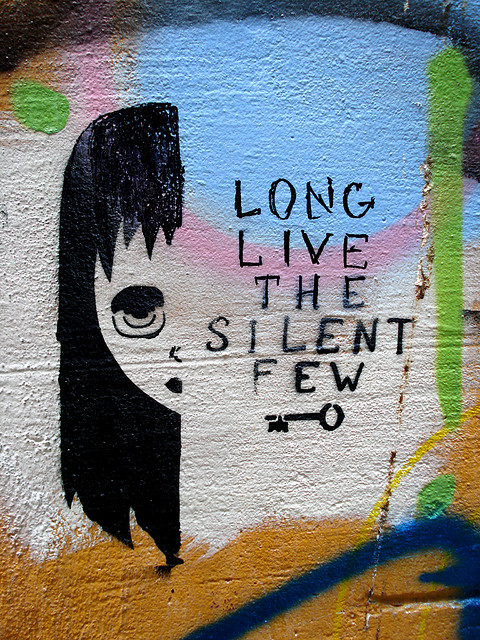
    long live the silent few
    Credit : flickr / Anna Phillips