CIO of Foxtel for over 11 years. On a mission to encourage women to step up and apply for technical leadership roles.
A leadership role is in your grasp and something you might find rewarding. Students don’t have a concept of what an IT career might be about, aren’t taking courses.
The tech industry changes rapidly, and it takes leadership to shape that direction.
On Her Career Path
Started as a programmer. Got first job programming COBOL.
Moved to being a team lead, about being good at what you do – and reviewing other people’s code.
Worked at company that became Accenture. Got to take on a lot of different sort of projects.
Said yes to a lot of different opportunities. Worked really well.
Was a project manager, but became more interested in the business side. Getting into position to question the why.
Started an MBA to study strategy side more. Helps connect with business stake holders.
On Working in the Tech Industry
Some people come unstuck because they are wedded to a particular technology, Need to be willing to learn and adapt, change and grow.
If want tech career that lasts the distance, need to stay current. Women are adaptable and resilient.
Stay curious and open, if offered opportunity to retrain, take it.
Started doing strategy work – what is the business trying to do? How are we going about it?
Believe in yourself as a leader and that your opinion matters.
Observation, if walking into a room with an important (tech) discussion chairs at table, around the outside – the women sit at the edge. Have to sit at the table (this comes up in Lean In too – Amazon).
Your opinion matters as much as anyone else’s. Sit at the table. Don’t take a “passenger” chair. Part of engaging, part of believing you have the right to be there.
Don’t underestimate the smaller, symbolic, things.
Women are good at being prepared.
Believe that you have a right to, and that you are ready to be a leader.
On Being a Leader
Had job to stop two shareholders fighting for long enough to get some technology up.
Was sure data warehouse would be the most important thing.
Leadership is having an opinion.
What could you do that could actually make a difference?
Find with women, wait too long for someone to give permission.
Forget the reasons, ask “what’s stopping me?”
Forget the reasons, ask what the next action would be.
Don’t underestimate the value of caring about something.
Lack of people who can see the bigger picture, and say they will try and get that to happen.
Work it out for yourself, back your judgement, and make it happen.
Belief that working hard and doing job well enough, someone will notice – it doesn’t happen like that.
Apply for jobs, even if you don’t have every skill on the list.
Notice that everyone is always “headhunted’? Not true – people apply for jobs, and they go out and get them.
Leadership jobs are stressful, demanding, but are very rewarding.
CIO is the last (or first) person responsible for technology in the company.
If it goes wrong, on her head. If it goes right… no-one notices. That’s technology!
Didn’t know how to do it, but found partners, learned.
Job as CIO is to find and build partnerships.
Think seriously about leadership
Leadership needed all over in community, health education.
Technology changes fast, effects people, and how people live and work.
Usually been backend, but recently did a new an interesting site for twitter and the elections. First time looking at responsive design, found it really interesting.
Example of the Sydney Morning Herald. As you make the view port smaller, you have to scroll. If you pre tent to be an iPhone, get a completely different version. m version. Simpler, smaller, cut down experience for mobile. One set of content, optimise for two different sites for different devices.
This means two sets of code, two places where it is hosting. Have to keep them both in sync. As a dev, having to do the same thing more than once is irritating. What happens when you introduce a new device type? If you go super widescreen, lots of whitespace either side.
Summary: “Never show a horizontal scroll bar” – always fit content horizontally. Have a single site that does this. Never show the scroll bar, regardless of what screen size. Multiple versions is more complicated and expensive. This way, one site, happy developers.
Case study for #youdecide9. Coverage of the 2013 federal elections. It’s an experimental site with twitter integration, and responsive behaviour is baked in.
Notes from demo
Top story bit, question that people can vote on.
Featured tweets.
Leaderboard. Secret formula with ranking for each politician.
Twitter stream
As you adjust, drops to two columns from 3.
Hide some things so columns are not uneven.
Then one column (what users see on mobile).
Vote modules starts with 2 columns.
Page reacts to the different properties do devices viewing it.
On Design
Movement in the last year or two.
Start with mobile first as it has the most limitations (tiny screen, processing power).
If you know you have to cut things out, better to cut earlier.
Mock up all layouts in parallel.
5 different layouts at least. Have to think about them all concurrently.
E.g. of tweet box – had to put the description on the right, because on the left it stacks below.
About 15% more effort to convert mobile site to the desktop.
Comparatively not that much overhead, huge benefit in terms of maintenance cost.
Downside: Need more time in design phase, more back and forth with designers.
On Optimising Content
Semantic web: make it meaningful.
Content is king! Content is the most important thing on the site.
Site without styles still works. Still makes sense in a linear way – this is important for screen readers. These are the most limited devices accessing the web.
Request images in largest sizes and adjust with CSS. Not efficient, asking for large images when only need a small one, but better than trying to request lots of them and pick the right one.
Choose which bits are important – can get rid of some.
On Implementation and Testing
Used @media screen.
Use print to print in serif fonts.
Supply queries – what is the size of the screen right now. phone/tablet 400/755.
Decided to break when content didn’t look good anymore, rather than default.
Orientation and aspect rations – lots of things you can do to your page to customise content.
Can see if device is in colour. Screen reader means no colour. If no colour, don’t need CSS.
Testing
Use viewport resized. Animates.
Lots of manual testing, not a lot of automated testing is possible.
BBC – wraith. Takes screenshots, highlights the differences in blue.
Things Learned
Focused well on smaller devices, didn’t focus as well on larger devices.
Whitespace on wide monitor. Didn’t change layout for widescreen, which is a shame. Left lots of content below the fold.
15% overhead. Interesting learning – something to put forward for new projects.
Trying to balance design requirements and product with lean development.
Didn’t implement all designs, could have had designers use that time differently.
Usage shifts during the day, more desktop during the day, phone as people go home.
I’ve known Tammy a long time (we worked together in Minnesota!) so I know how amazing she is – and I was really happy she agreed to speak at the Girl Geek Dinner we hosted. I thought it was a really interesting talk, about how to support and create innovation.
Tammy’s been in UX for a long time, but it has not always been called that. Had had lots of different names, but it hasn’t got much clearer. One interview said they were looking for someone who could build the Death Star.
Lots of engineers don’t talk to users. They build systems that don’t talk to each other. Doing great science, but understanding basic typography would serve them well.
Made some basic aesthetic changes to a website (“drained the color”) – and users thought it had increased speed by 80%. It had not.
Studied engineering and psychology at university. Asked – what if we talked to users? Could they create what they need? This didn’t work. Possibly because she was a beginner researcher.
Wanted agency to get things done, so worked with non-profits. Non-profits always need things. Worked on helping increase access to water; the water user of one American is equivalent to 32 South Africans. It turned out, designing a better water carrier better than digging a new well. Then men would help carry water – because they would race things.
Helping people build things after Katrina. People who couldn’t afford to flee wanted to build things for themselves.
Banks in Australia were guarded from the Global Financial Crisis because of the way they process lending. Banks in Australia face a different challenge – innovation.
She did not want to work in a bank – not compelled to swim with sharks. Prior was literally helping to cure cancer (selling DNA).
Innovation is… doing something different that delivers value.
New perspective + right idea + flawless execution = delivers value.
Can innovate on: Business Model. Process. Offering. Delivery.
Tagline – “Prepare for the best”
Now @ BT group in Westpac. Has drank the cool aid. Gets it. Believes in what they are doing.
Better decisions on financials, have greater wealth in super account. Supers work in Australia, because financial literacy is better.
“Design thinking: – isn’t more complicated. Balance customer want, business case, and what you can deliver. Makes for a great business model.
Financial services are not transactional, they are commoditized. Business only has a future if it helps people manage money most efficiently.
What are unicorns doing? Most places do some. All three, is transformational
1. Insight through empathy.
Henry Ford – people said they wanted a faster horse. Ask people, but what they say/think/do has a cultural context. The Bank of America “Keep the Change” campaign uses it – so many people save their coins, allows customers to save the change on their transactions.
2. Collaboration.
Not everyone has all three, so have to talk to each other. Bring in people early. Use postits on a wall to brainstorm/communicate.
3. Experiment.
Something isn’t the right answer, because it is true for us. Users are different – we are not designing for ourselves. Need to be broader, prototype.
Sometimes these will fail. Need to be able to fail without costing careers. Make small bets. Uses idea of business case on a page, and mocking up ideas.
This is a cultural mindset, not just a process.
Optimistic.
Intuitive.
Empathetic.
Inspirational.
Insight-driven.
Narrative.
Experimental.
Collaborative.
Look inside, and outside. Learn in UX classes.
Need to bring your whole self for transformational, it requires all the things.
Innovation is not the designer – it is everyone’s responsibility.
This picture is completely inaccurate… Jen explained everything and I actually feel like I understand networking now!
I was really excited for one of the network engineers to give a talk at Girl Geek Dinner. It’s easy to complain as a software engineer that people don’t appreciate what you do, but in networking that is actually true – people just complain when it goes wrong! I took a lot of notes, but Jen was really, really hilarious, and there is no way I will be able to convey that.
Quote from Sun: the Network is the Computer.
The network should be transparent for users, they shouldn’t worry about it. It should just work.
There are lots of things hiding in a diagram of “a network” – routers, switches, and firewalls (firewalls mostly break connectivity).
Network Engineers look after stuff. She’s a plumber, looking after pipes.
When trying to watch a YouTube video, the laptop is sending magic packets to the server. The bad news is, that sometimes returning packets have a different path.
Animals! Shotguns! Digging equipment! Daily fiber cuts in India, because people are always digging stuff. They find a cable and don’t stop because if they stop they know who will be upset, but if they keep digging no-one will be upset, or at least the people who will be upset will be pretty far away! Like – in Sydney.
Awesome video of a shark trying to bite an undersea cable. The cable is OK, digging equipment is more dangerous to cables than sharks – the poor shark is still hungry.
What Network Engineers do:
Consider how the network should be done.
Whiteboard, books, paper.
Make a nice network design.
Get equipment.
Sometimes get onsite and deploy.
Hard being a woman in engineering, have to be able to do heavy job (carry heavy equipment!) or avoid it.
Should be quiet, but pages everywhere when things go wrong. So monitor the network – can often find problems in other networks, finds herself troubleshooting other people’s networks.
Troubleshooting designs for network – feel like no idea what she’s doing. People usually have some specialisation now, but before working for Google customers would come with a broad range of questions that she wouldn’t immediately know the answer to.
Used to be that the network was like the old telephone network. Connection was OK, you would know you had a connection, and bandwidth. This did not scale – cannot do this with a lot of users.
Then, each device is independent. Each router makes a decision. Sometimes routers will have a different view of the network – then you can get loops. There are ways to break loops after a while. Each router needs memory and CPU. Needs more and more, because the potential route complexity is always increasing.
Next, every router does not make a decision. Want to send important packets a fast/expensive way, and other traffic (like P2P) another way. This is Traffic Engineering. End to end paths, so only the first router needs to make a decision about the route.
Then, in a Software Defined Network, you put the brain outside the network. There are lots of stupid routers but just one brain (or, two, or three, depending on redundancy).
IPv6
IPv4 – 32 bits. Not many, have spent almost all of them. There are none left in APAC, so if you wanted to start a small ISP you would not be able to get enough.
IPv6, people saw the problems with IPv4 a long time ago and came up with a solution. But people are lazy and complain that they can’t remember a long number. You’re not supposed to remember it! You’re expected to use DNS.
To support IPv6 you need to change:
End user OS
Network Infrastructure
Server
Not easy.
Issues:
Users do not care
ISPs say that users don’t ask, and there is no content.
Content providers say there are no users.
Users shouldn’t care!
It’s not so bad. IPv6 adoption is increasing, about 1.5% worldwide. Some places it is 0, and some ISPs more like 80%. Australia is good, Switzerland is better.
June 2012 was the world IPv6 launch. Internode has 3.6% of users on IPv6, which is double worldwide average.
For Software Engineers, it’s a lot of work. See: Making Application iPv6 Compatible. It’s not just a new address, it is a lot of boring work. The devil is in the details!
When I was doing my undergrad in Edinburgh, in around my second year, I was at a ceilidh, and a guy asked me out on a date. And I said, “sure”. Then, he asked my roommate if I was single, which was a little bizarre. And finally, he tried to “get to know me”. We were walking down the Royal Mile and he asked me, as everyone does when you’re a student, what program I was in. And I said, “Computer Science”.
And he said, “I don’t believe you, you’re too normal”.
And we then proceeded to have a disagreement about this, with me saying, “no, I am”, and him continuing to find this incomprehensible. Of course, this is Scotland and we were students, so he was drunk, but still.
Perhaps the most bizarre aspect of this, was that I found this almost flattering. I mean, I had recently been dating another compsci who, when trying to pick women up, would tell them he was in “Social Anthropology”.
Credit: flickr / Laughing Squid
The stereotypical image of a programmer, is a skinny guy who doesn’t wash or go outside enough. And don’t get me wrong, I’ve met a few of those. But how did we get here?
Credit: Wikipedia
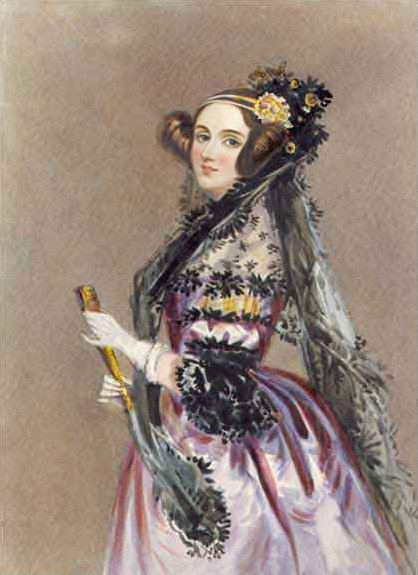
The first programmer was Ada Lovelace – she wrote code for a computer which did not even exist yet.
Credit: Wikipedia
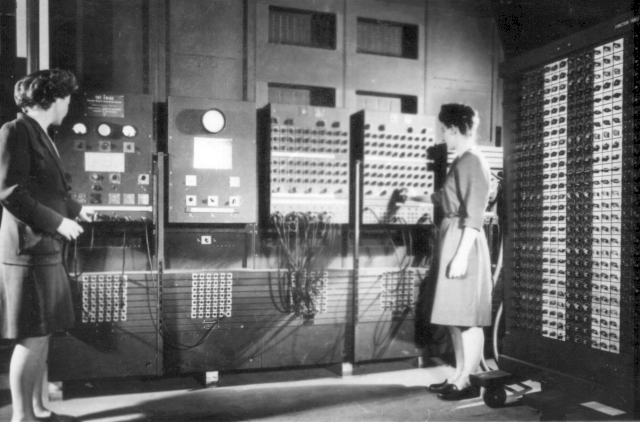
During the second world war, the US invented the ENIAC to calculate missile trajectories. It had 6 programmers, all women, who worked out how to use it without a manual – and their contribution has been historically under recognized (ENIAC Programmers Project).
And yet here we are today, I’m reading a book called “Coders at Work” – profiles of 15 programmers. There’s one women. She’s an IBMer.
So computer science has a terrible image problem, and that’s probably why we have to lie to get dates. But even more than that, we have a communications problem. We don’t communicate the value we bring well, which is why admitting to a degree in compsci will end a conversation. We also have not done a great job of speaking human. And that’s why, I think, we have software like Windows Vista and ridiculous tangles of privacy settings like those for Facebook.
Picture taken by me at the Museum of Science and Technology in Tokyo, Japan
You know that expression, “be the change you want to see in the world“? I try to live by that. And I would like all programmers to speak human, fluently. And so I’m trying to be that change through talks like this, and programming workshops, and blogging. I want to make a dent in this communications problem, it’s a passion.
Second passion – users. I think your computer should make your life easier, not harder. As an industry, we can do better at this.
Third and final passion – information management. We live in the age of information overload, there’s so much great stuff out there that it seems like if you don’t have information overload, you’re doing it wrong! I think that we should be able to help people better manage the information they have, and to condense it so that meaning can be extracted from it. This is something I’m currently working on in my project at IBM.
So, why is this talk called “Art, Life and Programming”? I think it could also be called “Programmers Create Change”. Art is great example that illustrates this because technology gives us new ways to create and distribute, to the point where we need to reconsider what Art actually is. Programmers can be artists, and artists can be programmers.
Yes, sculpture is art, as are paintings, and photographs. Art is a product of human creativity, and there are various medium we can use for it, so let’s talk about some new things, as well.
We Tell Stories is a project that uses the web rather than the traditional medium of a book. This enables another dimension to the story, one of the stories is interactive (your choices change the story), whereas another is recounted through Google Maps.
PostSecret is a community art project, where people write secrets on postcards, and send them in. They’re collated by a man, Frank Warren, who collates them into a series of books and speaks at universities all over the US. Every Sunday, he publishes a blogpost called “Sunday Secrets”. This combines the traditional medium (post and books), and a new medium (blogs).
I Want You To Want me visualizes data from dating sites, it, “explores the search for love but also the search for self in the world of online dating”.
See the video below.
I really love this project, it’s a great source of inspiration to me in my work and I think illustrates beautifully the intersection of programming and art.
This video shows the evolution of special effects in cinematography. Because the movie studios are often at the edge of computer graphics work, it illustrates the evolution of 100 years of technology.
Through human history, there have been various inventions and discoveries that have fundamentally changed things.
The first was probably fire – it’s suggested that the reason for the sudden growth in the size of the human brain was a result of early humans cooking meat.
The combustion engine brought about great changes in production and human mobility. It’s made it possible to flit between continents, the way we take for granted today.
Another was the printing press, which allowed for the easier sharing and distribution of information. Before the printing press, everything was hand-written – very time consuming. The church got very angry about this development, and tried to fight against it saying that people would use it for pornography. However, ultimately they couldn’t stop the advance of technology. To show how utterly futile this attempt was, consider that in order to get enough copies of their reasons why the printing press was such a terrible thing, they had to use the printing press – because scribes couldn’t copy fast enough. I think what they were really afraid of – and with good reason, as it turns out – was information. We see similar reactions today from some industries and some religious organizations when it comes to the internet. In general, when someone in a position of power says that they’re trying to save people from porn, I distrust it – like the catholic church they’re afraid of information. Hopefully their efforts will just just as futile.
Model of the Internet
Taken by me at the Museum of Science and Technology, Tokyo, Japan
The internet is another such invention, and we’re just at the beginning of the changes that will ensue.
I wrote this talk for kids, to inspire them, but you guys all know exactly what changes I’m talking about – because you’ve lived through them too. And I think if we can just take a moment here to reflect on that, we’ll be amazed.
I had a really important day at work a few weeks ago, and so I went in early – before 8 am – to get a jump on the day. And my computer had turned into a brick overnight. It would not turn on. IBM has amazing tech support, so after lunch I had a brand new machine but for that morning, I was completely useless. Without a computer, I am completely redundant. That was a strange feeling, but one that I think is increasingly the case for many of us. We’ve all heard those quote about there only being a market for 5 computers (disputed) and how much RAM we might need. Wow were they wrong! We’re more and more dependant on our computers, and an internet connection that it’s hard to cope without them.
Timeline for the Evolution of the Internet
We can see here that the internet was created about 40 years ago, and email shortly after. The internet as we know it really starts with the invention of the “World Wide Web” over 20 years later, though. The internet is the infrastructure, and the web is the software that runs on top of it. Many people don’t understand the difference, but without the web the services like YouTube, Wikipedia, Facebook, and Twitter would not be possible. Now, we’re at the start of the mobile web – by 2020 it’s predicted that more mobile devices will be accessing the internet than computers.
I think we’re just at the beginning of this change, and there are a number of reasons for that. The first is – innovation. Programmers are not done inventing the web, and other leaps innovations, such as good machine translation will give people in developing countries amazing resources to improve their education and quality of life. The second is access, because only around a quarter of the world’s population has access to the internet. The third is demographic – in western countries, we’ve just about reached the point where everyone who wants to be online is – the people who hold out are mostly older. So when services, particularly government services can be only offered online, things will change. Finally, I think censorship will ultimately fail. This will be a big change in and of itself, but I was in China last summer as the government shut down Facebook, Twitter, the news… When people there and in Iran have free access to everything that is going on, the world will be different as a result.
One of the huge changes that programmers have brought about, through the creation of software, is the possibility for everyone to create content. This is so new, because if you think about it – before we used to distribute everything in books and newspapers etc, which have much higher costs of distribution. This development is something that impacts many people every single day.
The content users could create used to look a little… plain and dull and required some know-how.
Now, very little knowledge (if any) is required and designers can create beautiful looking web pages, that showcase their artistic sensibilities as well as their content.
In fact, the creators of I Want You To Want me used blog content to make another installation – this one online – called “We Feel Fine”.
So there’s a lot of stuff that’s going to change, and one of those things we can say with a good degree of certainty, is that newspapers are going to die out. Some of the brands will remain, but we’ll access them in a different way than on giant pieces of paper.
Some people are getting very angry about this, but it’s pointless to cling onto a dying business model. Innovative companies will survive. Those who waste time complaining probably won’t.
But innovation doesn’t just mean the destruction of old things, there will also be new things that are created. Tactile computing, like tablets and tables will become mainstream. Communications will evolve through services like Google Wave. And eventually we’ll have house cleaning robots! (Sooner the better!)
Binary
Earlier, we talked about how programmers weren’t perhaps what you expect. Code isn’t either. Programmers used to program using series of 1’s and 0’s punched into cards (crikey!) but that’s not the case any more.
Program code has got more and more high level, and some languages are actually quite readable by humans! Some programming can even be done using drag and drop.
Programming is really just a way of thinking. More and more people are becoming programmers, some of them without realizing that’s what they’re doing.
You can learn to program using The Sims – isn’t that awesome? It’s a great initiative called Alice.
Warcraft World Editor
Image used with permission of Kelvin Schutz
More and more video games come with programming capabilities, Warcraft is another example.
There are also programs such as Game Maker or Fusion that allow you to create video games without writing any code – you just have to learn to think logically! If you want to do something useful instead, Automator for mac is essentially drag and drop programming.
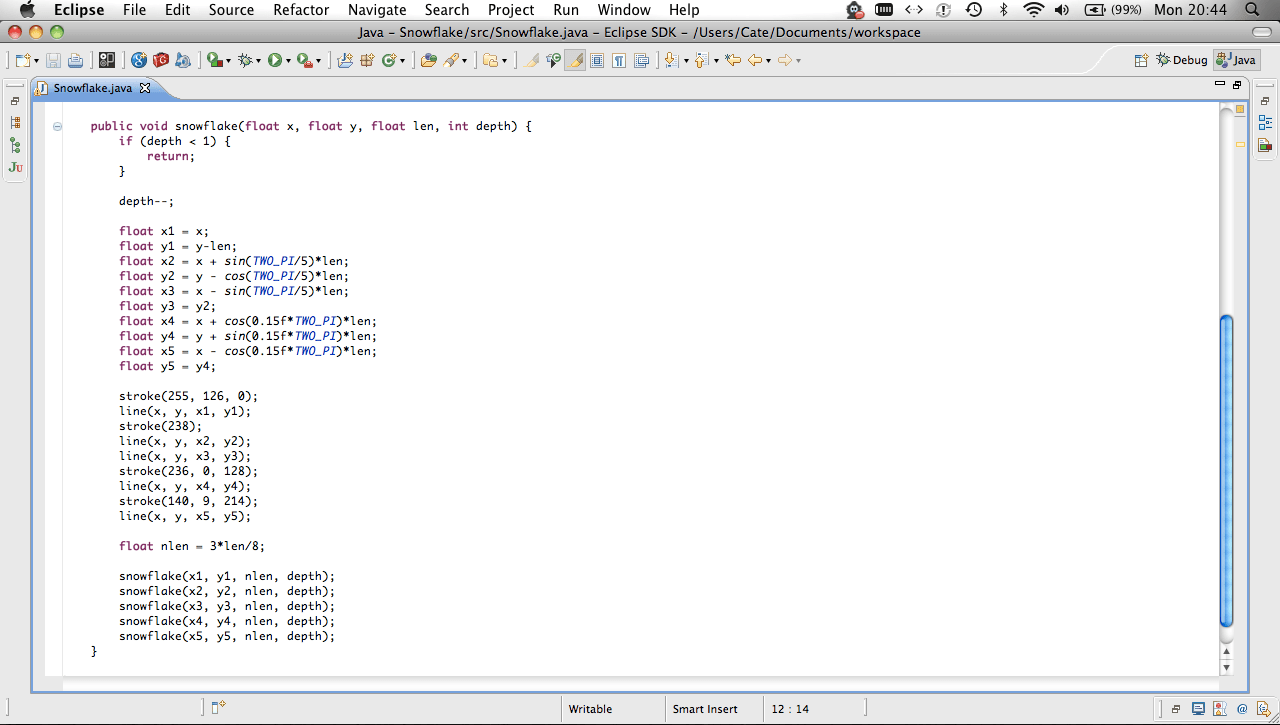
Remember this?
This is relatively simple to create, and doesn’t require much code. It’s recursive, which means we split it into the same problem again and again and again – until we reach something really small and easily solved.
Here's the Code
That’s pretty short, hey?
Click on the images to enlarge.
This is something I’m working on currently, what I try to do is take some of the huge volume of information we’re presented with every day and make it into something that’s both pretty and useful. For instance, this shows the size and interactions in my Twitter network.
We can also write programs to extract important information from the noise. Here, this graph picks out my core, central network.
The “hard” part of the code is just 6 lines!
Imagine how difficult it would be to create these things by hand!
Technology has changed our lives considerably relatively recently – we have new and impressive “hardware” and creative and innovating programming. This is just the begining – there’s much more to come.
Technologists – hardware designers, programmers – are at the center of what we will achieve next. However, whilst computers and technology are a part of everything I’ve talked about, what’s perhaps most inspiring is the human capacity for innovation and our reaction to change.
I’m super excited that I’ve been asked to speak at the next Girl Geek Dinner. I have a couple of talks prepared and so the plan is to modify one of them – the underlying theme to everything I’ve been talking about (and doing) lately is about how technology is changing things, and how can we better organize data such that it’s more useful (and meaningful) to us.
Alternatively I can try and create something new. What would you like to hear about? All of these will need to be cut, so if you have a preference, what aspects of that talk are particularly of interest to you?
Cookie Consent
We use cookies to improve your experience on our site. By using our site, you consent to cookies.