Tag: energy

  • The Battery

    The Battery

    I keep coming back to what it means to recharge. The metaphor that has been working most for me lately is the idea of a battery.

    In the green, I have plenty of charge. Everything is possible.

    In the orange is the ideal place for “active rest”. But if that’s not an option, I can keep going.

    In the red, everything is a struggle. I am in the human version of “low power mode”. Service is diminished, and I need to be on the charger, or I will keep cutting out.

    Trying to recharge, I operate from three lists:

    • Adventures and real breaks. These happen infrequently.
    • Planned recharging activities, like a date night, seeing a friend or spa trip. These happen a couple of times a week (mostly).
    • Unplanned low effort activities. Picking up a novel from a backlog (note: no decisions), giving myself a facial, watching an episode of something with my partner. These happen most days.

    Of course there are also the things I do when I don’t make an active decision to recharge. Mindless doomscrolling or playing a game.

    It takes energy to plan, so things that require planning need to be arranged in the orange (or green). The low effort no planning activities are actually the most crucial. Decisions take energy, so making those activities as easy as possible is critical.

    Decisions increase the activation energy of a activity. I.e. reading might be recharging, but trying to choose a next book is not (for me). In the red, there is no activation energy.

    Some activities also require significant activation energy. For example, generally, I find writing a recharging activity. But it has a relatively high activation energy. I need to sit at my desk, open up the editor, come up with some kind of idea. The best thing I did for my writing was to reduce the activation energy – I bought an iPad Pro with the fancy keyboard, and I keep it on the sofa, to pick up and write something (anything) when I might not muster the drive (activation energy) to make it to my desk. I drop random ideas into a notes app sync’d across all of my devices, so that at any time I can just go through and see if there’s some idea to flesh out, so I don’t have to think of one.

    The other side of recharging is: what drains you? There was a lot of talk early in the pandemic about how much time and energy people freed up by not commuting, and how they were happier and more effective as a result. I never got the boost of losing a commute, and in this timeline, I feel like I drain more quickly and recharge more slowly. Paying attention to why has been illuminating.

    • Having set times and needing to make phone calls made the activation energy of working out much higher and the quality lower. I leant into Peloton classes instead.
    • Heavy meeting days are exhausting, and it’s easy to think it’s just “zoom fatigue”. The battery metaphor helped me understand that “only” 6-7 hours in length on Zoom used 10-12 hours of energy. I realized that beyond the time on Zoom it was the context switching and lack of breaks. I reorganized my calendar as much as I could, and reframed my expectations for myself to make those days less depleting.
    • People management is more draining when people are stressed / unhappy, which in this timeline was more regular an occurrence. I gave myself more space to manage that, and looked for ways to expand my toolbox.

    One of the core things I’ve taken from this exercise is that when something feels “disproportionately” draining, that’s not automatically me failing at something, but an opportunity to learn something about myself. Getting curious about why helps me understand things more fully – which makes it easier to address them. I’m hardly alone in finding some things oddly exhausting, and it’s always fascinating to see what other people find draining. One question I like to ask is, “if you could change one thing about your job, what would it be?” – the answer illuminates what for them is particularly hard, which is useful to know even if there’s little to do about it.

    The biggest change for me, however has been to accept being at zero. It sucks to be at zero, but fighting and judging it doesn’t change it – actually it makes it worse, because fighting and judging are exhausting activities. Only once I can let myself be at zero without judgement do I begin to recharge.

    If you want to start analyzing your battery, a some things to try:

    • Every day for a week (or a month!), reflect on what was most draining, and what was most rewarding. At the end of the period review, and see what patterns emerge.
    • Make a list of low activation energy activities that recharge you. See if there are things you can do to reduce the activation energy of them – e.g. identifying things to read or watch to reduce decision making, or buying supplies for crafting or facials or whatever is your jam.
    • Make a list of planned activities and see how you can make them more regular occurrences. Schedule standing dates with your friends or partner, or set aside time to book advance tickets or appointments for things you know you’ll enjoy.
    • Think about how you can reduce the activation energy of things that you know you enjoy but sometimes struggle to start.
    • Pay attention to where you are at when you finish your work day each day. If you finish in the red every day, your rest time is likely to be lower quality. What would finishing in the orange 1-2 days a week give you, and how could you make that happen?

    One big difference is for people who enjoy planning, it can be a recharging activity that is self re-enforcing when what is being planned are recharging activities. For people who aren’t planners (it me) planning may be a chore to accept in pursuit of an overall happier life.

    What is personally recharging or draining to you will be different, but the first step is identifying what that is and deciding what – if anything – you want to do about it.
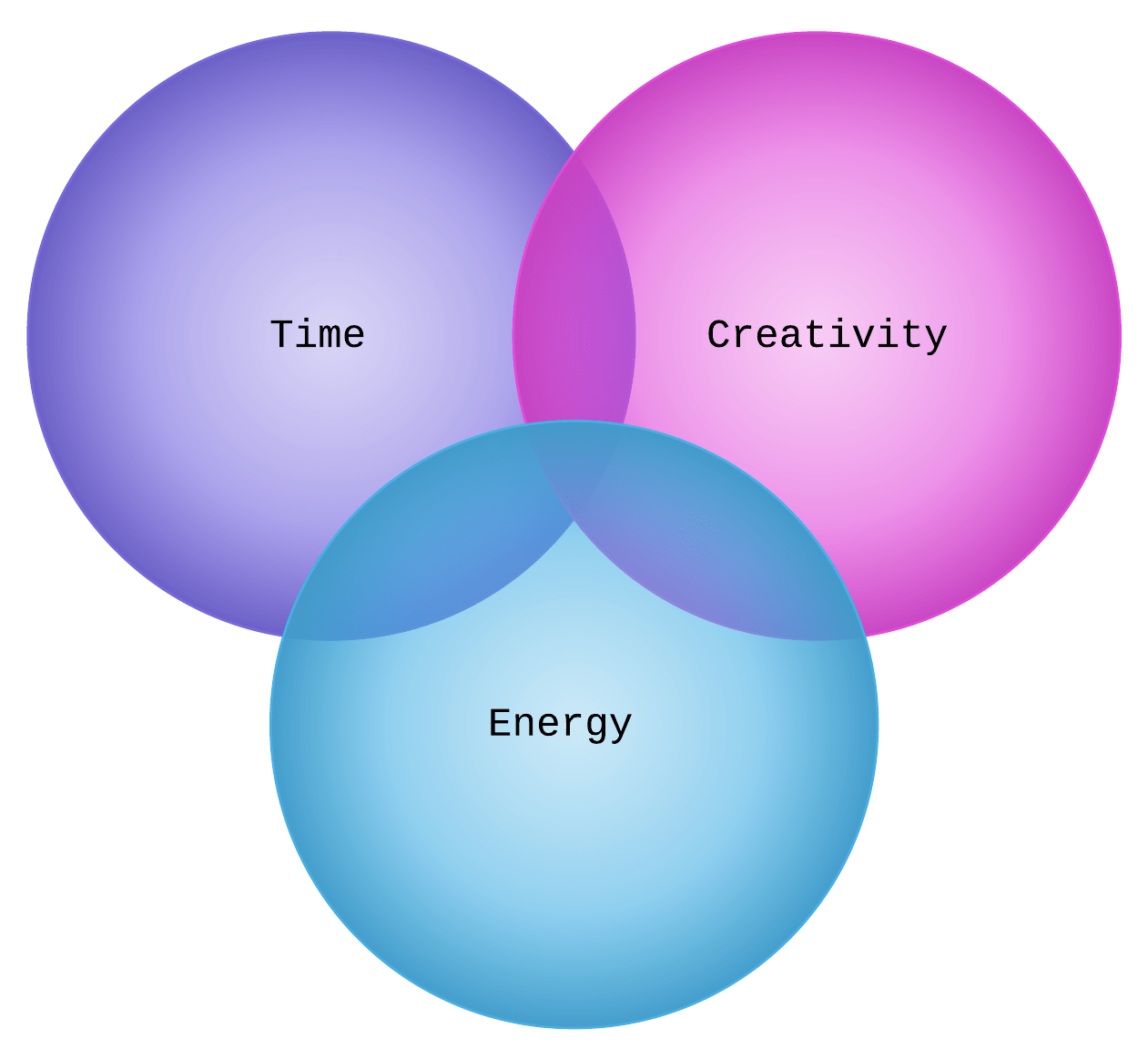
  • The Myth of the Intersection of Creativity, Energy, and Time

    The Myth of the Intersection of Creativity, Energy, and Time

    intersection - Plain

    There’s a common myth that makes side projects close to impossible. It’s thinking that side projects can only happen at the intersection of energycreativity, and time.

    That’s a pretty high bar. That intersection doesn’t come around all that often. For me, it’s usually about day 3 of a 3 day weekend.

    The UK has 8 public holiday days a year… so that’s 8 days a year. Max.

    Say half of these work out, and on each you get 6 hours of solid work done. That’s a whopping… 24 hours a year.

    Don’t get me wrong. These may well be the best 24 hours of the year. But, we have 168 hours every week. What if we could carve out 4 of them, every week?

    Our side projects might start to move a lot faster… or at all.

    Creativity

    This comes down to: pick one thing.

    If you have too few ideas, well, you only need one.

    If you have too many, how do you pick?

    Too Few

    • Jam with a friend!
    • Solve a problem you face yourself.
    • Answer a question: “Is it possible to…?”
    • A university project you wanted to extend?
    • Some feature of a platform you want to explore? (e.g. as an iOS dev I was keen to make something on Android that took advantage of intents).

    Seek our creativity:

    • Solo travel! (my fave)
    • Art galleries (an art gallery in Hong Kong encouraged me to start coding on a side project I’d had in mind for a long time).
    • Science museums.
    • Go somewhere to think: take a long walk, or go swimming (I solve so many problems and have so many ideas in the swimming pool).

    Too Many

    • What is the closest to done? Finish things first.
    • What can you build on later (i.e. projects that will teach you things to know in other, more complicated projects).
    • What has fewer dependencies (e.g. your collaborator has gone AWOL).
    • What will be most useful to learn.
    • What is the best break from your day to day?

    Energy

    Our energy is often sapped by work, especially when our work is not rewarding. We need side projects most when we are close to burn out, but that is often when we have the least energy. Days are often long in the tech industry, and work travel derails personal schedules and habits.

    Remember: Energy is renewable.

    Some ways to renew your energy:

    • Remind yourself what you love.
    • Disconnect from the office over the year (focusing on something else is the best distraction).
    • Small wins create bigger wins.
    • Aim for the next minimum shippable improvement.
    • There’s no need to be secretive.

    Where do You Draw Energy From?

    At one point, I was going home in tears several days a week. There were a lot of things wrong with my job at the time but here were the big two: 1) not shipping (for reasons outside of my control), and 2) not feeling appreciated.

    By focusing on side projects where had control of the feature set, and the priorities, and all of it, I could decide when to ship. And of course it was a much lower bar, it was “here’s something interesting”, not “here is a new product!”.

    And when I started to put things that I was making, and writing, out into the world, people started to notice, and say nice things to me, and about my work, and I started to get the appreciation that I needed, and feel like I was doing things that were worthwhile.

    When I’ve thought that what I did all day at work was meaningless, creating things that people found useful redressed this balance. And even if I came home in tears, it helped me get up and do it again the following morning. And over time, it helped me gain the confidence to go and find a better place to be. And when I’ve felt like I don’t have much to say about my day-to-day, I have a story to tell about my side projects, and things that I’ve learned, and what I’ve built.

    Time

    Giving up TV

    Everyone is short on time, and the standard advice is “cut out TV”.

    I don’t think this is helpful advice, I think people watch TV because they are too tired to decide what else to do. Because it’s nice to escape. After a long day a great TV series is a way to absorb yourself in someone else’s life, and forget about the things you should be addressing in your own.

    Personally my rule is, TV is OK, but not just TV. I watch most of my TV in the gym, it’s a great way to get enough cardio. Especially with dramas, like Covert Affairs. She’s running… I’m running… there’s shooting.. faster faster!

    Or whilst writing unit tests. I decide what they should be, then fill in the mindless boilerplate (Java has a lot of mindless boilerplate) whilst Keeping Up With the Kardashians plays in the background.

    Because no side project is 100% fun, although I understand my comprehensive unit testing strategy is somewhat aberrational. There will always be some dull, or less demanding tasks. Like setting up your environment, or downloading bits and pieces.

    So “I’m tired, I’m just going to watch some TV” can become “I’m tired, I’m just going to watch some TV and do some [task requiring less concentration]”. And somehow, I’ve caught up with the Kardashians and also made some progress.

    Even if it wasn’t amazing progress, even if it took twice as long because what is she wearing? Progress is progress.

    That One Hour Before Work

    The other advice is to find an hour before work. Definitely regardless of whether it is exercise or a side project, there’s something very powerful of knowing that whatever happens over the course of the rest of the day I have already done something that is just for me.

    However decisions in the morning are really hard. That’s why if you want to work out you’re supposed to pack your gym back the night before. But then you get advice like “write for an hour in the morning” and the first time I tried this I woke up and drew a blank, “write what?”

    Luckily I keep a very detailed task list, which includes blog posts I mean to write. So I just looked at what was at the top of the list, and wrote it. Draft over, I went to work. Then later I edited it and scheduled it.

    I live under the continual delusion that Future-Cate is going to be super-human, and I’m continually proven wrong. I’ve learned that Future-Cate in the morning is going to be a mindless zombie, so if I want her to crank out some of the stuff on my endless todo list, I need to make it really, really easy for her.

    Because future me, past me, and me as I write this, we’re all the same. We all find starting to be the hardest part. And yet in the throes of creativity, I never remember that. I think “what an amazing idea” as I pace up and down the swimming pool. I’m convinced that I will have it fully articulated within 30 minutes of walking in my front door.

    But actually by then I’m asleep and I forgot to hang my swimsuit out to dry, as well.

    You can do a lot with one hour, as long as none of it is spent wondering what to do, or looking for inspiration. Make your creative self put their brilliant ideas on a detailed task list, and your zombie self can probably knock one out before 8am.

    There is No You in Team

    I love being a software engineer. I love making things, big things, as part of a team. I love working with designers, because I appreciate great aesthetics but can’t create them, and I love working with good product managers, who care deeply about and take the time to deeply understand the user so I can trust their judgement and focus on building, coding, testing.

    But my side projects, they are all about me. What I want to make, what I want to learn, what I’m inspired by.

    And so amid decisions I don’t agree with, be they product or engineering, when some guy shoves me out the way to get what he wants, my side projects are this space on the internet, on my computer that is all mine.

    Everything else, it’s just a technique for making progress, and these work! Try them! But really your side project starts in the place where you decide that you want to carve something out that is all for you.

    It might grow, or it might fail. But it’s yours.

    Failing

    I had this idea for a side project, I was sure it was brilliant. Back in 2011. I wanted to be able to visualize a series of photos. I found the perfect layout (the sunflower layout) and then… did nothing with it. Later I returned to it and discovered that extracting the dominant color in an image was much more complicated than I had thought. I learned about different color spaces, the difference between HSB and RBG, and ended making my own image filters. Turned out, the original idea sucked. For starters, it takes forever to run. Secondly, it just doesn’t look as compelling as I thought it would! But making my own image filters became the main project, and later a book chapter.

    In so many ways, this project was a failure. Firstly, it’s kinda ugly. Second, it took nearly 3 years.

    But in other ways, it was a huge success. I applied some stuff that I’d had no need to apply before (the way images are just an array of pixels), and learned things about colour that I hadn’t previously known. And it was a great topic for a book chapter, and of course I’d had that common goal about seeing my name in print.

    It started, on one of those amazing 8 days of the year (although I lived in Ontario, Canada then, so technically it was 9). And really, it was a super fun day. But it ended up where it is because I found ways to carve out some time out of every week, every 168 hours, for the things I wanted to build, and that I wanted to write.

    4 hours a week will get you further than you think.