Tag: change

  • One Positive Thing

    One Positive Thing


    Palace of Arts, Staircase
    Credit: Flickr / Istvan

    I have a simple rule when I get overwhelmed.

    One. Positive. Thing.

    It’s so simple that whatever state I’m in I can’t argue with it. It’s so easy that there can never be an excuse. But, applied diligently, it can change pretty much everything.

    When I’m in a tizzy, one of the first things to go is the state of my apartment. If I say one positive thing, and keep at that for a week, it becomes livable again. Some days all I do is load the dishwasher. But others it snowballs. I start with “take out the trash” and end up with a sparkling bathroom. I just need to start.

    When my self-esteem is on the floor because I’m unhappy with how I look, I use it. It’s a lot easier to get out of bed and go to the gym for 6am when I know that this is all I’m going to ask of myself in that regard all day (of course, having started off so well I’ll tend to eat better and sleep earlier, too). If it’s not a gym day, my one positive thing can be “no chocolate”.

    Often one positive thing is about attitude. It’s focusing on the design that I came up with, rather than the change that I didn’t get approved (again). It’s thinking, “I made time to go to the chiro which will make my shoulder better and then I can work out harder” rather than focusing on the fact that I rolled over and didn’t go spinning that morning. It’s thinking about the thing I did for my boyfriend, rather than the fact that we are (still) on different continents.

    The power of sustained small achievements is underrated. If every day I did one positive thing for my health, my living space, and my relationship, what would my world look like a month, six months, a year from now?

    I decided that February I would focus on rehab. What this has meant for me, is that almost every day in February I did one positive thing for getting my shoulder better – sometimes chiro, sometimes massage, sometimes the gym, and sometimes (frankly) strong painkillers. It’s in a lot better shape now, and I’m in a lot less pain than back in January.

    Meanwhile, one of my friends is completely overwhelmed by… life, I guess, but particularly school work. So I shared this rule with her. She’s been getting overwhelmed by everything, but one thing? That seems totally doable.

    So it seemed worth sharing with you as well. Try it, and let me know how it goes. Meanwhile, what tricks do you have for making things seem manageable when you’re overwhelmed?

  • In Search of Stability

    In Search of Stability

    Credit: Bao Pham / http://bao22.blogspot.com/

    Last night, I was on the phone to my friend whilst I was pottering about unpacking my apartment, and he said:

    “Have you taken anything? You’ve not been happy like this without meds in a while”

    (To clarify, I have strong painkillers because of wrenching my shoulder in February – which is still causing me pain)

    I hadn’t taken anything. I just feel semi-settled and un-rushed for the first time in 3 months. And I feel guilty, because I worry I’ve been complaining about my life when my life is awesome.

    Oh no, I got my dream job and I have to move to a cool new city. Damn life is hard. Wow, I met so many cool people in Ottawa that I have to actually spend time with them before I go. Sucks to be me. Why are people continually presenting great opportunities to me? How frickin’ unreasonable are they?

    If you’ve wanted to give me a good shaking lately, I totally empathize. I kinda want to give last-week-me a good shaking too.

    Change is hard. At the Risk Taking Workshop at GHC, Dee talks about people’s change cycles. Most people were about 2 years. I came it at 6 months.

    Perhaps I like change more than most, but the process of changing I find stressful. So I do things like book a flight to Canada and move with a week’s notice because my visa finally arrived. Or make a snap decision to give up my apartment because it was bought and I realized I wasn’t getting a TA. These things drag me, kicking and screaming, through the change process and then I sit in my new apartment, surrounded by boxes, and think,

    Why on earth was I getting so worked up about that?

    And then I make it work. So far, it’s always been fine. I’ve only been in KW a few days, but I know I’m going to be fine here too.

    Maggie is a 3rd culture kid, and so something we had in common and talked about this summer is this feeling of not quite belonging anywhere, and not really knowing where home is. I’m from the UK, but for a number of reasons (many political) I can’t see myself going back there. Brits think I sound Canadian. Canadians think I sound British. Canada has been good to me, but I don’t think I can live permanently in North America – I find it too homogeneous, and miss the culture and diversity of Europe. How you can get on a plane and get off an hour later somewhere with different food, different values, different language…

    Feeling that life is in a permanent state of flux, it’s easy to seek out something stable to cling to. A popular way to do that is with a relationship – because it seems like a binary variable, 0 or 1. So you set that bit. And then discover there are any of a million states your relationship can be in, some which add to your stability… and many that do not. For me, I have never wanted to buy an apartment so much as when my ex was making me miserable.

    If I feel the need for stability, I think the thing to do is recognize why. Some new stress or something unknown? Is it just hard to be in a new place? Realizing this, I’m trying to find my stability somewhere else.

    PHiZZ Unit Color-Change Variation
    Credit: flickr / tomster0

    In little things, like being a regular at a favourite restaurant or coffee shop, or the Clinique counter (leaving the Clinique counter at Sears in the Rideau caused me much devastation). In routine – gym first thing, or (currently) work in coffee shop in the morning, errands in the afternoon, unpack in the evening.

    In bigger things – like good friends that stay constant wherever you live, in doing what I love.

    When these fail, a trip “home” reminds me why I left in the first place.

    Since I’m staying on a work visa, people keep asking me if I’m staying “permenantly” – I joke that I don’t stay anywhere permanently. Being a bit of a nomad has some challenges, but ultimately I love the adventure. The stress of the process of change I find hard, but the thrill of making it work – that makes it all worthwhile.

  • Priorities and Next Steps

    Priorities and Next Steps

    Ballooning Over Albuquerque
    Credit: Flickr / Danae Hurst

    The other day I was having lunch with some other interns, and they were discussing their GPA. It made me question what I was doing, surrounded by 20-22 year-olds who think that a GPA is a measure of achievement and/or a defining characteristic. I mean, to participate in the conversation should I calculate my GPA? I don’t even know how. Should I point out that nonsense courses to lift your GPA don’t actually make you a better programmer? Should I keep my mouth shut and edge away, because afterall I don’t fully understand the Canadian undergraduate system… except this focus I see on grades over substance makes me extremely grateful that I got my undergrad from Edinburgh.

    Being at intern at 25 is… weird. Yes, it’s an amazing opportunity. Yes, we have great training. But I can’t shake the feeling that I should be doing more than being an intern at this stage in my life.

    My friend Maggie (another intern) is planning her next steps at the moment. She’s incredibly together and only 20 – she makes me feel 1) old and 2) clueless. She was telling me recently, that she’s figured out that before she can work out what she wants to do and where she wants to go, she needs to figure out her priorities.

    This made me realize – I’ve been picking themes by which I prioritize my choices. When I left Edinburgh to be a nomad, I prioritized an interesting life and being interesting myself (Penelope Trunk on an interesting vs a happy life). Arriving in Ottawa, I was lost, but my theme evolved to making change, or being the change I want to see – though taking a different approach to programming curricula and the talks I give, through WISE, and through the Awesome Foundation. Even working on defining influence – influence can be seen as the ability to make change.

    So for my next step – what’s my theme going to be? I want it to be about how programmers can change the world; through better software, facilitating remote working, enabling connections across geographical barriers and – crucial in this age of information overload – helping people better manage the information they have available to them. What does this mean? A programming job. Finding an open source project to contribute to.

    Where can I do this? IBM is a great place to work on all of this, as is the company where I’ll interview next week. And now I’ve identified my theme, I can look out for other places where I could chase this next dream.

    How about you – what’s your priority for your next step?

  • You May Say I’m a Dreamer…

    Recently, I read something that said (I’m paraphrasing):

    The surest way to mediocrity is trying to be liked by everyone.

    Shortly after, I met the conspiracy theorist Mike Levin, of Unfolding Magazine to talk about Awesome Ottawa, you can read the article here.

    Follow Your Dreams
    Credit: Flickr / miss miah

    I didn’t really like the article, but I’m trying to embrace the idea that criticism or just bitchy innuendo means that we’re doing something out of the ordinary. Mike uses his 30 years of experience as a journalist as evidence that people don’t behave altruistically. I wonder when that became self-perpetuating, but to be fair I don’t think reporting tends to focus on people being nice.

    But – I would like to clarify here, that as a technologist, I take privacy seriously. My research makes public more public and as a result I graph people who aren’t spammers or public figures only with their permission. Also, as a technologist, I’m aware that the internet is often very public, and I can’t give a better warranty on other people’s data than I have on my own. I also can’t guarantee the actions of 10’s of others – the Awesome Foundation has members in many other countries, and we share information. I can say that our intent is only to publicize the winners of our grants, and perhaps those other projects that we think deserve a distinctive mention. But of course, cynics like Mr Levin can feel free not to apply to us.

    The other suggestion was one of ageism. I can’t tell you what other trustees do, but I do know for myself that when I’m looking through the grants I’m completely uninterested in anything but two fields: the proposal, and what they need the money for. It wouldn’t surprise me if applications mostly come from younger people – as a result of information flowing through social networks, more free time, or just more need for the money to fund their project, but I have no data on that.

    My feeling is, that the things we fund shouldn’t fit well in either of the following sentences:

    • I’m going to the bank to try and get a loan to fund My Awesome Project.
    • I’m going on a sponsored cycle/walk/bungee jump/whatever in order to raise money for My Awesome Project.

    Thus far, that’s the only criteria I’ve come up with.

    At the end of my meeting with Mr. Levin, he said he thought I was naive. Honestly? I was not displeased with this assessment. I’m 25 – I’ve dated idiots, had my heart broken, covered for an alcoholic co-worker and been completely disillusioned by the graduate school experience. So naive? Not in respect to love, work, or, really, people. I’m just not sufficiently cynical that I think it’s impossible that there might be 10 other people in Ottawa that can get behind this idea of ENABLING MORE AWESOMENESS.

    There seem to be a lot of people who will complain about the way things are, but not try to change them. Every month, I get together with a bunch of people who, like me, are trying to make change happen. These people inspire me.

    We may not succeed, but at least we’re trying. Some months we make make a firework, and some it may be a damp squib. I’m realistic about it – just not realistic to the point of inaction.

    So sure, call me a dreamer – but I’m not the only one.

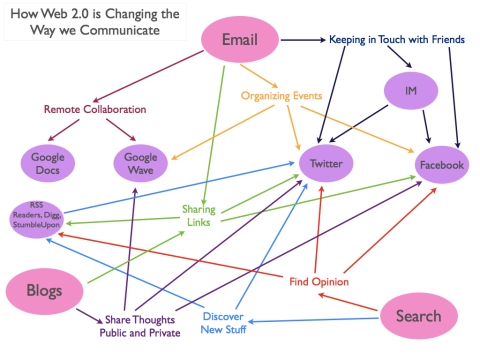
  • How Web 2.0 is Changing the Way we Communicate

    How Web 2.0 is Changing the Way we Communicate

    How Web 2.0 is Changing the Way we Communicate


    How Web 2.0 is Changing the Way we Communicate

    This is what I’ve been finding in my research – what do you think? Anything missing?

  • Relationships 2.0

    I had an argument with a friend yesterday. He’d been a little economical with the truth and I found out and was angry. I found out via Facebook – of course. Facebook knows everything.

    This propelled me to write this post I’ve been thinking about for a while. The thrust of the talk that I will give in December is how much computers and the internet have changed the way humans live. Perhaps the thing that has been changed most is our relationships.

    If the web is now a communication medium, what more powerful way to change our relationships than to change the way we communicate? I know someone who broke up with her boyfriend by changing her relationship status. My boyfriend and I mostly keep our interactions off Facebook, but we do argue on Twitter from time to time – to the amusement of our friends. Of course, I’ve also seen people playing out their breakups on Facebook, using it as a medium to exchange those messages, you know, where he tries to explain that it’s over and she begs and pleads and promises everything to make him come back.

    One of my friends is dating someone who I consider toxic and try and avoid. Now that they’re “Facebook-official” I can’t use the reasoning that it’s not on Facebook and therefore can be ignored anymore. Wow. Taking a step back and looking at this objectively – I’m amazed that this is how we interact now. My friends and I have our share of drama, but I don’t think that as a group of 20-somethings we’re that out of the ordinary.

    Admittedly most of my knowledge of dating in the pre-Web 2.0 era comes from Sex and the City. But did people use to look up the people they go out with using Google and Facebook? Pick people up via mutual friends on Facebook? Analyze their date’s Facebook profile with their friends? Pick people up on dating sites? Check out the exes? Facebook increases jealousy in relationships, well yeah. Of course it does! What other medium can you use to obsessively stalk and obsess over your recent exes’s new girlfriend? Note – this was not my behavior, but the behavior of someone I knew. She was obsessive after her breakup – and Facebook helped every step of the way. She’s not alone, though – there was an article in September’s (UK) Cosmo written by a guy who’d found out that his ex had got married (via Facebook). He was quite upset, but is continuing the stalking – looking for baby pictures.

    When I last broke up with someone I quit Facebook for a month. I also started checking my email only once a week (after reading Tim Ferris’s The 4-Hour Work Week) and I happened to be working in the US (I’m British, most of my friends are too – this was before I moved to Canada). So I literally didn’t talk about how upset I was for a month. By getting rid of Facebook, I could just put dealing with it on hold for a while. I was working about 70 hours a week – it was helpful.

    However it got me thinking. We used to take our dumped friend’s phone when she was inebriated. Change “his” number to ours to stop the obsessive calling. What do we do now? I changed someone’s password, once, to stop the stalking. Others thought it a step too far, but it seemed to help (albeit temporarily). Our friends could be our will power before, but how do we do that now? I wonder if there’s a business model in a 3rd party service that locks you out of things, archives the romantic emails and the pictures until you (and a trusted friend) confirm that you’re no longer a nutcase.

    On a more upbeat note, you can also use Facebook to help create relationships – basing your dating profile on your Facebook profile and having your friends vouch for you. Niche dating sites are doing well, there’s even one that’s more of a matchmaking service (although results seem to be mixed). So it’s not like Web 2.0 is just destroying relationships – it’s creating them too. It’s just a lot of change.

    Some people still meet the normal way. I recently introduced two people last week, they’re getting on well so far! And in India it’s common to meet your partner at work – some companies even have internal dating sites! And, of course, if it doesn’t work out there are plenty of blogs by and for the dumped.

    It’s not just your boyfriend or girlfriend though. What about our friends? Like I mentioned above, I don’t interact with my boyfriend much on Facebook but I definitely interact with my friends. I use it to plan and organize events for my local friends and keep in touch with the ones I’m away from. I’m a big fan of ambient awareness or ambient intimacy, I like to know what’s going on with my friends that I don’t get to see that often any more. Sure, some people are less interesting than others but I can turn them off any time I want. There’s a really interesting NYT Magazine article about ambient intimacy, it’s long but very worth reading. Of course, there are mixed opinions – the alternative view. For younger people, “real” friends are on Facebook, apparently – due to ease of sharing and the level of interaction.

    What about, though, the people you’d like to just fade out of your social circle. In the past if someone pushed it too far, you could just “forget” to invite them to things. If you delete someone’s number, they’re never going to find out unless you run into them (and you can always claim to have got a new phone / had a problem where all your numbers mysteriously disappeared). Whilst Facebook doesn’t broadcast when you “un-friend” someone, if someone catches on they can definitely tell. Unfriending is this more active step to dropping someone from your social circle – but it’s so necessary, because there’s so much information on Facebook that if you don’t they will know what’s going on, maybe assume they’re invited. There’s not much overly personal about me on Facebook anymore, but even so – there’s enough that I’m just not comfortable with someone I don’t like having access to it. De-friending, or Un-friending is this whole new area of privacy and etiquette that there’s no consensus on yet. Will there ever be, though? We’ve probably always managed our relationships differently. Just now with the popularity of services like these, it’s harder to hide how differently.

    Sometimes I feel like Facebook is awful. In some ways, I kinda hate it. I hate how gossip propagates, how quitting it for a while is a big deal. I hate that some people don’t just fade away as you thought they would. I hate the whole area of un-friending, but think it’s necessary. I hate the opaque privacy settings. I’m a little weirded out by how it’s normal to start a conversation by, “So how’s <<X>>? I saw <<Y>> on Facebook…”. But here’s what I hate most – that I can’t live without it, because it’s so great for keeping in touch, because for those people I want on my Facebook there’s this great medium for us to interact and invite our other friends to interact with us. Because weird a conversation starter as it is, it’s a conversation starter. And I love having conversations in the real world, too.